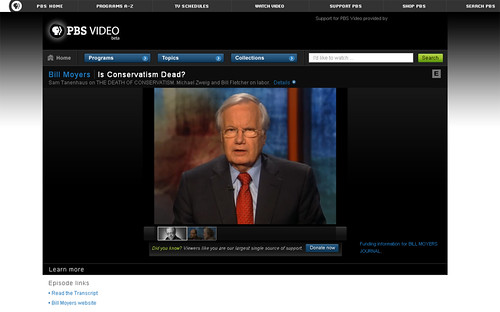
This post was inspired by a video I recently watched on the web. I was tickled pink to discover that @pbs is placing their video collection online. Time and again I see PBS innovating and using technology in new and meaningful ways, and this is no exception (though, please, I want to embed, PBS!) – the video archives are rich with the kind of nerdy stuff I love to watch, including the Journal with Bill Moyers. In this clip, Sam Tannenhaus was on the program to discuss his new book, The Death of Conservatism. From Bill’s introduction:
Sam Tanenhaus edits two of the most influential sections of the Sunday NEW YORK TIMES – the Book Review and the Week in Review. He’s had a long fascination with conservatives and conservative ideas. He wrote this acclaimed biography of Whittaker Chambers, the journalist who spied for the Russians before he became fiercely anti-communist and a hero to conservatives. Now Tanenhaus is working on a biography of the conservative icon William F. Buckley JR.
They discussed the protests in Washington (teabaggers, health care reform, anti obama, glenn beck, september 2009) and I must say, Sam quite blew me away. I’m not sure I recognized all the names he mentioned, but here was a guy who knew his American political history. Wow! My first thought after the show ended was – where does THAT guy teach, I wanna go there!
And then I thought, it sure would be nice if you could choose your professors, not from the pool at your current institution, but from anywhere in the world, and perhaps even from outside academia. Why can’t we do that already? With distance being so easily mediated by technology – through video, skype, virtual worlds, podcasts, twitter, RSS – the web and all its glory, why aren’t the very BEST teachers already teaching online to reach more people, more motivated people, more motivated people willing to pay (and maybe handsomely) for their expertise? Why hasn’t this already happened?
Well, there is that pesky issue of assessment and accreditation and the institutional ballyhoo that’s tied into the “degree” but barring all that, why hasn’t some accredited, established institution emerged to facilitate this kind of customized education? MIT famously opened up their their course content, but I think we’re learning it’s not just the reading lists, powerpoint slides, and class notes that make a great class – we also need great teachers and mentors.
But what happens when you find that the great specialists in your field or area of interest aren’t AT one institution, they’re scattered all over the place? If I were going to mortgage my future for grad school, I’d really want access to the best of the best no matter where they were. Wouldn’t you?
Just catching up on the start of Connectivism & Connective Knowledge 2009 – a Massively Open Online Course (MOOC) being offered by George Siemens and Stephen Downes from the University of Manitoba. (Search this blog for CCK08 to see posts from last year’s class.)
This year I am making a conscious effort to not feel pressured to participate in the synchronous components of the course. If I can attend the synchronous meetings on the web or in Second Life, I will, but I want to experiment with taking full advantage of the flexibility of this kind of course format – can I get as much out of the class, and the connections with other course participants, in a mostly asynchronous way? I think so!
This will be in contrast to the Second Life cohort I facilitated last year, we met weekly in Second Life to discuss the course readings and the mechanics of taking a MOOC, which was a new experience for most of us last year. This year, Sharon Collingwood (SL: Ellie Brewster) from Ohio State University has taken over the SL Cohort, and she’s posted details on the course Moodle:
SECOND LIFE COHORT for CONNECTIVISM & CONNECTIVE KNOWLEDGE 2009
PRELIMINARY GET-TOGETHER & ORIENTATION SESSION, Sunday Sept 20
at 4pm Eastern U.S. time (1 pm Second Life time, as read at the top right-hand corner of the Second Life screen) This is bound to be inconvenient for some people, we’ll talk about meeting times then.
To get to the meeting, sign up for the Second Life group “Connectivism and Connective Knowledge”
– search menu, “groups” tab, find Connectivism & Connective Knowledge
– follow link, find group profile, click “join”
– be sure group is activated (>>edit >>groups)
– read previous messages (>>info >>notices)
Become my friend
>>>search menu >>people >>Ellie Brewster >>add friend
(Feel free to friend me in Second Life, too, my name there is Fleep Tuque of course.)Â 🙂
The introductory videos by George and Stephen are good starting points if you’re not sure what the course is, how it works, or what Connectivism is, and I’d highly encourage you to participate if you have any interest in education, learning theories, how technology is changing how we learn, or how large open distributed courses can be delivered on the web – it’s free after all and fun too!
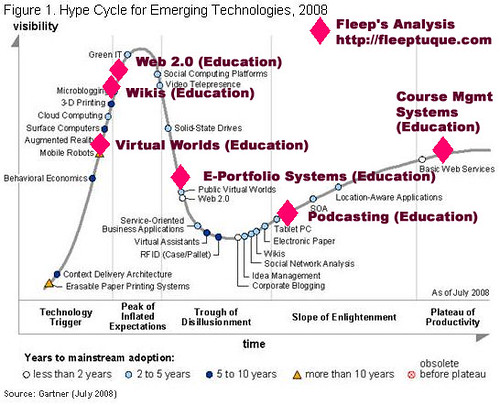
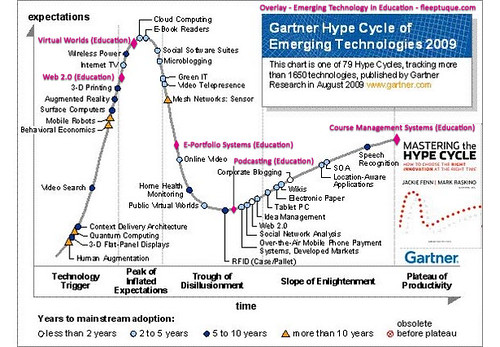
While I don’t always think Gartner gets it right, I finally took a moment to compare this year’s hype cycle for emerging tech with last year’s – interesting to see where public virtual worlds are relative to the 2008 chart. You can see both Gartner’s analysis and my own thoughts from 2008 in the next graphic.
This year I think not much has changed, in terms of the _hype_ and level of adoption, with the exception that virtual worlds for education seems to be closer to the peak of inflated expectations. By 2010, I’d think Course Management Systems shouldn’t be on the list as an emerging technology as most institutions have adopted a platform by now.
Web 2.0 for education, or anything 2.0, still has not caught on except among technophiles, though the explosion of Twitter in the news is helping to move things along the hype cycle curve.
Do you work in higher education? What do you think?
UC Irvine’s Donald Bren School of Information & Computer Sciences has established the Center for Computer Games & Virtual Worlds, led by ICS Associate Dean Magda El Zarki and senior research scientist Walt Scacchi of the UCI Institute for Software Research.
The center’s goal is to expand campuswide research activities that draw upon UCI’s strengths spanning the social and technological aspects of games and virtual worlds. More than 20 faculty members from computer science, arts, humanities, social science and education will collaborate in the center.
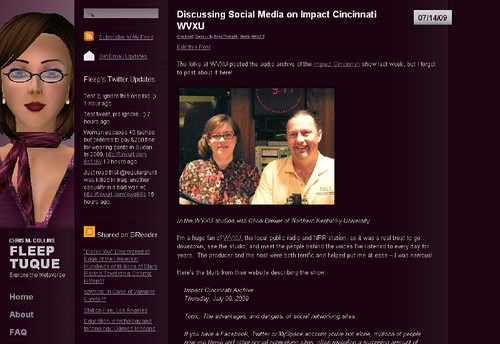
I’ve been playing with a new website design and have been intending to move everything over to the http://fleeptuque.com domain for some time, but I was worried about losing traffic and subscribers and yadda yadda.. sometimes I guess you just have to take the plunge.
I’m experimenting with a very different design and I’m not sure I like it yet, but it’s been a while since my website got a new look so we’ll roll with it for now.
Thanks to all who read, contribute, link, post, and share, I hope to see you over on the new site too.
Deep Thoughts — Comments Off on Posterous – The place to post everything. Just email us. Dead simple blog by email. 06 Sep 09
The folks at WVXU posted the audio archive of the Impact Cincinnati show last week, but I forgot to post about it here!
In the WVXU studios with Chris Brewer of Northern Kentucky University
I’m a huge fan of WVXU, the local public radio and NPR station, so it was a real treat to go downtown, see the studio, and meet the people behind the voices I’ve listened to every day for years. The producer and the host were both terrific and helped put me at ease – I was nervous!
Here’s the blurb from their website describing the show:
Impact Cincinnati Archive Thursday, July 09, 2009
Topic: The advantages, and dangers, of social networking sites
If you have a Facebook, Twitter or MySpace account you’re not alone, millions of people now use these and other social networking sites, often revealing a surprising amount of personal information online.
Guests include:
University of Cincinnati Instructional & Research Computing department IT Analyst Chris Collins
Director of Online Technology for Northern Kentucky University’s College of Informatics, Chris Brewer
The toughest question came at the end – what impact do you think social media is going to have and sum it up in 2 minutes! That’s pretty hard to answer even in 2 hours, so that’s the answer I was least happy with, but overall it was a great experience.  Thanks to Twitter friends @barbarakb, @CRA1G, @corcosman, @wjjessen, and others for giving feedback before and during the show – it looks like we broke their record for number of tweets during the program!
George and Stephen are offering the course again this year, and just like last year, it is completely free and open access to any and all who want to participate.  Here’s a brief course description blurb:
Connectivism and Connective Knowledge is a twelve week course that will explore the concepts of connectivism and connective knowledge and explore their application as a framework for theories of teaching and learning. It will outline a connectivist understanding of educational systems of the future. The course will begin on September 14, 2009.
I highly recommend the experience to anyone involved in education in any capacity.  George and Stephen utilize the web, RSS, blogs, wikis, podcasts, tagging, and crowd sourced teaching and learning in a way I’ve never experienced in any other course I’ve ever taken, and the experience last year had a tremendous impact on my understanding of what a “course” is, is not, and what it CAN be in the future. Sign up here to receive course information in preparation for this year’s course!
Connectivism Cohort in Second Life
Last year I facilitated the Connectivism Cohort in Second Life, an experience that also taught me quite a lot about using virtual worlds as a site for meeting, discussing, sharing, and building in the context of a MOOC like Connectivism & Connective Knowledge. You can read more about my conclusions and experience as a facilitator (in addition to some stats about participation) in this post from last year CCK08 – Off the Wagon, But Not Off My Mind.
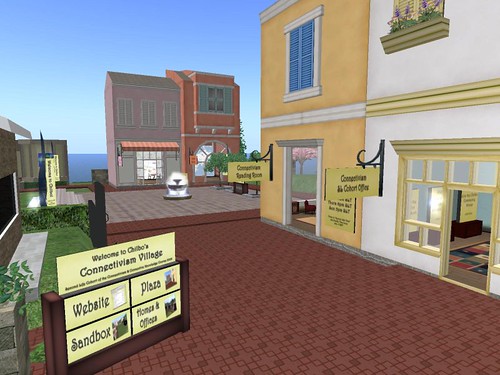
While I won’t have the time to be a main facilitator for a Second Life Cohort of the class this year, if someone is interested in taking this on, the Chilbo Community in Second Life can host the cohort’s meetings and work in the re-purposed Education Village.  The Connectivism Reading Room is still available for holding discussions, and the sandbox and houses/offices can be used again this year for anyone who wants to participate.
Interested in facilitating or using Second Life as part of the CCK09 class? Let me know at fleep.tuque@gmail.com and I’ll do my best to help!
Just a brief update to apologize for the several months of silence on the blog. As many of you know, Dad passed away a couple weeks ago and the last few weeks have been spent trying to catch up on all the things that got left by the wayside while we were caring for him at the end. I should be back to blogging regularly again soon.
My sincere thanks to everyone who offered kindness, understanding, and advice throughout the last 18 months. The support of my professional and personal networks helped tremendously in learning about the cancer and how to cope with being a caregiver. I feel lucky indeed to know so many wonderful people, and you helped me be a stronger support for Dad. Thank you, from the bottom of my heart.
Feminism is a topic that I don’t talk much about these days, but in the last 24 hours it’s popped up on my radar twice and it’s made me think about why the word, the label itself, doesn’t seem to be part of my current vocabulary. 15 years ago, “feminist” would have appeared in any web profile I’d made if social media had been around then, but now you don’t even see it in my tag cloud on delicious or even on my own blog (until this post). “What’s up with that?!” I’m asking myself, “how could that be?”
The topic of feminism first came up when I attended Mitch Wagner’s Copper Robot show in Second Life, a bi-weekly discussion/interview session about technology, politics, etc. etc. This week’s guest happened to be a good friend, Aliza Sherman aka Cybergrrl Oh in world, who founded Cybergrrl, Inc. back in 1995 before anyone knew what the prefix “cyber” even meant. During the discussion, I got to ask her if she still considered herself a feminist and if she felt that technology had empowered women as much today as she’d thought it would nearly 15 years ago. Grab the podcast at http://copperrobot.com/index.php?post_id=431238 to hear the interview (the first part is about living in Tok, Alaska where it got down to -50F recently!), but she replied:
“Oh absolutely, I mean, in so many different ways. It’s not a cure-all, it’s not the silver magic bullet-y thing.. But first and foremost, women having technical skills puts them at a greater advantage than women without technical skills because our society pays people with technical skills much better!  Second of all, even if a woman is not using it for her career, a woman who is a stay at home mom is far more connected to the support she needs and wants and the information she needs and wants because she’s able to get on the internet, use the internet, and connect with family, friends, and communities – and that information. So right away, that’s much more empowering than to be isolated and alone.”
And I thought to myself, how true! I don’t have one of those fancy visualizations of my social networks online, but in my mind’s eye, the women in my social networks really stand out as the major -connectors- to other people, resources, and information (for example, the person who consistently shares the most great stuff on my Google Reader feed is iAlja, a woman from Slovenia who I’d never know without technology), and as the major -motivators- for keeping me on track with some of my larger goals (for example, Intellagirl is one of the busiest women on the planet but still finds time to send feedback and targeted advice), and as the major -doers- of the nitty-gritty hard work required to not just get good projects off the ground, but keep them running and sustainable long-term (for example, Rachel keeps the Chilbo Community running smoothly by making time to do routine tasks that need to be done, even if they aren’t fun or glamorous).
Generally speaking, the women in my social networks contribute some element to the overall picture that I think of as the lubrication that makes the network _work_. It’s hard to put my finger on it, but if I imagine my social network and eliminated all the women, there would be huge, gaping holes in every project or endeavor I’m involved with. So yes, without a doubt, technology is empowering women in ways earlier generations of feminists could only dream of and I am both a beneficiary of it and have obviously devoted my career and my work to teaching others technology skills so they can be empowered, too.
And yet.. My answer to that question would be different than Aliza’s. I’d say that technology has not empowered women as much today as I thought it would have back in the 90s. Feminism as a label isn’t just a dirty word, it seems almost irrelevant and completely absent from the discourse in my sphere of reference these days, despite all the STEM initiatives targeting women and minorities, and “women/girls in IT” or women’s leadership conferences/events I participate in every year.  It feels like “women’s issues” get plenty of lip service in the broader conversation, but other than for isolated events, it never even comes up in the male dominated IT world, and the fundamental issues underlying things like wage disparity and far, far fewer women in positions of management haven’t changed very much at all. Women have been graduating with degrees at higher rates than men for years now, but they aren’t anywhere near equal representation in terms of ownership, management and leadership positions, economic well-being, or nearly any other metric we measure “success” by in the US.  Technology may be improving women’s social connectedness, but it isn’t translating into economic success nearly as much as I might have predicted 15 years ago.
And then while these thoughts were stewing, I ran across a TED Talk from novelist Isabel Allende that gave me a serious reality check.  Here I am thinking of myself and the women in my network and the challenges we face.. but then Isabel’s talk reminds me of just how far I and most of the women I know are from the most brutal conditions of women in other parts of the world.
I found Isabel’s talk very disturbing. I don’t like to think of things in dichotomous terms like “developed/developing nations” but the stories she tells of child sex slaves and women in dire horrible circumstances make you feel sick to your stomach, and yet it is so far removed from me and my experience I can hardly identify with it except to feel a general sense of horror and helplessness, similar to the feelings I have about the situation in Gaza, Afghanistan, or any number of other human-caused tragedies.
Watching that video, I felt a deep sense of what others might call “white, western, worthless guilt” as I thought about how seldom I spend any time, energy or thought to empowering women, specifically, even in my own spheres of influence. I try to think back, have I done any special outreach to women, lately? Women students? Women faculty? Hmm, no, I haven’t.
So, geez, what happened to that feminist Fleep who moderated flaming, raging debates in the Feminism> rooms of BBSs of yore?  The one who identified as a woman first and everything else second? When did I start feeling guilty about the plight of women in the world, instead of angry and ready to fight to change it?
I really don’t know where that Fleep went, and most puzzling, I don’t even know when it happened.
I guess I don’t have much of a point here, except to say that I feel like I’ve lost some important thread in my own internal conversation about a topic that I was once extremely, publicly passionate about. If you had asked me yesterday, I would have said I don’t wear my feminism on my sleeve any more, but a feminist ethic is deeply embedded in my world view. Today I wonder how deeply embedded it could be if it doesn’t even come up on my mental radar very often and when it does it feels like a shock to my conscience.