No joke, this was my fortune cookie at dinner tonight – how apropos:

No joke, this was my fortune cookie at dinner tonight – how apropos:
The quote in the title of this post comes from Gretchen Morgenson, who writes the MarketWatch column for the Sunday New York Times, on the 9/19/08 episode of PBS’ Bill Moyers Journal. Watch it.

I am so thoroughly disturbed by the current state of affairs in the US economy that I must put all political correctness aside for a moment and ask you, dear reader, for a reality check.
It appears that our government is about to take on a tremendous amount of debt by nationalizing private entities, buying trillions in bad debt, and by some accounts, taking on some 70% of the mortgages in the United States.
This is unprecedented. Cataclysmic. Terrifying.
I spent some time last night actually watching TV, something I do less and less of these days, catching up on a backlog of Tivo from the past week. I watched a bunch of news reports, pundits, and analysis of how and why this economic crisis has come to a head, what the government is doing about it, what those who have been reporting on the financial sector for 30 years think about it, and the whole time I’m thinking to myself, wow: I have absolutely no faith that anyone in the US government or otherwise actually knows what they are doing with regards to this imploding/exploding economic mess.
If you somehow aren’t following this, you should be. Every American citizen certainly should be, because we the American people are about to be saddled with TRILLIONS of dollars of more debt – and I cannot imagine how this won’t impact the rest of the world in some way – so you should be paying attention even if you aren’t in the US. Did I mention _trillions_ of dollars in new debt? I can’t really fathom a trillion dollars, personally, it’s still hard for me to wrap my mind around billions of dollars. Here’s a quick primer, if you’re trying to catch up:
Government Pledges Swift Financial Crisis Rescue
Wall Street Turmoil Marks Wholesale Banking Shift
So, from what I can tell, the last 30 years of banking deregulation (i.e. relaxing the laws, standards, and oversight of what financial institutions and Wall St. investors are allowed to do), has led to ever larger financial institutions creating ever more complex financial “products” that have become so damned shady and complicated that even Wall Street itself doesn’t understand what they’ve gotten us all into.
You’d have to have been hiding under a rock to not know that a bunch of companies made a bunch of risky loans for people to buy houses they couldn’t really afford, and as the price of everything (especially energy) began to soar, a bunch of these people couldn’t afford to make the payments on their homes anymore. The companies that loaned them the money weren’t too worried, cause they’d “packaged” up big bunches of these loans and “sold” them to other companies and banks, who then themselves sold pieces of this debt to a bunch of other companies and banks, and so on and so on. And as more and more people stopped being able to pay their mortgages, more and more of these companies and banks were stuck holding the bag on all this debt that no one was paying on. This is the “Subprime Mortgage Crisis” that we’ve been hearing about all year.
Except it seems that the people in the US government and the geniuses on Wall St. either didn’t know or didn’t want to admit that these “packages” of defaulted loans had become so widely sold, traded, and mixed in with other stuff, that even big, stable, long term financial institutions and companies were in big trouble as more and more people became unable to pay for their houses. Suddenly the troubles of “Main Street” were wreaking havok on “Wall Street” and everyone began to panic. It got so bad, that big name companies that everyone thought were safe and stable started filing for bankruptcy and begging other big banks to buy them, it got so bad, that people and companies began to take their money out of money market accounts and other funds and that caused even MORE people to panic.
And so, in the span of a week, the Bush Administration’s people have stepped in and said, don’t freak out, we, the US government, will take over some of these failing companies, and we, the US government will insure your money market funds, and we, the US government will take on the debt of all these houses that no one is paying for anymore. And Wall Street rallied at this news on Friday and had a big party that Uncle Sam was going to swoop in and save the day.
…
From what I can tell, this is the craziest, scary economic situation of our lifetimes. The financial health of the United States of America hasn’t been this jeopardized since the Great Depression.
…
Now one of the analysts on PBS said that you don’t stop to fix the leaks in your roof when the hurricane is still going strong, you just do what you have to do to survive the hurricane, and you fix the structural damage when it’s over. I think that’s true. I think if the government had not stepped in, goodness knows how far reaching this crisis might have become, it’s truly terrifying to think about, particularly considering how much US debt is owned by foreign investors.
But. BUT.
It seems to me that this means that the US government is going to make damned sure that the free market capitalists don’t loose THEIR homes and savings and retirement, and the ordinary people who have already lost their homes and savings and retirement are just out of luck. For all of my living memory, the REPUBLICAN PARTY has stood for business, for smaller government, for telling regulators to butt out of what business does, let the all-knowing all-wise market sort out the winners and losers. And when they were winning, all those profits, all that money, was THEIR money and the government shouldn’t tax it, shouldn’t take any of it, the American people as a whole shouldn’t share any of it, because it was the gutsy risk-taking of the capitalists that led to the profit in the first place, and the market rewards winners and punishes losers. Not two weeks ago I saw a political ad for John McCain talking about making the tax cuts to the wealthy that the Bush Administration enacted early on permanent.
Except now, when the all-knowing, all-wise market started doing exactly that, started punishing the risk takers who were taking TOO MUCH RISK, now the REPUBLICAN PARTY is saying wait, hold on, the American people, the US government (you know, the ones who didn’t get to share in the wealth cause it was all YOUR money), well, we’ll take on a bunch of your debt. We’ll take on a bunch of the risky crap that you’ve gotten yourselves into. Hell, we’re even going to take over some of your companies. And the free market capitalists are saying HALLELUJAH, yes please, please take all this mess we’ve gotten ourselves into. PLEASE TAKE IT. The financial press is using words like toxic, poisonous, and radioactive to describe this debt. The wonky economic analysts in their rumpled suits and crooked ties and silver hair, the people who have been studying this stuff for their whole professional lives admit that even they don’t understand exactly how “toxic” this toxic stuff is.
And me and you, Joe, we’re about to get handed that bag of toxic stuff.
…
My undergraduate degree is in Political Science. I (sadly) didn’t focus on economics as much as I wish I had, and I can’t claim to understand everything that’s going on right now if even the pros don’t have a clue, but I just have to put this out there, publicly, for my own conscience.
The REPUBLICAN PARTY, representing free-market capitalists, has largely had their way in terms of economic policy, they have successfully gutted many of the laws put in place after the Great Depression, and they have successfully protected the profits – the sickeningly vast profits – of a very, very tiny percentage of very, very wealthy Americans.
I’ll sit tight with everyone else while the hurricane is upon us, but when it’s over, we have a LOT more than just repairing the roof to do. I personally know people in my family, people in my social circle, who are facing homelessness and dire economic circumstances. I personally know people who got a few thousand dollars into credit card debt (and I’m talking $4-5000 range) who then had something bad happen, an illness, a job loss, who were unable to get out from under it and are struggling to just plain feed their kids. And I didn’t see Uncle Sam coming to bail THEM out.
I am angry. Afraid. Worried. And I genuinely believe that the REPUBLICAN PARTY has quite literally wrapped themselves in the American Flag and used every dirty trick in the book to keep the average, church-going American distracted by issues like guns, abortion, and gay marriage so they can rob our country blind. And they seem to be getting away with it.
When does it stop? When does the party of “Country First” actually start putting the country – the whole country, not wealthy investors – first?
I do not understand how any sane person could vote for John McCain in this election. I really don’t. I don’t know how any sane person could be watching this and not see the horrible irony of wealthy “government keep your hands off” investors begging the government to take on their private debt, so much money than I can’t even fathom it in any real sense. 35% more than the entire US defense budget. 4/5ths of the output of our entire national economy in debt.
It’s staggering. Just plain staggering.
And the last time I looked, this is what CNN’s homepage looked like. The only indication of this on the front page? A tiny link on the right.

And on that depressing note, I’m off to finish laundry and go to my grandpa’s house. He grew up in just-post depression America, and I hope he has some damned good advice for me.
![Reblog this post [with Zemanta]](http://img.zemanta.com/reblog_c.png?x-id=d79345a3-7b92-4e35-9855-6deb1e7dda76)
(This post is about the Massively Online Open Course called Connectivism and Connective Knowledge being taught by George Siemens and Stephen Downes from September to December 2008. Over 2000 participants have signed up, and I am facilitating the Second Life cohort for the course. Over the following months, I will be posting about the experience, home work assignments, and other materials related to our activities.)
Suggested Reading for CCK08 & CCK08SL
Not that those of us in the CCK08 course don’t have plenty to read and keep up with already, but I’ve received quite a number of questions about the Second Life cohort of the Connectivism class. If you aren’t sure what Second Life is, what virtual worlds are, or why they might be applicable in a connectivist context, I think Sarah Robbins-Bell‘s article Higher Education as Virtual Conversation might be a good text to read.
She writes:
We know that the demographics of Facebook, Digg, Fark, and World of Warcraft are the same as the general demographics of college/university students. So, why don’t we see the same levels of participation in the social media that are used in the classroom (typically, learning management systems) as are evident in the social media that students engage in voluntarily? I think the problem is that our pedagogy often isn’t ready for an increase in conversation.
She goes on to examine the specific characteristics of virtual worlds and how they are manifested in the Second Life platform, a good primer for those who aren’t familiar with it, and continues with an analysis of how these platforms can facilitate an increase in conversation and dialogue – between and among students, students and instructors, and students and the world. More than just conversation, she demonstrates how they can be used to facilitate active and participatory knowledge making (and some things we SHOULDN’T do in virtual worlds that can shut down that kind of knowledge making).
A persistent world offers persistent learning opportunities. It is up to the instructor and the student to define and explore what kind of activities will be useful for the learning goals of a particular course, but it’s possible that many of those goals can be accomplished in the community at large rather than in a delineated space intended for “learning.â€
Second Life Education Multimedia
If it’s still hard to imagine what kinds of educational projects are taking place in Second Life, Claudia L’Amoreaux (SL: Claudia Linden) gave a keynote yesterday at the Holland Open 2008 conference in Amsterdam, accompanied by this beautiful and rich Vuvox collage called “Open Mind”. Take the time to explore it, it contains many types of embedded media.
Hopefully a few minutes with these resources will give some sense of what the Second Life cohort is on about in the Connectivism course.
![Reblog this post [with Zemanta]](http://img.zemanta.com/reblog_c.png?x-id=87d05662-8f59-453f-8396-693553b47120)
I’ve been a bit deluged this week with last minute preparations as the start of the new school year approaches, but I wanted to take a moment to post about the September/October 2008 issue of EDUCAUSE Review.

If you have any interest whatsoever in virtual world technology and how it is being used for education, I highly recommend taking a look at this issue. I felt so honored to have been asked to contribute an article (Looking to the Future: Higher Education in the Metaverse), but feel even more so now that I’ve had a chance to read all of the contributions by my colleagues. They write about theoretical and practical questions we all should be asking, describe a wide variety of use-cases across many disciplines, and give us thought provoking glimpses of what the future may hold, as both teachers and students, individuals and institutions. It’s good stuff!

I should also mention the web bonus section that includes several examples of works in progress, including a spot about the University of Cincinnati’s Galapagos Islands project in Second Life that I’m working on, as well as projects that I frequently tour with faculty in my workshops, such as the NMC Campus, Genome Island, and the University of Michigan’s Wolverine Island.
It’s really great to see the work of so many friends and colleagues highlighted – especially when I know how much effort, thought, and preparation has gone into their projects – and I hope it will inspire other educators to take the plunge into this fascinating and complex space.
Many thanks to all who lent their support and advice when I was wrestling with my contribution!
![Reblog this post [with Zemanta]](http://img.zemanta.com/reblog_c.png?x-id=f831edc0-881a-44cb-b491-b43107ea47bf)
(This post is about the Massively Online Open Course called Connectivism and Connective Knowledge being taught by George Siemens and Stephen Downes from September to December 2008. Over 1900 participants have signed up, and I am facilitating the Second Life cohort for the course. Over the following months, I will be posting about the experience, home work assignments, and other materials related to our activities.)
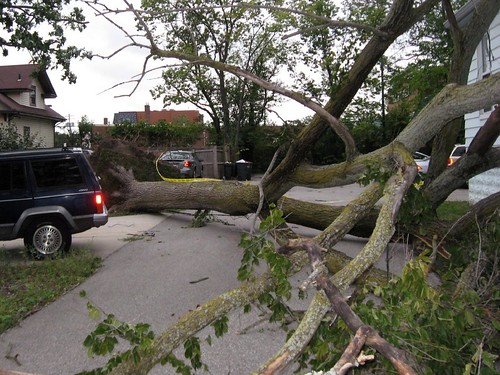
Storm damage in Cincinnati, photo by elycefeliz used under CC licensing.
On Sunday, the remnants of Hurricane Ike traveled all the way up to Indiana and Ohio, and though I’ve certainly seen my fair share of weird weather phenomena, I have never seen a wind storm like that! I lost my biggest shade tree in the back yard and have a little roof damage, but other than property damage, all my friends, family, and coworkers are ok. Being so far inland, this part of the country is certainly not prepared for hurricane or tropical force winds, and it caused a massive blackout in the region, shortages of gas and food, school closings, and a new understanding and sympathy for those in Texas who took the brunt of the storm.
And suddenly, in the middle of the Connectivism course, I found myself forcefully Disconnected.
I’ve had brief power outages before, but not for so long and never for so long in the summer. When you get a big winter storm, there’s a snowy white visual barrier between you and the rest of the world and you know it will melt and things will get back to normal. This time, there was no visual, nothing but the hanging powerlines and broken telephone poles to remind you that our modern society and all of our connections are really quite tenuous. Without the juice that those cables provide, and the pipes that transmit all of those 01010101011110001’s, those of us who are hyperconnected online may be more isolated and disconnected locally than ever before. It was a sobering thought.
It wasn’t until sometime on Monday when I began to worry that the power might not be back by Tuesday’s Connectivism course meeting in Second Life that I remembered my Utterz account. I have Utterz set up in such a way that I can call Utterz from my cell phone and record a message. Utterz then creates a post automatically on my blog, and WordPress is set up with a plug-in to automatically send a message to Twitter whenever something is posted on my blog. This means that when I was stranded with no electricity, internet, or landline phone, I could flip open my cell phone, record a message, and within a few minutes my voice was online and my network of twitter friends were notified. Chilbo residents Malburns Writer and Tara Yeats noticed it, and Tara is also in the Connectivism course, so she very kindly sent an email out to the Second Life Cohort to let folks know I was offline. (Thanks Tara!)
Hmm, so maybe not so disconnected after all. But it was quite strange to be standing in the dark and sending out what felt like an SOS of sorts into the ether. What to say when you’re talking to.. well, anyone? Should I direct the message to my blog readers, to the Connectivism course? Without access to my online calendar, I wasn’t even sure who else I was supposed to be meeting with, so maybe it should be as general as possible? I realized I am quite weirded out by posting a voicemail to anyone who happens to hear it!
Mobile post sent by fleep using Utterz. Replies. mp3
And then a few days later I ran across a post by fellow Connectivism student Janet Clarey, who writes about my Utterz post, saying:
Chris Collins (a/k/a Fleep) sends a mobile post to her blog because she has no power and no Internet connection. She’s letting her ~2,000 online course mates (in the CCK08 course) know that she won’t be in attendance today. No biggee right? It’s no different than a voice mail sent to a group. Or is it? I think it’s significant. She’s communicating with anyone.
I’m not sure I could be as creative if I found myself without power or a connection. Perhaps that’s because Fleep seems to have several less wrinkles than I do and doesn’t carry the weight of my prior telecommunication experiences. Or maybe I’m just not cool.
See, I’d call someone even though anyone would be the better choice for learning (e.g., what was covered during her absence). She’s inviting dialogue over monologue.
Janet gives me too much credit. =) I am actually old enough to remember shared phonelines, dialing telephones, and pressing 9 to get an outside line. I’m old enough to feel awkward speaking to just anyone who happens to hear, and I’m still experimenting with and feeling out my own boundaries about what is and isn’t appropriate to broadcast out to the whole wide world. The only difference, perhaps, between Janet and myself, is that I had previously played with Utterz, had taken the time to set up the cascading automated linkages that would make that audiopost > blog > twitter chain happen, and remembered it during the blackout. But on the inside, I’m still uncomfortable both with my connectedness and disconnectedness, I still feel unsure, strangely vulnerable talking to anyone and yet discomfited when the lights were out and the PC buzz was palpably absent.
I think we’re all still learning how to be connected, how to cope with disconnection, and where our comfort level begins to stray into uncomfortable territory. One of the lessons I took from this (besides the fact that I really should have a bigger store of batteries and non-perishable food!) is that there turned out to be great value in the hour or so I spent playing with Utterz.. what a year ago when I set that up? It turned out that by connecting my blog and twitter to some new service I wasn’t even sure how to use or what to use it for would eventually come in handy. That the few minutes I spend from time to time listening to my friends’ Utterz was back there in my memory, recalled in the moment of need. Setting up connections is time consuming, and sometimes I don’t know what value, if any, it will have, but in this case, it turned out to be very handy indeed.
And it wasn’t just the technology connection that made this work, it was also the people connection. Malburns and Tara are good online friends, good citizens of our community, and good hyperconnected netizens. Who knows how many people saw/heard that post and did nothing, but Tara took the time to not only listen to the message, but then to compose a message and forward it on my behalf, completing a circuit in the chain that was NOT automated (notifying the Connectivism SL cohort) – and it was our personal relationship and connection that made that part happen, not the technology itself.
Lesson: Need batteries and better emergency stores at home – you must plan for the unexpected.
Lesson: Our electronic connections are more tenuous than they sometimes appear. The energy crisis and degrading infrastructure in the US is a Serious Issue that we need to pay more attention to.
Lesson: Keeping abreast of and playing with new online tools and ways to connect can have big payoff in the future, even if you don’t see value in it now.
Lesson: Technology facilitates many things, but it’s the people connections that ultimately save the day.
![Reblog this post [with Zemanta]](http://img.zemanta.com/reblog_e.png?x-id=9e33f733-af87-47b4-9629-1f594b072d85)
(This post is about the Massively Online Open Course called Connectivism and Connective Knowledge being taught by George Siemens and Stephen Downes from September to December 2008. Over 1900 participants have signed up, and I am facilitating the Second Life cohort for the course. Over the following months, I will be posting about the experience, home work assignments, and other materials related to our activities.)
Cross posted from the Chilbo Community Blog:
Following the end of the very successful Chilbo Summer Fair, we said goodbye to the Ferris Wheel and fabulous rides, artworks, and projects and made way for a new three month project in Chilbo.
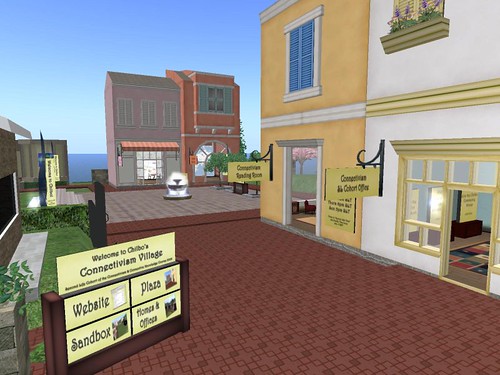
The Main Gate of the Connectivism Village down in the south Madhupak area of Chilbo.
This month marks the start of the Connectivism & Connective Knowledge course, a Massively Online Open Course. From the course info:
Connectivism and Connective Knowledge is a twelve week course that will explore the concepts of connectivism and connective knowledge and explore their application as a framework for theories of teaching and learning. It will outline a connectivist understanding of educational systems of the future. George Siemens (SL: Whatever Russel) and Stephen Downes – the two leading figures on connectivism and connective knowledge – will co-facilitate this innovative and timely course. The course will run from September 7, 2008 to November 29, 2008 and will be fully delivered online.
Over 2000 participants from around the world have signed on to take part, and several members of the Chilbo community are fellow students, including Gann McGann, Olando7 Decosta, Samuel Sputnik, Sine Rennahan, Tara Yeats, and Wainbrave Bernal. The Chilbo Community is hosting the Second Life cohort of the class, and Cosimo Urbanowicz has also joined some of the early discussions and helped with the construction of the Connectivism Village down in Madhupak.
SL Cohort Wiki: http://chilbo.wikispaces.com/Connectivism+Course+in+Chilbo
SL Cohort Googlegroup: http://groups.google.com/group/connectivismSL
SL Cohort Tag: CCK08SL
Second Life Cohort Weekly Meeting Times:
Tuesdays at 11AM SLT (-7GMT)
Thursdays at 6PM SLT (-7GMT)
Sundays at 5PM SLT (-7GMT)
Initially, the impulse was simply to see if other students in the course who also had Second Life accounts were interested in meeting weekly in-world to discuss the Connectivism course. Though there are many communications tools used as part of the course structure, I’ve begun to feel I haven’t really “met” someone until I’ve “seen” them – even if that meeting and seeing takes place in avatar form. Psychologically, it seems as if I don’t feel the same level of engagement with another person through their blogs, tweets, or discussion board posts unless I’ve “met” them first, and I was interested in meeting other students in the class.
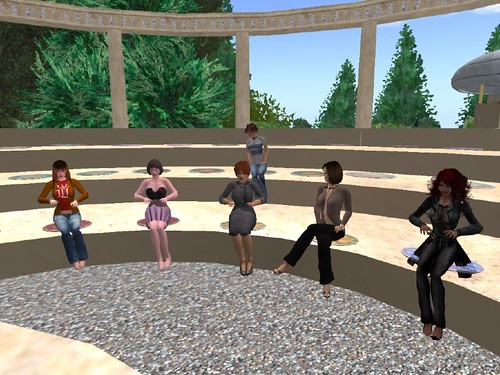
Thursday is ladies night? Members of the Connectivism course discuss the first week in Chilbo’s Shrubbery Amphitheatre.
But as I began to read more about Connectivism, I started to think that it might contain concepts that could be better visualized in 3D, and for SL building, the Second Life cohort would need land and prims. After talking with folks in the community, we cleared up the Fairgrounds area and made room for a temporary Connectivism Village project that would last three months and house members of the course who needed a home base in Second Life.
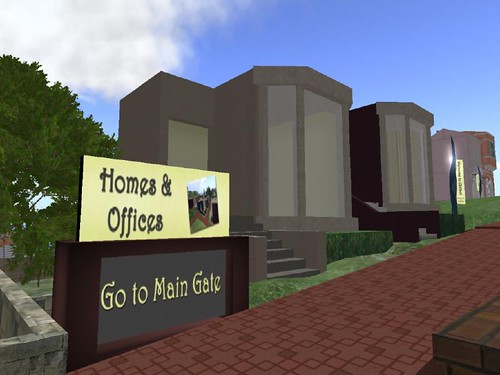
Small mini-homes and offices are available for members of the Second Life Cohort of the Connectivism course for the duration of the class time. Some students are interested in finding roomates!
The Fairgrounds area is also large enough to host some central facilities and resources for the course, to help make sense of the plethora of web based feeds, tools, readings, and course media. The Connectivism Second Life Cohort Office will simplify the process of folks joining the cohort, and the Connectivism Reading Room contains all of the assigned weekly readings and some introductory materials for the course.
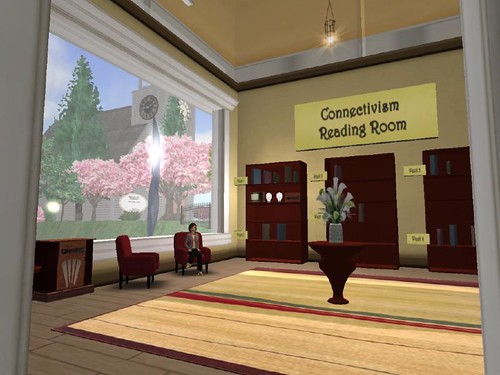
The Connectivism Reading Room can help students visualize course readings and discussion archives, as well as provide a place to discuss readings ad hoc through the week.
The Connectivism Course Tools Sundae Shop is a whimsical take on the somewhat overwhelming nature of the course structure. With several websites, communication mediums, RSS feeds, and course emails, Moodle forums, Facebook, and on and on, it’s a little rough trying to figure out which tools will work for your particular needs. The Sundae Shop is a metaphor for taking the flavors you like and sampling some of the others, not putting every choice on the sundae!
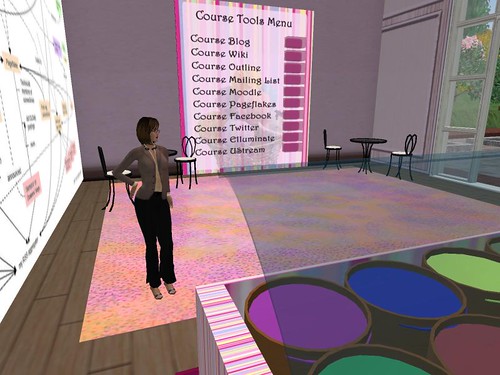
The “Menu” of various course tools in the Connectivism Sundae Shop.
Beyond the few buildings near the plaza, however, I think it will be the Connectivism Sandbox that will hold the most interesting content of the course. Here we can play with models, particles, sets, artwork, media.. whatever strikes our fancy as we play with the concepts of the course and learn more about Connectivism. For those who are new to building in Second Life, visit the Ivory Tower of Primitives for a walk through, self-paced building tutorial. The Ivory Tower is a cultural institution of Second Life and shouldn’t be missed even if you’ve learned on your own!
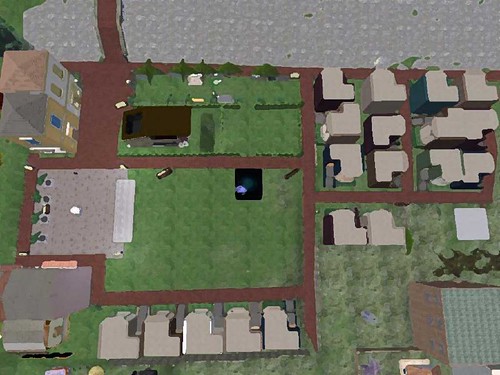
An overhead view of the Connectivism Village in the Chilbo Community (Madhupak sim).
I look forward to seeing how the Second Life cohort of the course progresses, and I encourage anyone from Chilbo to participate or check it out! If you have time to wander down, please say hi to any students you see too! They are members of the Chilbo Community Building Project group and have the group tag “Chilbo Connect!” ~ Fleep
![Reblog this post [with Zemanta]](http://img.zemanta.com/reblog_c.png?x-id=03eb08ee-fe1b-46f0-ad4c-1de4fb485cf9)
Thanks to Kevin Jarrett for this tip! (PS Kevin was just featured on an NPR segment about tech in schools! Listen here!)

WHERE WE STAND: America’s Schools in the 21st Century, premiering
Monday, September 15, 2008 at 10 p.m. on PBS, presents a frank
evaluation of our educational system’s strengths and weaknesses.
Hosted by Judy Woodruff, Senior Correspondent for The NewsHour with
Jim Lehrer, the documentary will visit schools throughout Ohio, an
important swing state that represents a range of socioeconomic and
geographic school districts. The program will feature schools in urban
Cincinnati, suburban Columbus, and rural Belpre.
See http://pbs.org for local listing times.
But there’s more! Educators from around the nation are going to gather on Thursday of next week to discuss the documentary in Second Life. Kevin writes:
As a fitting follow-up activity, the International Society for Technology in Education (ISTE) will be hosting a free “Educator’s Social†in Second Life on Thursday, September 18th at 9:00 pm Eastern (6:00 pm Pacific). Educators from around the country (and the world) will gather at ISTE’s Second Life Island “Campfire Area†(http://slurl.com/secondlife/ISTE%20Island/213/150/22) to discuss the documentary. I’ll be moderating one of the discussion groups but there will be several others. If you have a Second Life avatar, please consider joining us!
![Reblog this post [with Zemanta]](http://img.zemanta.com/reblog_c.png?x-id=7cffd73b-bd95-4175-8da9-40d874050998)
(This post is about the Massively Multiuser Online Course called Connectivism and Connective Knowledge being taught by George Siemens and Stephen Downes from September to December 2008. Over 1900 participants have signed up, and I am facilitating the Second Life cohort for the course. Over the following months, I will be posting about the experience, home work assignments, and other materials related to our activities.)
Catching Up!
Because I was so busy with SLEDcc 2008 and SLCC 2008, I have already gotten behind in the Connectivism course! I’m trying to play catch up now, and so far I’ve done some Connecting but not much Learning.
1. The Second Life Cohort of the Connectivism course held their first meeting yesterday, where I discovered I’m not the only one who is feeling behind and a bit overwhelmed and confused. Transcript here.
2. I added myself to the Googlemap for the course.. wow, people from all over the world! Sadly absent is much participation in Africa, I find that depressing.
3. I added myself to the TwitterPacks wiki for the Connectivism Cohort.
4. I registered and added my profile to the CCK08 Moodle site, and scanned some of the introductory posts. I don’t feel like adding to the din in there though, I think I’ll just stick to my blog for now unless there’s a compelling reason or requirement to participate in the Moodle? (I’ve become anti-course-management-system these days.)
Pre-Week 1 Homework: Introduction
I’m currently located in Cincinnati, Ohio, where I work at the University of Cincinnati in the UCit Instructional & Research Computing department, focusing on teaching and learning about emerging technologies, social networks, and virtual worlds (particularly Second Life). I’m interested in the Connectivism course for several reasons – I want to see a MMOC in action, learn where a mass participation learning experience works and where it fails, and because I am intrigued by the concept of knowledge existing in external networks. I don’t feel I have a very good grounding in many of the other learning theories that came before, and I don’t know where the boundaries of Connectivism exist, but I want to know more.
The course will be a success for me if I a) connect on a deeper level with the members of the Second Life cohort of the course, b) gain a better understanding of the connectivist theory of learning and understand clearly how it is different than behavioralist/constructivist theories, and c) learn to navigate the complex network of websites, blogs, discussions, videos, and other web and virtual world artifacts I see forming in this course without feeling lost or overwhelmed. I hope by the end that I adjust without feeling left behind.
Random information about me: I logged onto my first online social network in 1994 fresh out of high school, and though I quickly moved from ISCABBS to many different BBS systems, I’ve been participating in and moderating online communities for all of my adult life. I believe the online communities, forums, and social networks I have participated in has made up the bulk of my “real” education – my university experience, even in the best of classes, simply doesn’t compare with all of the learning, sharing, and knowledge acquisition that happened for me on the net. It has been a transformative experience, one I want to share and extend to others.
In other words, I’m curious to see if I may be part of the first generation who could be learning in a connectivist way. It certainly seems – at first blush – to resonate with my experience more than other learning theories have. I guess we’ll see!
![Reblog this post [with Zemanta]](http://img.zemanta.com/reblog_c.png?x-id=013c1654-9bb0-4bdd-9e1d-b0203e9a731d)
The Second Life Community Convention 2008 and Second Life Education Community Conference 2008 wrapped up in Tampa, FL and in Second Life on Sunday afternoon, two days ago, but it is only now that I am relaxed and awake enough to write about it. I think the things that affect us most profoundly are the hardest to put into words, but I’m gonna take a stab at it.
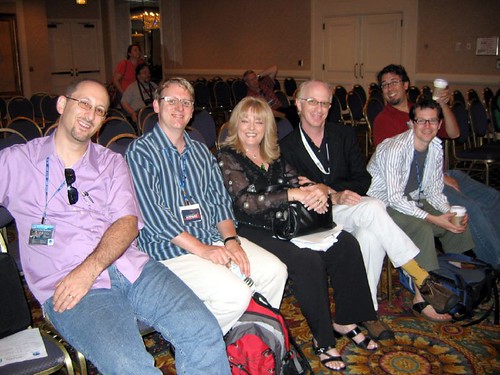
Last educators standing for the final panel on SL media at SLCC07 in Chicago.
My first SLCC was last year, in Chicago, and I remember driving up with such a feeling of.. trepidation and worry. I remember wondering if all those people I’d met and worked with during the organizing of the Second Life Best Practices in Education 2007 conference would like me in Real Life, worried what the dress code would be, worried I’d not feel as comfortable with people in person as I was in our virtual spaces. I ended up having a really good time, met so many great people, and spent the next year strengthening those friendships through all of our online interactions and at other educational conferences throughout the year.
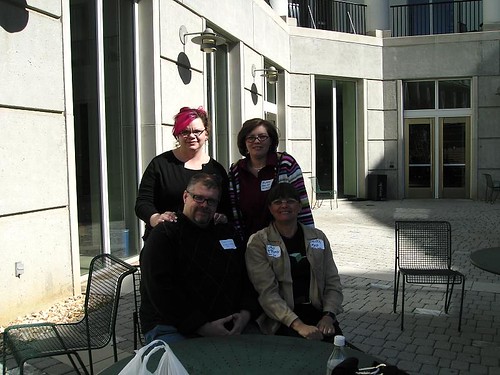
Intellagirl, Fleep, Typewriter, and Decka at Emory’s Virtual Worlds conference, Feb 2008. Image courtesy Decka Mah.
This year leading up to SLCC, I didn’t have time to be nervous. Organizing the SLEDcc component of the conference was a staggering amount of work! (At some point, I really should write about the differences in organizing a real world conference that served some 4-600 people and organizing a virtual world conference that served 1300 people. With NO QUESTION, the virtual conference served more for far less work, money, time, and effort. Holy smokes. But that’s another post for another time…)

Wainbrave, Frans, Rhiannon, Fleep, Armath, and Jeremy Braver outside the hotel in Tampa.
No, this year I didn’t have time to worry or be self-conscious, there wasn’t any time for it, and when I flew in on Wednesday, got unpacked, my only thoughts were of details and things to do and being anxious to see all of my friends. Looking back on it from the other side now, all I can say is that it felt like the most excellent of family reunions – there truly is nothing better in life than spending good time with great friends.

Jeremy Koester and Sarah Robbins hanging out in the hotel lobby at SLCC08.
I think in any large scale event like this, you come into contact with so many people so rapidly, things begin to blur together, for me in just a general warm happy feeling. But I want to be sure to acknowledge, personally, the people who really made this a terrific experience for me, and I think for the whole of the SL community.

Carol Tucker and Scott Merrick, leaders of “The Stream Supreme Team” made the cross-world connection with those in Second Life possible. Image courtesy Scott Merrick
My personal heroes, the ones who I worked with and was helped by, and who gave so selflessly of their time, their equipment, their expertise, and their passion for Second Life that I simply must call them by name are Jonathon Richter, Jennifer Ragan-Fore, Scott Merrick, Carol Tucker, Suzie Medders, Jeremy Kemp, Daniel Livingstone, AJ Kelton, Anthony Fontana, Bonnie Mitchell, Sarah Robbins, Mark Bell, and Jeremy Koester.
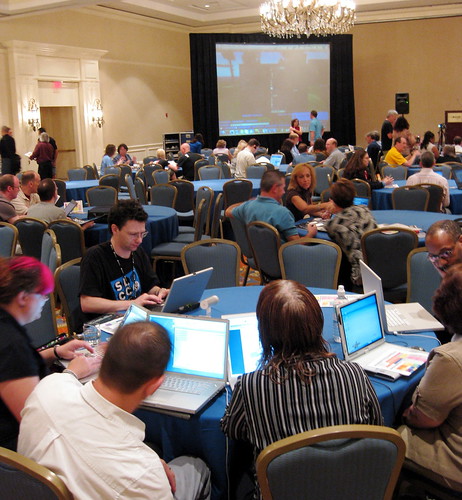
AJ Kelton and others live blogging, twittering, and supporting SLEDcc sessions. Image courtesy http://flickr.com/photos/nkellett/
In one way or another, their contribution to the SLEDcc in Tampa was crucial to its success – they were the ones who answered the call when something absolutely needed to be done and could only happen if someone with a big heart jumped in to do it. I hope you guys know the depth of my affection and appreciation. Thank you so very much. <3 <3 <3
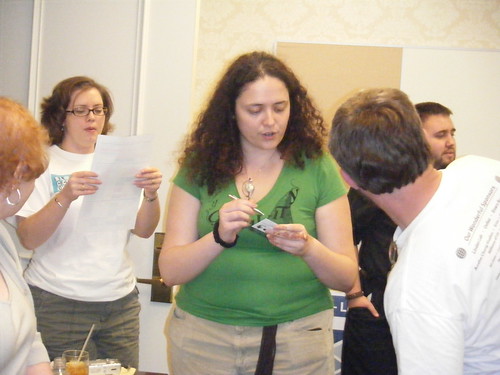
Fleep and Joyce trying to get the programs and sponsor stuff situated.
If I thought it would really convey the awe I feel for all of the presenters and volunteers, I’d list every one of them by name too -it seems like I never really got to sit down and hear all the presentations or thank each person who was working behind the scenes because I was on the go running from place to place myself, but every time I looked into a room, I saw passionate people giving great talks about things they worked on, believed in, and wanted to share with others, helped by great volunteers who were on stand by to solve problems, gopher supplies, stuff bags, and more.
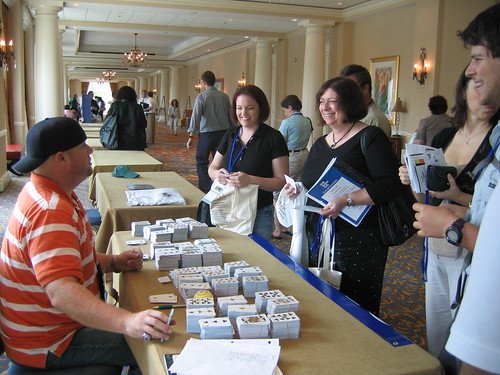
Jeremy Koester manning the SLEDcc Game Control table. 7 of diamonds ftw!
I saw the products of their work in smooth sessions, great handouts and resources, terrific machinima and reports, and the collective and growing wisdom of the educational community in Second Life – I saw the pioneers of this field in person, I got to meet them and hug them and share meals with them, and I feel so tremendously lucky to be in such good company. As colleagues, as friends, the people who share their Second Life work with others are what make SLED special, no matter our other affiliations. Thank you one and all for your terrific work.

Peter freaking out on day 1 of the SLCC! Image courtesy Nexeus Fatale.
It was in Tampa, too, that I finally got to meet the voices on the phone from The Future United. Peter, Leo, Misty, and Joyce, through all those many months of stressing over the details and logistics, were a joy to work with. It’s easy for those of us in the education community to stay engrossed in our work, but SLCC really makes you look up and see all of the diversity in Second Life, and that’s what these guys did for me.

Nexeus working even during the party! Image courtesy Nexeus Fatale.
When they talk about “the community”, they are inclusive of everyone, and they taught me to see more than just the needs of educators in planning a celebration of all of Second Life’s residents. After working with them in person in Tampa, I came away thinking that we have a lot of work to do for 2009, and I can’t wait to get started.
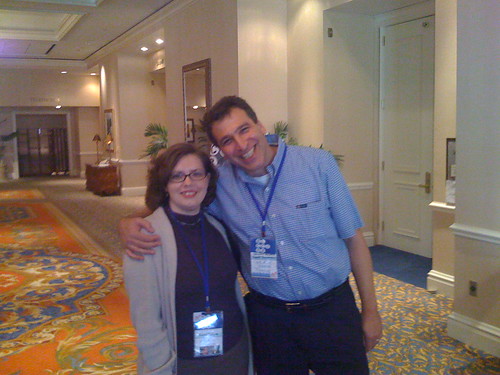
Fleep with Robert Bloomfield of Metanomics fame.
I didn’t mean for this to turn into a big thank you note, but it seems to be coming out that way. I guess it’s because SLCC this year was such a gift for me. As some may know, my grandfather has been very ill and these past few months have been grueling and hard trying to keep up with work and still spend as much time as I can with him. I’d reached such a state of utter exhaustion leading up to SLCC, I almost didn’t come at all. I worried about spending the time away from my family at such a difficult time, I worried I wouldn’t be able to handle all the pressure of pulling things off.. I didn’t even realize what a huge and wonderful support network of friends I had behind me.
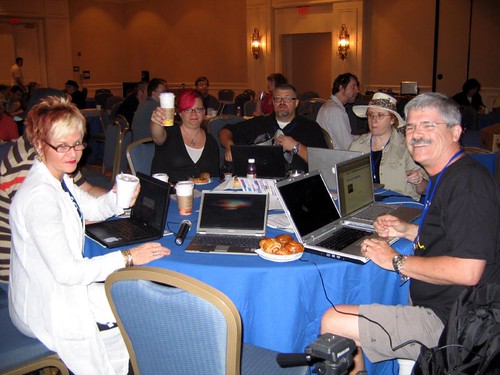
Peggy Sheehy, Sarah Robbins, Mark Bell, Carol Tucker, and Scott Merrick at the streaming table.
Sitting here even now, it really makes me teary to think of all the people who gave me a hug and told me they were thinking of and praying for me and my family. I had no idea how much joy and respite it would give me to spend a few days with such warm, caring people, my good friends. Instead of coming back feeling drained and exhausted, I’ve come back feeling rejuvenated and reminded what it is that we’re all working for – a better life, real and virtual, for ourselves, our friends, our families, our communities, and our world. I’ve come back feeling rested and recharged, inspired anew in my passion for Second Life and the people that create it.
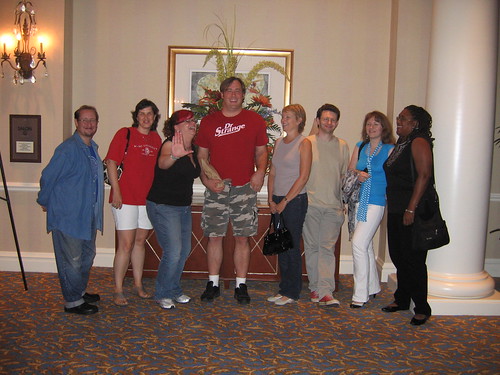
SLEDcc folks doing a late tour of the facilities in preparation for the start of SLEDcc!
And I guess in the end that’s what makes SLCC so special. When people gripe about the ticket cost (which is really unfair because the planners do everything they can to make it as absolutely affordable as possible and still put on a good, high quality show) or wonder why anyone would bother coming to the Second Life Community Convention, I wish I could explain what makes it special. They ask, isn’t it just a big geek meet with weird laptop toting people?
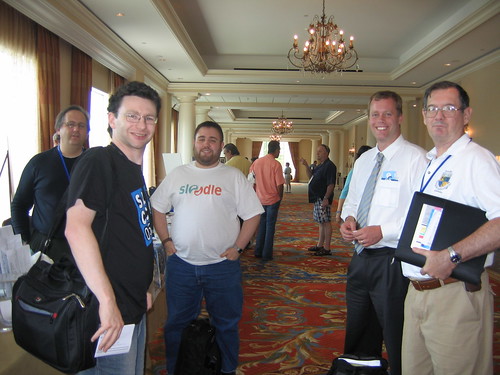
Sloodle and Rockcliffe U at SLCC08.
The answer is yes and no, we’re all weird in our own ways, and you’re sure to spot a laptop or a geek around every corner, but of all of the conferences, conventions, and meet ups I attend throughout the year, SLCC is special. For whatever reason, Second Life inspires a kind of creativity and diversity and range of passions in people that when we come together in person, it feels as much like a festival and a celebration of life itself as it does a convention or a conference about a technology.
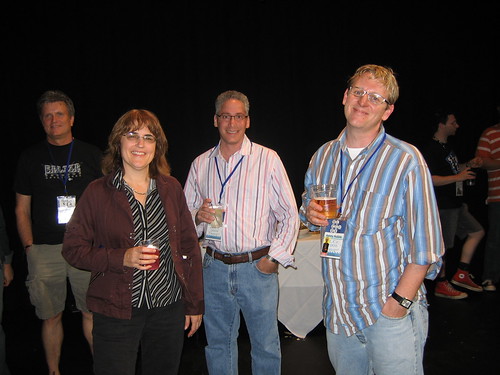
Bonnie Mitchell, Steven Hornik, and Ken Hudson at Tampa Bay Performing Arts Center social mixer.
As I look at all the pictures on Flickr, and see all of those happy, smiling faces, I feel blessed, lucky, and privileged to have been a part of it. My only regret is the time I didn’t get to spend with sooo many people who I really wanted to be with and just couldn’t, but was glad that I at least had a few snatched moments to meet and hug in person – Cybergrrl, Crap, Draxtor, Bjorlyn, Harper, Bevin, geez I could go on for days. And for all the people who weren’t there this year, whose presence was sorely missed (Randy, Prokofy, Dizzy, Douglas, KJ, Joanna, Chilbo, I’m talking to you!), I can only hope to see you at SLCC next year. It was a spectacularly great time.

Jonathon and I finally taking a break!
To Jonathon and all my personal friends at SLCC, Velks and all, I don’t think I need to say anything else other than thank you. I love you guys and I can’t wait until we see each other again. xoxo.
![Reblog this post [with Zemanta]](http://img.zemanta.com/reblog_c.png?x-id=06a6f36b-4d69-4b08-ae2a-91cb68de5cad)