Recently I was invited to join friend and host Malburns Writer on his MetaverseTV talk show called “Cross Worlds”, which focuses on the greater metaverse beyond Second Life. Â It was so much fun to talk about Opensim and FleepGrid, and where we think the metaverse is going in a broader sense. Â Here’s the interview and super thanks to Malburns and the MetaverseTV crew for the invitation!
Confession: Â It’s been so long since I logged into my blog, I momentarily forgot the password. Â Yikes!
I’ve had my head buried in work, house repairs/maintenance, family stuff, and when I have spare moments – OpenSim. Â I intend to write up my first try at installing OpenSim in grid mode sometime soon (I’ll skip the part about it taking a weekend to rebuild a box to use a server, hello Blue Screen of Death, not nice to see ya so often), but in the meantime, this week I walked a group of educators through the installation of OpenSim on their personal PC to create their own private OpenSim sandbox, and I thought I’d share the slides:
Note that this guide skips all of the networking configuration that would be required for someone else to log into your sim. Â This is intended to be an entirely private sandbox for only your own personal use.
Why would you want that? Â Well, a couple of reasons.
First, if you’re a virtual worlds or Second Life enthusiast, watching the console and seeing what’s happening on the back end when you’re rezzing a prim or changing clothes or running a script is endlessly fascinating. Â It’s like seeing your virtual experience through the Matrix. Â It boggles my mind to imagine what that looks like for Second Life, with hundreds of thousands of users and transactions and activity.
Second, anyone who builds or creates content in Second Life really SHOULD be able to save a local copy of their work to their personal machines. Â With OpenSim you can do that, indeed, you can back up objects and whole sims, and re-import them wherever you like. Â I think from this point forward, I intend not to build a single thing IN Second Life ever again – I’ll do all my creation work on my sandbox and then import it in to Second Life when it’s done. Â That way I really DO own my content.
Finally, installing even the most simple instances of OpenSim gives you a new appreciation for the service Linden Lab (and Reaction Grid and InWorldz and all the other grids out there) provides. Â This is not trivial stuff, and in the aggregate, it’s important to understand the sheer complexity of what running the Main Grid must be like – running your own OpenSim installation helps give you a sense of that complexity in a way that 7 years of being a Resident did not.
I hope the tutorial is helpful and I’d encourage you to give it a try even if you consider yourself to be a “non-techie” sort. Â It’s strange and disorienting to find your poor Ruthed self on a little island all alone, but it’s also.. enchanting and exicting to know it’s your very own world to do whatever you like.
“Are you crazy?” That was pretty much the sentiment when I told friends in April that I’d decided to help try to pull something, anything, together for this year’s Second Life Community Convention. The timing, the workload, the politics – for all sorts of reasons it felt like a terrifying commitment. I’d not attended SLCC in 2009, my grandpa had passed away a few months prior and I didn’t have the heart for it, and my experience as part of the organizing team in Tampa 2008 hadn’t been exactly positive. But when the phone call came…
Stuffing bags and folding tshirts on Thursday…
Image courtsey Sitearm
The hardest part of organizing something in such a short time frame wasn’t the sleepless nights or ignoring the house cleaning (and friends and family) for weeks on end, it was the fear that it would all be for nothing. That no one would show up, that no one would come, or worse that the people who had paid to come would ultimately feel it had been a waste of their time and money. We stressed about the budget, the program, the venue, the logistics, and all the things that every event planner worries about going wrong, and perhaps even moreso given the shortened time line to nail down all the details.
Conversation the night before the convention over drinks.
What’s Wiz Nordberg saying? Image courtesy DirkMcKeenan
But more than the logistics, and venue, and schedules, and updating the website and all that .. stuff that goes into making a convention, we were far more worried about something less tangible. Something invisible that it’s harder to put your finger on, that’s hard to even describe – that amorphous “community spirit” that threads through a diverse group of individual people to weave a sense of belonging together, an identity separate from one’s own that makes you feel a part of something larger.  Was the “community” still out there? Did they still want to come together in person, and especially after such a difficult roller coaster ride of a year for the platform?
Hanging out with Tomkin Euler, fellow Chilbo resident, and Amulius Lioncourt,
one of the 11th hour in-world builders who did an amazing job.
I can only speak for myself, but I am so thankful that the answer to both questions was “yes” – a resounding, boisterous, defiance in the face of all challenges yes. Yes, the people who discovered something new about themselves and found each other through this platform called Second Life are still out there, and though many could not come due to timing, cost, or circumstance, enough of us made our way to Boston and engaged in the annual ritual of baring our real life avatars for a weekend of fun, laughter, hopefully some learning, and lots of passionate discussion and debate about the future of the metaverse. I was too busy to engage in much of it myself, but watching it unfold was a beautiful thing to see..
Stopping by to chat with Olivia Hotshot and AJ Brooks at lunch.
Image courtesy OliviaHotshot
The question I heard so many times over the last few months as we planned the convention is why, if the virtual world is so powerful, do people want to come together in person in the first place? The answer isn’t so simple, but it has something to do with the fact that those of us living simultaneously in the metaverse and the physical world are living complicated lives.  Life itself has no guidebook, but virtual life has even less of one, and there is something inordinately powerful about being in the presence of hundreds of other pioneers in this space who know on a deep level some of the challenges you yourself have faced.
Laughing hysterically with Beyers Sellers..
Image courtesy Imjsthere4fun
Second Life is a platform, a technology, a tool.  But it gave us a glimpse of the future, and in one way or another has forced all of us who have immersed ourselves deeply to ask fundamental questions with a new perspective – Who am I? Who is Fleep? Who do I want to be if I can be anything? What is real?  What is virtual? What do all these technological changes mean for the future – for me, for society? And where is this all going, anyway, this platform called Second Life, and this concept we call the metaverse? Is it stalling? Is the vision we shared breaking apart or are we just hitting some stumbling blocks?
AvaCon board meeting at PF Chang’s on Thursday…
Fleep Tuque, Misty Rhodes, Peter Imari, Rhiannon Chatnoir
My personal goal for SLCC was to provide a space for that conversation to take place. Nothing more, nothing less. All we needed was a place to sleep, a place to eat, and a place to talk. It didn’t have to be fancy or out of the box, indeed there wasn’t time for that, and the end result was a very conventional convention with some very unconventionally wonderful people. I think for this year, that was enough, for us to see each other in the flesh, to know that these deeper questions that drive us to put up with the lag and the deficiencies of the platform are not the result of some madness unique to ourselves, but a madness shared by many to understand what the future holds and hopefully to help shape it.
Hugs from Dirk McKeenan at the Avatar Ball.
Image courtesy Debi Latte
And for all those who helped make the conversation possible this year, in world or in Boston, on the web and in Twitter, I hope you feel as I do on the other side of SLCC10:
The community is as strong as ever. Second Life, and the people who make it meaningful, aren’t dead by a long shot.
The vagaries of a particular platform are like the vagaries of the weather, something we must deal with but that doesn’t control our destiny unless we let it.
The future of the metaverse is as exciting today as it was five, ten years ago.
I can’t even think too much of next year right now, I’m too tired. :)  But I hope we can do an even better job facilitating that conversation in 2011. Thank you to everyone who made it possible and I hope you’ll join us next time around.
The concept of “Life as a Game” is certainly not a new one, when I was a kid, the game of Life was my favorite board game of all time. I still remember the thrill of filling up my little car with boy and girl babies I imagined I’d have at some point in the far off future, or the crushing defeat of bankruptcy, a term I didn’t really understand, but in that context basically meant “Game Over.” Spin the dial – what does the game of Life bring you next?
And it’s not as if I’m not a big fan of video and online games – I cut my teeth on the Atari 2600/5200, hand drew maps in colored pencil to find Princess Zelda, played Ultima on a Commodore 64, still have an account on the Medievia MUD that goes back to 1994, have an 80 level holy spec priest on WoW (they nerfed holy spec, don’t get me started), and most recently celebrated the completion of my horse stable on Farmville.
I grew up on games – the first generation to grow up playing video games – I was a “Girl Gamer” back when we were a pretty rare breed and I’m still playing now that “gaming” in its various forms is so common that the Pew Research Center reports that, “Game playing is ubiquitous among Americans teenagers. Fully 99% of boys and 94% of girls report playing video games.” They also report, “More than half – 53% – of all American adults play video games of some kind.”
We are increasingly (already?) a nation of gamers.
And yet, despite the fact that virtually all young people game, and over half the adults in the US game, there still appears to be a very finite line between “gaming” and .. everything else. We still delineate “real life” (RL) as separate from game spaces – even when the space isn’t actually a game space, as in Second Life. The skepticism and often openly hostile reaction of scorn/pity that Second Life residents get from non-SL peeps is almost remarkable considering that the very people delivering that heaping dish of disdain turn right around and log in to WoW or EVE or Farmville.
Just yesterday, in a debate about a topic wholly unrelated to gaming, someone I was arguing with bolstered his point with the concluding line:
“I think of you as less of a person for using Second Life, and for no other reason.”
Now, to be fair, we were engaged in a sort of theatrical debate where the low blow is not only acceptable but expected, and it was all said in good fun and humor, but.. like with many kinds of humor, it was funny because it had the faint ring of truth. Many people actually DO think less of me as a person for using Second Life, just as a decade ago they thought less of me as a person for playing EverQuest, just as a decade before that they thought I was not only insane but maybe dangerously insane for talking to strangers on the internet through those weird BBSs and MUDs full of D&D playing soon-to-be-axe-murderers.
Ahhhh how times have changed. The internet, she vindicated me. And ahhh how times of changed, now half the adults in the US play WoW or some other game and it’s not so crazy anymore.  Alas, I’m still waiting for virtual worlds to vindicate me, but having gone through this combo-pity-scorn routine a few times, I’m not shaken by the current state of attitudes about virtual worlds, augmented reality (why would you want to look at DATA on top of the REAL WORLD on your PHONE, what’s wrong with you?!), or most of the other technologies I use that cause people to look at me askance and with wary eyes. (Twitter???? Whaaa???)
What DOES cause me great concern, however, is that these Ludic Luddites have no clue about what’s coming.
Barry Joseph delivers the SLEDcc 2008 keynote address.
His keynote talk, Living La Vida Ludic: Why Second Life Can’t Tip, is worth watching, and it’s one of those talks that sticks in your mind like a burr, at the time it didn’t quite penetrate (I was one of the conference organizers, so my brain was on 50,000 other things) but it stuck with me, and in the years since, the message he delivered only resonates more strongly with time.
Loosely translated, it’s about living a playful life. It’s about combining the adventurousness, fun, openness, exploration, and all of the other joyful aspects of our game play into our “real life”.  The central thesis of his keynote was that virtual worlds and other platforms like Second Life can’t and won’t tip, until the broader culture of “living la vida ludic” tips. One must come before the other, and back in 2008, he made it clear that the title of his talk could be taken in two ways – first, that virtual worlds like Second Life would NEVER tip – or that something was holding Second Life back from tipping into the mainstream. He left the question about which interpretation was right for the audience to decide, but I thought then as I do now that the answer was the latter. There are forces at work holding back virtual worlds, Second Life, AND the ability for us to live a ludic life as openly and as joyously as we wish we could.
Those who don’t understand not only feel scorn and pity, they feel fear.
Yes Virginia, NASA scientists say the earthquake in Chile may actually have knocked the earth's axis. It's not just your perception, the world has actually shifted.
As I said to a good friend of mine the other day, I’m struggling with this.. feeling I have, that all of the meta-narrative that stood at the very foundation of my understanding of the world – how the world works, where it’s going, where I fit into it, what I’m supposed to be doing – the meta-narrative from my childhood seems to not make much sense anymore.
The world seems off kilter. It’s changing so quickly, I don’t know anyone who feels like they can keep up with the pace of change. And so many major systems that underpin our society and culture appear to be, frankly, broken. On the rocks. Our government. Our banking and finance system. Our ecosystems. Our healthcare system. Our system of education. None of these systems and institutions appear to be meeting the needs of our society as we experience it TODAY. They all seem to be failing us.
Why? It’s a no brainer, of course, and not an original thought at all. It’s simple – the systems and institutions built to address the needs of a pre-digital-society don’t work to address the needs of a society that can get, transmit, and transform information as quickly as we can today.
And boy is that causing a lot of fear.
I feel it, don’t you?
Fortunately, the nation’s best teachers have some advice
(well, mostly the nation’s best male teachers, but that topic is for another post)
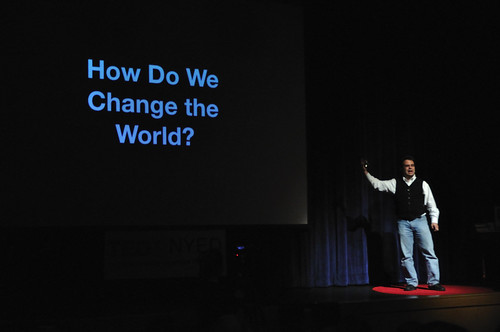
Chris Lehman at TEDxNYED explaining that changing education necessarily means changing the world. Photo credit WayneKLin.
Perhaps most importantly, the subtext of the conference was that the issues teachers and educators are facing aren’t just confined to the “educational system” – as if it’s some discrete thing disconnected from the society and culture at large – and indeed, as George Siemens said, considering that society dumps every ill and issue at the doorstep of education to solve, it’s amazing the system functions as well as it does. But take out the word “education” from these TEDxNYED Talks, and they are talking about what society at large needs to do to adapt to our changing circumstances. (The videos aren’t up yet, but they’ll be available on YouTube soon.)
At least for the purposes of this post, I think the first important piece of advice came from Michael Wesch. Which is simply this:
When a game changing technology enters a society or culture, you don’t have the option to opt-out. It changes everything.
All those Ludic Luddites, who fear the technology, avoid the technology, feel that the current systems of getting things done would work just fine if only they could better regulate, standardize, and enforce them, are just plain wrong. The world has shifted and there’s no turning back now.
What does this have to do with gaming?
Slide from Dan Meyers' talk at TEDxNYED - quests anyone? Photo credit kjarrett.
Well, I’m getting round to that.
As I watched these presentations and suggestions from teachers about ways to improve (society) education, I couldn’t help but see game elements – and the ludic life – infused throughout their talks.
When Dan Meyer talked about changing math curriculum to stop asking kids to give the answers, but instead help them figure out what the important questions are, itlooked like creating good game quests to me.
When Lessig and Jenkins talked about mashup culture and how destructive it is to limit the creativity unleashed when you put tools in the hands of individuals, it reminded me an awful lot of how content gets created in virtual worlds like Second Life and OpenSim.
George Siemens at TEDxNYED. Image credit WayneKLin.
The solutions we need to address societies biggest problems – (global) warming, population growth, poverty – will be found through serendipity, through chaotic connections, through unexpected connections. Complex networks with mesh-like cross-disciplinary interactions provide the needed cognitive capacity to address these problems.
Sounds like the serendipitous, chaotic, and unexpected connections you form in WoW, or EVE, or any other game world, and “mesh-like cross-disciplinary interactions” is just fancy talk for good class balance. Can’t have too many tanks and not enough healers or the whole thing comes crashing down.
Ok. And one more, also from George:
The big battles of history around democracy, individual rights, fairness, and equality are now being fought in the digital world. Technology is philosophy. Technology is ideology. The choices programmers make in software, or legislators make in copyright, give boundaries to permissible connection.
This is, of course, the perennial battle between the game players and the game gods. Except wait, what? The whole story of the birth of the US is all about us being our own game gods. Hm.
In any case, the point here is, I think the Ludic Life is starting to tip.
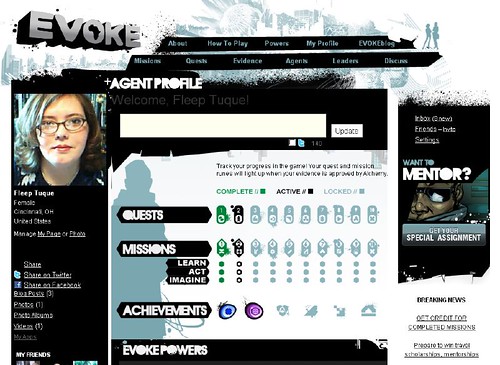
We haven’t hit it just quite yet, but the elements of game play that Barry talked about in 2008 are starting to show up in the oddest of places. The World Bank is funding an Alternative/Augmented Reality Game called EVOKE that has thousands of people, from school kids to adults, and from all over the world, playing a “game” that promises to teach us how to address major global issues and respond to global crisis. Oh, and you might win scholarships, grants, or seed funding from the World Bank if you have a good idea. Put that on your resume!
While Facebook and other social networks like Twitter have been the talk of the town, a recent NPR story cited research showing that more people play Farmville than use Twitter. And it isn’t your kid playing, it’s your mom. The average Farmville player is a 43 year old woman, and there are 80 million people playing. 80 MILLION.
So, what’s bad about that? Isn’t this a GOOD thing?
Well, yes and no.
Many thanks to my good friend and neighbor in Chilbo, Roland Legrand (SL: Olando7 Decosta), for the post on his Mixed Realities blog that brought the video below to my attention.  Check this out:
What happens when game devs (working for corporations?) become our primary social engineers instead of the nominally elected politicians?
Naturally, I’m interested in the ways that game mechanics, game culture, game concepts, and game design filter out and influence RL. And though I work in higher education, my undergrad degree is in Political Science and my not-so-secret passion is sort of the nexus where the emerging metaverse and game culture is changing “real life” society and culture, which of course includes education but goes beyond edu, too.
I know I’m not the first guild master to think that herding this bunch of cats is way more complicated than many RL jobs, or to realize the skills I learned adventuring with my guildies often had applicability to real life situations. I’d like to think I learned something about teamwork, diplomacy, compromise, and all sorts of organizational, strategic, tactical, and political skills through my journeys in worlds that only exist in bits and bytes.
Generally speaking, my career, my work, this blog, everything I’ve been doing for the last 10 years is about bringing this technology to people who don’t have it/know about it/use it yet.
But watching that video gives me the willies.
First, because I don’t think it is as far off in time as some think it might be. Second, because I don’t think it’s that far fetched in terms of what could actually come to pass. And third, because I’ve been a lowly peon player in the game god universes/metaverses for a really really long time. On an old BBS I’m still using, I’m one of the “moderators”. And you know what we say? This ain’t a democracy. Don’t like our rules, don’t play.
Furthermore, my post the other day about Stickybits demonstrates just how quickly the barriers to privacy are falling. I posted that barcode just to figure out how the service worked, and before I knew it, I was collecting the home addresses of my blog readers without even realizing what I’d done.
Want me to know your home address? Go ahead, download the app to your smartphone and scan that barcode. I’ll get an email within a minute or so letting me know you scanned it, and where you were on the planet when you did, right down to the address and a lovely Google Map pinpointing your exact geo-location.
And I guess I should award you 5 points if you scan it. Redeemable for.. I don’t know what yet. An hour long private tour of Second Life, I guess.
And now I’ve broken the #1 rule of the 140 character metaverse, which is to make a really really long post and get to the end and not have any answers.
I don’t know exactly what train we’re on here, but the train seems to be moving ever faster and faster. And I worry more and more about who’s driving the train, and I have a sort of sick feeling that about half of the passengers have no clue that they are even on THIS train – I think they think they’re on a different train entirely, and that they’re driving it. But they aren’t.
I dunno.
As much as I love gaming, and I do love it, I’m not so sure I want Crest giving me points for brushing my teeth. I think I’ll have to come back to this.
Thanks for reading if you made it this far, and if you have any thoughts, I’m all ears.
Robert Scoble, the guy with one of the loudest voices on the internet, just posted about Second Life and an upcoming announcement that he suggests might breathe some life back into the platform.
Considering I’ve been working there pretty much full time the last few years, I didn’t know it was dead. 😉
OK that’s not fair, the hype cycle of 2007-08 came and went and it’s had a palpable effect to be sure, but those kinds of posts always make me vaguely defensive even though I have my own criticisms of the platform and the company running it.
I started to write a response in his comments, but I lost my text twice (I think it’s Chrome’s fault) so finally I said heck with it, I’ll put it here instead:
Whatever the failings of the platform or LL’s specific implementation of it, they were hugely successful at introducing the concept of a non-game-based virtual world to millions of people, and most importantly IMO, a world created by the users rather than the company. User generated content and crowd-sourcing is practically passe now, but back in the day, those were still very untried, untested concepts. The idea that an immersive 3D space could be populated with content using the same community/random user model as Wikipedia was definitely not a given. That it succeeded at all in Second Life still seems miraculous to me, especially given the technical skill required and the dreadful interface.
As it stands now, Linden Lab’s biggest advantages are 1) that enough of us who saw the potential in those early years have managed to stick it out and continued to populate the world with experiments, interesting use cases, and compelling content, and 2) they got a very lucky reprieve, just when things started to not just plateau but decrease, the economic crisis dried up a lot of funding for potential competitors. Anyone professionally interested in the future of the metaverse has little choice at the moment BUT Second Life (or its cousin OpenSim).
Hopefully it will give them enough time to fix what’s broken, especially with the interface and new user experience, but just as importantly with the scalability issues and lack of APIs that have hindered integration with other platforms and enterprise data systems – it’s the latter holding back increased institutional adoption more than the former.
Either way, whether Second Life as a platform (or Linden Lab as a company) endures through the ages is less interesting to me than seeing where the concept of the metaverse goes from here. I still think robust competition from some wholly different conception of a virtual world will be the best medicine for Linden Lab, but I worry that they’ve got such a corner on the still relatively small market that currently exists that it’s actually stifling innovation in other directions. It wouldn’t be so troubling if I saw more evidence that they could continue to innovate, but the Second Life we use today is not _markedly_ different than the Second Life I logged into in 2003.
Perhaps whatever they’re going to announce will prove that statement wrong, but if my long experience in Second Life has taught me anything, it’s not to get my hopes up too high.
Having said all that, I still give them all due credit for what they’ve accomplished, and for what they’ve made possible for people who have had the patience and foresight to understand that this is still very, very early days for the metaverse indeed.
Scoble promises an announcement tomorrow at Building43, I plan to tune in and see what’s got him so excited.
This is one of those self-indulgent, reflecting on my own blogging posts, so if you hate that sort of thing, stop reading now.
Wherein the Optimist Wins the Internal (Eternal?) Debate:Â To Blog or Not To Blog
A friend and I recently got into a heated debate about blogging. The context isn’t important so much, but it made me reflect a bit about my own blogging.  (Though I do wonder if I am alone in thinking that sites like Slashdot and the DrudgeReport – no matter how they may have started – are not “blogs”. They are or have become news sites, and news sites are not the same thing as blogs, in my mind.)
What is a blog anyway?
First, I had to separate out what _I_ do that I consider to be blogging. Is Twitter a blog? People say it’s a “micro-blog” but it rarely feels that way to me. It feels more like a group IM conversation with an archive instead of a reflective piece of writing. I think my core definition of blog includes that – a reflective piece of writing is a main feature of the vast majority of blogs. It may reference other sites, it may incorporate different kinds of media, but the essence of the “web log” is a person logging their thoughts, experiences, results, art, images, whatever documentation that can be submitted to the “web log” system, so that others can learn and share from our experiences, so we can learn from the experiences of others, and so we can contribute some part of ourselves to .. well, the world – the world wide web log system, the internet, the metaverse – whatever you want to call it.
This is my blog. This is where, when I can, from time to time, I try to share something of interest to the world. Whoever’s listening, whoever’s reading, whoever shares a passion for the same things I do – here’s the stuff I’m working on. I’m trying to “web log” my work, parts of my life, parts of my family, parts of me. I don’t get as much time to do it as I wish I could, I’m not nearly as skilled at all the different forms of media as I wish I were, and I often self-consciously worry terribly about what people will _think_ of what I say or what I do – but I want to try to share my stuff with people who might care, and I want to have a web log for myself, so I can go back and reflect on what I’ve said, reflect on how my views have changed, or remember why it was that I chose some path that didn’t work out at all like I intended.
A “blog” to me is personal. This blog is personal.
And in this age of .. such rapid change, with all notions of privacy being challenged, of a time in my life when I wear so many hats I couldn’t print a business card that would fit, when my work (which I personally define as attempting to study and help provide answers to the questions: What’s happening on the internet and particularly in that part of the internet they call “virtual worlds”? What implications does it have for education and for society as a whole? What or which of these tools are most effective for teaching, learning, sharing ideas, and instigating positive change?) is studying a rapidly, constantly dynamic phenomenon that I can only study by doing and being involved in to understand the technology well enough to study it.. What part of my life or my work is personal?
Isn’t ALL of it personal?
Is that a stupid question?
Why teachers, professors, and educators should blog
I try in my workshops to talk about how a technology can be used, for teaching, for personal discovery and learning, for organizing distributed workforces or volunteers, for communicating with constituents – but essentially, I don’t know if any of it makes sense until you’ve done it yourself – for yourself. It’s hard to understand the real power of a “web log” until you’ve done it and seen how much it improves your own learning.
For every instructor or faculty member who has asked the question – why would _I_ want to blog? That would be my answer.  We talk about experiential learning, and reflective writing, and all the appropriate buzzwords, but in terms of a tool that really truly enhances and promotes experiential, self-reflective learning, I almost can’t think of a better tool than a blog. Telling a story, to yourself or someone else, and creating or finding the media, creating the narrative, and sending it .. out there, into the big world of all the people in the world having a conversation or sharing in the big web log system, is, frankly, a thrilling experience. Or it can be, it should be. The ability to create something, share something, document some part of your experience, communicate with others who share your passions, create an archive for yourself to learn from too – it’s journaling in the 21st century. All of the great forebears of science, philosophy, and human knowledge recorded their experiences, publishing research is the heart of academia, and the web simply provides a better way to do it.
The “blog” – no matter how far they stretch the term in the media – is a reflective piece of writing that exists for its own sake or ties together all of the elements of an “entry” that is thrust into the global web log system of human knowledge. When you put it out there, you’re talking to everyone, anyone. You’re talking to the person who is reading it now, and the person who will read it tomorrow, and all the people who will read it in the future to come.
What do you have to share with the world of now and the world of tomorrow? What do your students have to share?
Education, at its core, is about training people to think rigorously. It is about teaching people how to distinguish between signal and noise, correlate data, understand cause and effect, think broadly about the implications of our choices, and contribute something meaningful to society as a result of this training.
Speaking with your Digital Voice
To me, this is the beauty of blogging, of twittering, of connecting.. Watching the “web log” and learning from it, seeing my experiences echoed in it, recognizing and appreciating the art in it, applying what I take from it (to my own life and to my work), these things make blogging and participating in the conversation worth the investment of time. The reward, the return, is enormous. The power of finding the information I need or want when I need or want it, of finding the people I need or want when I need or want to talk to them, running across information I didn’t even know I needed – this stuff has changed how I work, how effective I can be, how many people I can reach, teach, learn from – it allows me to be my own teacher, my own guide, and still find the wisdom and the guidance from others whenever I am receptive and ready to learn from them.
Podcasting, videos, virtual worlds, blogging, twitter, social networks, social media, wikis, YouTube, they’re all elements of the same thing – using your digital voice to speak. It is simply another mode of human communication, one with many implications for changing society in the future, and every student, and every teacher, should learn to speak with their digital voice. When you do, the results of what you share are better indexed, searched, and located, which allows others to find you and you to find each other so that between you – between us – we can do a better job of.. whatever it is we want to do (or need to do).
Using our Digital Voice to Solve Real (Big) Problems
The people of the world seem to agree – global warming is real. The people of the world seem to agree – solving the energy crisis is one of the great challenges of our time. The people of the world seem to agree – giving every child an opportunity to live, grow, and learn in safety is a priority. The people of the world seem to agree – actually on quite a number of things. And what we disagree about, what we argue and debate about, the choices we make in our real lives as a result of our experience or nature or knowledge – the web log system is one way we are working it out and looking for answers, looking for solutions, or maybe just the right questions.
Everyone I know these days is saying and thinking, “There has to be a better way of doing things. The world seems like a mess.”  We, as a people, have unprecedented power to reach each other, learn from each other, and work together using our digital voices. Why aren’t we using it to solve the big problems ourselves? Why does it seem everyone is waiting for Them to come up with the answers? Institutions, governments, NGOs, charities, your boss, the board, the People In Charge.
I’ll ask again – why aren’t we solving the big problems ourselves?
I think I’ve come to the conclusion that not enough people with not enough of the right skills know how. I don’t know how, myself, I’m trying to learn. I’m trying to understand how my own actions help or diminish my own cause(s), I’m trying to understand how best to leverage my time and my resources to help solve common problems – or is that ridiculously naive?
A Bad Addiction or Addicted to Empowerment?
Maybe I’m just addicted to the fire-hose, watching the next generation’s version of the boob tube on endless repeat except there’s no repeat – just a steady stream of fresh data, fresh experiences, fresh laughter, fresh music, fresh conversation, fresh opportunities, fresh challenges.. all of the stimulation, freedom, creativity, joy, efficacy, acceptance, and .. empowerment.. that I feel quite denied in the “real world”.
I can’t afford to drive all over and pay for concerts. I don’t have the right credentials to help plan cities or communities or spaces in the real world. I don’t have the right wardrobe to attend certain kinds of functions. I don’t have the capacity to hop-skip around the world to meet a colleague for coffee and chat when I have time. But I can do all of these things online. I can practice at any number of things that relate to people, to creating, to planning, to experimenting.. with virtual things instead of physical things. Virtual resources are, electricity permitting, infinite. Time is not. Talent is not. But if I need to get people together to help me solve a problem, or create a community, if we collectively are going to solve the really big challenges of our time, I’m more convinced than ever that we’ll need our digital voices to do it.
That’s my optimistic answer for why you should blog, why I should blog, why my mom should blog, why teachers should blog. I dunno if that’s right though. The pessimist wins some days.
Screaming 3D Bootstrapper Csven Concord had been pinging me for weeks about the Superstruct game organized by the Institute for the Future. I finally got a few hours to take a look at it and was stopped cold at the very first mission of the game: describe yourself in the year 2019. Not a fantasy you, but you you, where you think you might actually be. It took me three days just to accomplish mission #1 to make my profile.
My efforts to get into the Superstruct mindset were somewhat hampered by the technology being used. Not sure if it’s just my PC or that I’m using the FF3 browser, but I continually have to relog into the site over and over just to navigate around (is it not tracking cookies properly or what?) and the framing they use makes it hard to grab direct links to specific content. With some trial and error, I finally got to Cven’s Screaming 3D Bootstrappers Superstruct page, and managed to add myself to the S3DBers wiki page, and saw a call for help under the heading “Young Farmer’s Outreach”:
Request: “we need 3d VR environments that mimic the reality of a farm/ranch so that our young farmers can share their skills”
So the idea is that it is the year 2019, and five major superthreats are having devastating effects on human populations. To play the game, you create or join Superstructs (groups) to address one or any of these threats by using your unique talents, resources, and perspective to generate ideas, stories, videos, websites, pictures, or anything else that helps us imagine how life would really be in that situation and what solutions might really work to address the problems we face in this fictional reality of 2019.
In my imaginary 2019, the Chilbo Community has grown tremendously into a large, global community in the metaverse. To deal with the Ravenous superthreat – where major disruptions in the global food supply chain threatens the world with starvation and lack of healthy, nutritious food – the Chilbo Community has established a virtual garden to allow farmers and scientists from anywhere in the world to help people learn to grow their own gardens. In this fictional world of 2019, Respiratory Distress Syndrome (ReDS) has also forced many cities and populations into Quarantine, so the Chilbo Community Garden might be especially useful for those stuck in quarantine zones where access to food supplies may be dwindling. By using virtual world technologies to connect people who cannot visit one another in real life, we can spread information about sustainable farming to a larger audience, use the 3D modeling capabilities of virtual worlds to create roleplay scenarios, display equipment and demonstrate techniques, and reach populations who are isolated because of possible contagion.
To flesh out this idea, I worked with some Chilbo residents to actually build out this garden in the Chilbo Nature Preserve in Second Life, and recorded a machinima clip to “report” on our progress in the year 2019. This is only the second machinima I’ve ever made, so pardon the amateur execution.
When I think about the future of education, I wonder why we don’t spend more time doing THIS kind of work. I wonder if we’re teaching students the skills they need to really evaluate information on the web in context. For example, in the process of “playing” this game, I came across the ReDSNet Project website. Now, this website is so well done, so realistic, it would be easy to think ReDSNet was real. How many students would have the skills to read for content AND context and eventually discover that this is a fictional website? How many students would have the creativity or skillset to create a fictional website that was so convincing? How can we use these types of .. roleplay scenarios to build digital literacy skills that really WILL be useful in the year 2019?
I wish I’d had more time to spend on the Superstruct game/concept. It was really a fascinating, thought provoking exercise. And even if the machinima still doesn’t make any sense to anyone but me, I enjoyed the experience, I spent some time seriously thinking about my own future and where I _want_ to be in 11 years, I got an excuse to practice my machinima skills, and I strengthened some bonds in my network, personal and professional. Quite an accomplishment for some crazy collaborative game on the intarnets that I only had a few hours to play.
I’ve been a bit deluged this week with last minute preparations as the start of the new school year approaches, but I wanted to take a moment to post about the September/October 2008 issue of EDUCAUSE Review.
If you have any interest whatsoever in virtual world technology and how it is being used for education, I highly recommend taking a look at this issue. I felt so honored to have been asked to contribute an article (Looking to the Future: Higher Education in the Metaverse), but feel even more so now that I’ve had a chance to read all of the contributions by my colleagues. They write about theoretical and practical questions we all should be asking, describe a wide variety of use-cases across many disciplines, and give us thought provoking glimpses of what the future may hold, as both teachers and students, individuals and institutions. It’s good stuff!
It’s really great to see the work of so many friends and colleagues highlighted – especially when I know how much effort, thought, and preparation has gone into their projects – and I hope it will inspire other educators to take the plunge into this fascinating and complex space.
Many thanks to all who lent their support and advice when I was wrestling with my contribution!
This panel will feature a discussion about the current state of virtual worlds and how they may evolve in the future. What do we hope to see? What would be a “bad” outcome?
Moderator: Fleep Tuque
Panelists: Malburns Writer, Tara Yeats, Olando7 DeCosta
Second Life Community-Building: What We’ve Learned – Island Experience
Saturday, 8/23, 11:00 AM SLT
Location: Shrubbery Amphitheatre
SLurl: http://slurl.com/secondlife/Chilbo/167/129/109
This panel is one of a pair of panels that will take a look at lessons learned that can make – or break – communities in Second Life. What’s the “glue” that holds virtual world communities together? What helps people engage? What are the challenges? What Second Life tools and features help – or hinder the process? Saturday’s panel will focus on island communities; Sunday’s panel will focus on mainland communities.
Moderator: Tara Yeats
Panelists: Sophrosyne Stenvaag, Director, Extropia Core; Fleet Goldenberg, Community Manager, EduIsland II, 5 & 6
Second Life Community-Building: What We’ve Learned – Mainland Experience
Sunday, 8/24, 12 NOON SLT
Location: Shrubbery Amphitheatre
SLurl: http://slurl.com/secondlife/Chilbo/167/129/109
This panel is one of a pair of panels that will take a look at lessons learned that can make – or break – communities in Second Life. What’s the “glue” that holds virtual world communities together? What helps people engage? What are the challenges? What Second Life tools and features help – or hinder the process? Saturday’s panel will focus on island communities; Sunday’s panel will focus on mainland communities.
Moderator: Tara Yeats
Panelists: Prokofy Neva, Owner, Ravenglass; Fleep Tuque, Land Steward, Chilbo Community Building Project






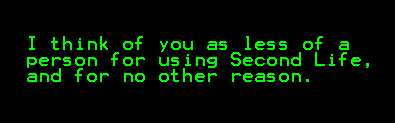 “I think of you as less of a person for using Second Life, and for no other reason.”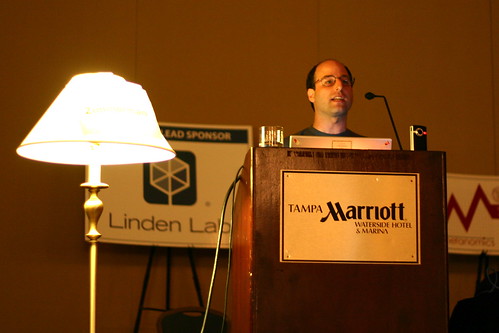









![Reblog this post [with Zemanta]](http://img.zemanta.com/reblog_c.png?x-id=f831edc0-881a-44cb-b491-b43107ea47bf)
![Reblog this post [with Zemanta]](http://img.zemanta.com/reblog_c.png?x-id=95bddbe6-dd0d-43fa-8a64-c14576474127)