@corcosman @chilbo Been trying to login, something wrong with my viewer? TH Draft agenda on the wiki if someone can send a reminder notice. 7 hours ago
@courosa I posted about stickybits earlier today, cute concept but the privacy implications are a little disturbing. 8 hours ago
RT @jokay: RT @SecondLie: Ask M how many of the original Lindens it takes to screw in a light bulb? M shouts "There's still some left? T ... 8 hours ago
George and Stephen are offering the course again this year, and just like last year, it is completely free and open access to any and all who want to participate. Here’s a brief course description blurb:
Connectivism and Connective Knowledge is a twelve week course that will explore the concepts of connectivism and connective knowledge and explore their application as a framework for theories of teaching and learning. It will outline a connectivist understanding of educational systems of the future. The course will begin on September 14, 2009.
I highly recommend the experience to anyone involved in education in any capacity. George and Stephen utilize the web, RSS, blogs, wikis, podcasts, tagging, and crowd sourced teaching and learning in a way I’ve never experienced in any other course I’ve ever taken, and the experience last year had a tremendous impact on my understanding of what a “course” is, is not, and what it CAN be in the future. Sign up here to receive course information in preparation for this year’s course!
Connectivism Cohort in Second Life
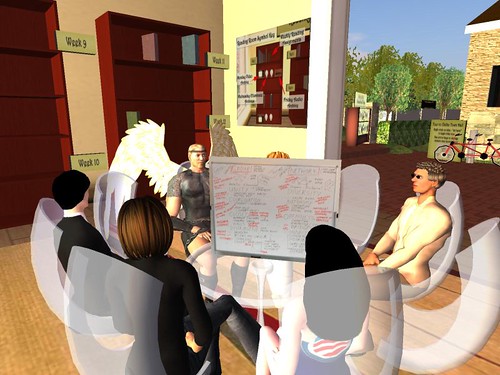
Last year I facilitated the Connectivism Cohort in Second Life, an experience that also taught me quite a lot about using virtual worlds as a site for meeting, discussing, sharing, and building in the context of a MOOC like Connectivism & Connective Knowledge. You can read more about my conclusions and experience as a facilitator (in addition to some stats about participation) in this post from last year CCK08 – Off the Wagon, But Not Off My Mind.
While I won’t have the time to be a main facilitator for a Second Life Cohort of the class this year, if someone is interested in taking this on, the Chilbo Community in Second Life can host the cohort’s meetings and work in the re-purposed Education Village. The Connectivism Reading Room is still available for holding discussions, and the sandbox and houses/offices can be used again this year for anyone who wants to participate.
Interested in facilitating or using Second Life as part of the CCK09 class? Let me know at fleep.tuque@gmail.com and I’ll do my best to help!
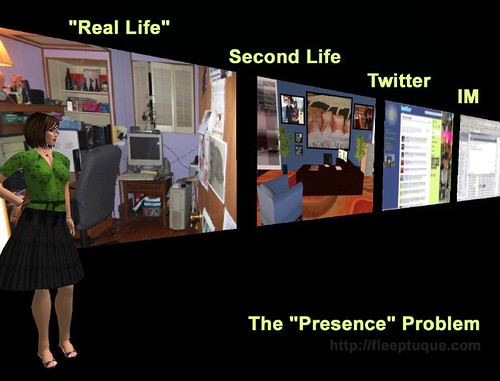
Concepts like “place” and “presence” can get really mushed up when you’re working in the metaverse. I’ve been puzzling about these concepts so intently over the last couple of weeks that I was actually motivated to do some (*gasp*) scripting to see if I could mediate that “sense of presence” in Second Life. Let me explain.
Right now I am sitting at my desk in my office at home physically, and at least nominally I’m also sitting at my desk in the Chilbo Town Hall virtually (which is where I park my avatar to let people know I’m probably off in another window instead of paying attention at that moment), AND I’m also “on” Twitter and IM. So, if you wanted to get in touch with me for a synchronous conversation or “visit” with me, you could come to my house in Cincinnati and ring the doorbell, but a) that would probably freak me out unless you’re a really good friend and b) being an internet peep, you’re more likely to send me an @fleep or DM on Twitter, or if we’re good friends you’ll poke me on Gtalk or AIM or send me an SMS on my cell, or if you’re a Second Life resident, you’ll log in and look for me in the Town Hall.
So many places I’m in at once, and that’s just trying to keep things simple – we’re not even including all the asynchronous options. But if you asked me “Where are you right now?” the answer I’m likely to give depends on context – if you called me on the telephone or sent me an SMS I’d say I was at home, but if you IMd me the same question in Second Life, I’d say I was in Chilbo, and if you asked me on Gtalk or AIM or Twitter, I don’t even know which way I’d answer. BUT, the truth is, I’m am in all those places and locations and “mental spaces” simultaneously – and yet it’s not REALLY simultaneous because my attention can only be focused on one “space” at a time.. Or is that really true?
And forget about me for a moment, “where” are all my friends right now? What are they up to and if I have a question or want to visit with them, “where” do I go to find them? With so many options and each relationship/friend connected to me in different ways through different media (some are on Twitter, some aren’t; some are in Second Life, some aren’t, etc.) it gets to be quite complicated not only figuring out where _I_ “am” but also where my friends “are” too.
This is probably a round-about way of approaching this issue, but that’s how the question/problem presented itself to me a few weeks ago when I was crunching numbers from the Chilbo Community census data and saw many comments that Chilbo often felt “empty” and that the residents of Chilbo didn’t know as many other residents as they’d like. I was a bit surprised by that finding, since the traffic reports show Chilbo gets pretty steady traffic, between 700-900 visitors per week, and because I am connected to so many Chilbo folks on so many different platforms, Chilbo rarely feels “empty” to me because even if a Chilbo resident’s avatar isn’t in the sim at that particular moment – I still “hear” what they are up to on Twitter and can still contact them any time through Second Life IM or Gtalk or wherever. I have a sense of where people are from all these other tools and that tenuous connection is enough to convey their “presence” to me that it doesn’t matter that they are not physically in the room with me or virtually in the sim with me. But are others having that experience?
If you’re not on Twitter or other web places, does Chilbo seem even more “empty” or disconnected than if you are? And could that be mediated with some way to “blend” these spaces?
That was my question. And so I embarked on trying to modify Ordinal Malaprop’s fantastic TwitterBox script to see if I could attempt to blend two different “spaces” together – the virtual location of the Chilbo sim and the .. “mental space” of Twitter (and if you use Twitter and SMS on cell phones, you know Twitter can be used on the go just about anywhere you are physically).
Now I should note, despite taking a programming class (I got a B+ and was thrilled), I remain stubbornly obtuse when it comes to understanding all of the logic involved in scripting. The lines of code, the variables, the repetition, the test-fail-test-fail all to no avail.. I find it incredibly frustrating. And, it turns out that in my ignorance, I attempted to modify the wrong script – instead of working on the basic one Ordinal gave me, I began with the more complicated one, so this probably took me many many many hours longer than it should have, and I was determined to try to figure it out myself and not bug one of my coder friends to help me, so it was an even longer time before I realized I’d taken the hard path. Doh. However, I am very pleased to report that THIS “Fleep Tries to Program” story has a happy ending! I eventually had to ask for help, but I learned much more about the Linden Scripting Language than I probably have in ages, and I have a working prototype going in-world, so I think all the torture and 3AM nights was worth it.
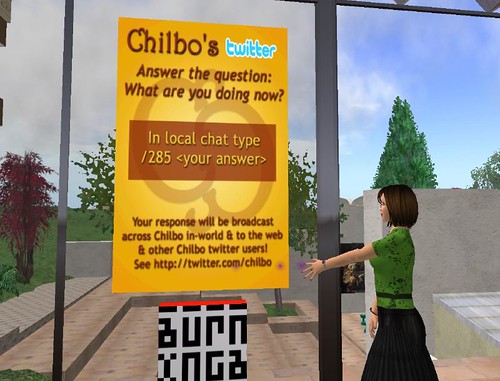
So what does this thing do? Considering all the effort it took, it sadly does not do your dishes or laundry. What it does do is a) imports tweets from the Chilbo Twitter account and all the people that account “follows” and reports them back out into the Chilbo sim in Second Life by printing the line in local chat and b) allows anyone in the Chilbo sim and within local chat range to send a tweet OUT of Second Life to the web world (through the Chilbo account).
So, if you’re walking down the street in Chilbo and happen to be near a Twitter station, you might hear a little birdie tweeting sound and see text appear on your screen that says “fleep: I’m waiting in line at the grocery store” and a few steps further down the road one that says “malburns: I’m visiting this cool sim in Second Life” or whatever our tweets might say. If you know Fleep and you know Malburns, even if they are not there in Chilbo with you, might you feel that Chilbo is less empty if you have some sense of what Chilbo people are up to at any given moment? Does it change your sense of presence if in some ways Second Life and Twitter are blended together so that your attention does not have to be focused on one OR the other, but can engage with people in both spaces at the same time?
Will it change the sense of “community” and “connectedness” the residents of Chilbo feel with each other if they can send and see communications to and from Second Life even without being logged into Second Life, or for that matter, even if they don’t have personal Twitter accounts?
I don’t know, but that’s what I’ve been working on lately. I guess we’ll see how it works out. I’m still tinkering with the script, but if you’d like a copy in progress just let me know..
Between the crazy workload for Fall Quarter, being out of town for conferences, and a bout with the Martian Death Flu, I confess to having fallen completely off the CCK08 and CCK08SL bandwagon. I didn’t just fall off, I think it ran me over on its way out of town. =)
Today is the first day in I can’t recall how long that I’ve had a moment to just sit down and think about CCK08 – and how woefully sad I am that I’ve ended up missing most of it. The first few weeks were a little overwhelming, but also very exciting, and the conversations we had at the synchronous meetings in Second Life were some of the best.. deep thinking I think I’ve ever truly done about “education” as a knowledge domain – what does it mean to “learn” something? What ways do we “learn”? How do we know when something is “known”? How do we “learn” best? Through the materials and readings in the course, the discussions and videos and podcasts, and the dialogue with colleagues and facilitators, I really enjoyed the experience.
Then life got in the way and the CCK08 bandwagon rolled on without me.
But it didn’t leave before leaving me with lots of interesting concepts, thoughts, conversations, and resources to think about and revisit. In spare moments making the rounds to check for litter in the Connectivism Village in Chilbo, I’ve stopped into the reading room and clicked the little TV screens or radios to listen to a recording of a session I didn’t get to attend. Or when triaging my ever-overflowing email, I take a second to scan The Daily newsletter to get a sense of what the wagon is talking about now.
And thinking about it, I really.. appreciate and admire the work and effort that has gone into this experiment. Even when my life is so truly busy that I don’t know which end is up, I am still “connected”. The technology implemented purposefully, in addition to the technology used and resources created ad hoc by the various participants, really enables you to “hook in” to this network in a multitude of different ways so that even when you aren’t paying attention – the currency of the web – you still are connected to these people, media, places, conversations, and readings. You have access to subject matter experts, a cohort to discuss and work with, and wide-ranging library of resources created by not just the instructors, but the participants themselves. You have peer review and feedback built into the system – every single time I contributed to CCK08 in any way, I _always_ got a response from another person – someone friending me back, or following me on Twitter, or leaving a comment on my blog, or responding to an email or question. I certainly did a lot of _CONNECTING_ when taking this class.
But I’ve been thinking it’s a real shame that I had such a hard time managing all of my other responsibilities and couldn’t fully participate, because it seems like under normal circumstances, this would be an almost perfect learning environment for me. When I did have the time, I wasn’t just “engaged” in that clinical sense (the “engagement” buzzword is starting to wear on me), I was really _into it_. It felt like learning, but it was _fun_. It was interesting, and thought provoking, and though I don’t know how much I “learned” if I had to take some standardized test about the course material, I can tell you I learned a heck of a lot.
And in realizing that 1) I’m still connected to the people I formed bonds with in the beginning of the course (I’m imagining the lines between the boxes on my social network graph, and realizing that it wouldn’t work to model those lines with, say, thickness as an indicator of the strength of the bond, because in reality, the bond is mutable – at times I have weaker ties with nodes in my network, and when they become relevant, or needed, or reach out to me in some say, those ties become stronger – so the “lines” should be modeled more like energy flowing, with ebbs and tides), 2) I still have access to all of the archives, media, and readings from the course, and 3) I actually learned a tremendous amount of skills, information, concepts, technical tools, and other people in an extremely short period of time…
I’ve come to the conclusion that I’m not so ashamed to have fallen off the wagon, after all, because the metaphor of the wagon is all wrong.
It’s really puzzling to take a course about the course, that is to say, learning about connectivism and connective knowledge by putting into practice the theory of connectivism and connective knowledge. I can’t separate out in my mind which of my .. reactions, for want of a better word, are related to the course material – the theory – and which are related to the experience of taking the course – the implementation. I think for the moment I’ve given up worrying about it. In the end, I realized that I’d been thinking of this “course” as a “course”. And when I could no longer participate in the “class”, then it felt as if I’d dropped out, and the group traveled on without me. But I think what this class taught me most of all, is that my concept of what makes a “course” completely clouded my thinking about the experience. I don’t think I failed the course, nor do I think the course failed me. This was a voluntary effort, and when I had the spare brain cycles to attend to it, I learned one heckuva lot.
So now, all these weeks later, I’m finally getting around to writing my first paper about/for the course, even if the synchronous component of it is nearly over. And I hope that all the plethora of resources that people created will remain for as long as they can, so if others fell off the wagon, or want to refer back to them as they continue on with their learning, they will be available to everyone who comes after. I thank @arieliondotcom for bringing this to my attention.
I did fail, however, in fulfilling my role as a _facilitator_ of the Second Life cohort, and I DO feel guilty about that. I apologize to all those who showed an interest in exploring how learning about Connectivism might be enhanced by using a virtual world. I did my best to provide the space, the tools, the initiative, the original organizing force to help make it happen, but I didn’t have the time to really _facilitate_ its use. I’m not sure what – other than time and personal attention – I could have done to improve making the tools available to whoever wanted to participate. If anyone has suggestions, I’m all ears. Here is what I did try:
- I created a web form so that anyone with an interest in exploring the SL cohort could sign up
- I created a CCK08SL Googlegroup and added everyone who signed up on the webform, so we could communicate asynchronously via email with each other
- I created a space in Second Life, with informational rooms linking back out to web resources (to provide a visual component to digital resources), offered anyone new to Second Life a personal home/office space, offered kiosk space for experienced SL participants to share their other work/projects in SL with members of the cohort, and left as large a blank canvass sandbox space for people to play with building/creation as much room as Chilbo could afford to provide (land costs money there too!). I tried to add some “fun” or “interactive” elements like an automated bike tour and visually pleasing spaces to make the SL component as attractive and functional as I could.
Here are some stats on the results, as of November 20, 2008:
- 133 people initially signed up for the Second Life cohort on the web form.
- 94 of those people responded to the very first email inviting them to join the SL Cohort Googlegroup (email list)
- 46 people responded to an email and expressed a time preference for synchronous meetings on Doodle
- There were 72 messages posted to the email list (only members could post, 69 web views of the discussion (anyone/public could view)
- 16 people responded to the invitation to create an account on the wiki to edit it, and 4 people took the time to make any edits (highest rate of participation was those who responded in email or added their blog to the wiki:
I’ve subscribed to them and thank those who made the effort to share.)
- It generated 88 emails, IMs, tweets, or messages from Second Life that I would classify as “support requests” – these were not on one of the lists, they were personal messages to me asking for assistance. (I think I answered all of them, though sometimes not as quickly as I would have liked.)
- In Second Life, a total of 808 unique avatars visited the Connectivism Village. These 808 visitors spent a total 14,652 minutes there. (244 hours total, a half an hour per person averaged across all 808 unique visitors, but my intuitive sense from getting a daily traffic report is that about 30 people spent the vast majority of time there, coming back repeatedly week over week. I have the data if anyone is crazy to do more analysis, but it’s in plain text form, a separate text file for each date.)
- The highest number of visitors together at the Connectivism village at the same time, throughout the whole period, was a max of 14 simultaneous avatars.
- 7 people in the “experienced SL’er” category created a kiosk to share info about their other SL projects.
- 5 people in the “new to SL” category took advantage of the free home/office and personalized their space.
- 8 people contributed some kind of object, build, or project in the cohort sandbox.
So. Coming out on the other side of my part in this experience, here are some things I think I’ve learned:
- Facilitating a MOOC or even just a small part of one took an enormous investment of time. Ultimately, I couldn’t sustain it at this particular time in my life (crazy busy time at work, very ill family member requiring lots of care, up to my eyeballs in other volunteer projects/efforts). If I had more _time_, however, the mechanisms I used to communicate, get information, and share information, seemed to work pretty darn well for me on my side of the facilitation equation. The googledoc sign up form worked perfectly, the googlegroup invitations were kind of a pain, but once it got going, it worked with no additional tinkering. It is definitely possible to organize larger-scale coordination using free or nearly free web-based tools with a moderate level of tech savvy-ness. It wasn’t the technology implementation that required so much time, but rather the _social_ investment required. I could have increased or sustained more participation, I think, if I had spent more time poking, prodding, emailing, twittering, meeting, asking for help, teaching.
- Wikis, in this experience, and with other projects I work on, continue to be one of the hardest tools to get people to use. I don’t know why this is, but people who otherwise sign up, contribute, join.. they really fall off the wiki wagon quickly. Maybe it’s because I don’t know how to facilitate wiki participation, but I must be missing a really big clue bus on this one, cause I’ve tried everything, and participation on wikis (vs blogs, email lists, even SL itself!) is always lowest.
- Virtual worlds platforms offer two really key affordances to education - 1) the sense of co-presence that enriches synchronous interactions (the sensation that you are really “there” and the other people you’re with are also really “there” and you are all “there” together) and 2) the ability to model, create, simulate, build, share, and collaborate on projects, environments, symbols, data visualization, and other elements that make up the shared environment. In my judgment, except for in the beginning, and even then by a smaller number of participants than I anticipated (only 14 at the height of it), the Connectivism Cohort in Second Life failed to really leverage either. That isn’t to say that those who did participate didn’t get some value out of it, but out of 133 people who originally signed up, I would guess that maybe 20-some people out of the SL Cohort got _some_ substantial value out of their participation (either talking with other class members, or creating something in the space, or learning more about Second Life/virtual worlds).
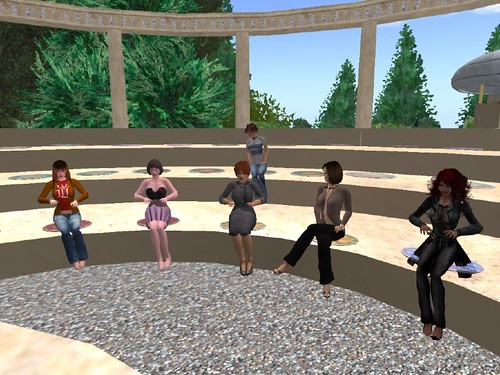
We simply didn’t have enough participation with enough skilled SL content creators to really explore the medium together in a substantive way, particularly in how a virtual world platform could be used most effectively for _this specific course_. I imagined people collaboratively building together, modeling things we read about or saw in the course content in a 3D form, exploring how concepts might be best represented in 3D versus text, video, image, or 2D. Except with a few minor exceptions, that just didn’t happen. We were more successful in leveraging affordance #1 – I don’t think I am the only one who came away from our synchronous discussions feeling that it had been a very valuable way to spend my time, and that I learned a lot from them – but these remained very small discussions, usually with between 3 – 6 participants.
As I said, I think I made some mistakes along the way, in how I framed the cohort, or implemented the various technologies I used. For example, we scheduled the synchronous meetings at several different times to accommodate different time zones, but I think having many different meeting times just diluted the initial momentum and fractured what could have been a stronger, more connected group. Now I’m thinking, if you’re going to commit to the synchronous participation of using a virtual world, then you have to really commit and pick a day and a time and stick with it – unless you have a much larger starting group, more passionate participants, or more people to facilitate the meetings. It seemed like as soon as I stopped being able to make the synchronous meetings, everyone stopped going, even though I had hoped people would just continue on without me, as I’d tried to “crowd source” all the tools needed to do so.
Or perhaps I incorporated _too many_ technologies in trying to empower the crowd. Maybe if I’d just had people sign up for the cohort and then invited them to the group in Second Life and done ALL of the communication through Second Life, maybe more people would have participated… I’m skeptical, though, since SL’s built in communication tools are suboptimal and often don’t work. I dunno.
I’m not entirely sure what all I could or should have done differently, and I do regret “falling off the wagon” – but I don’t regret for one second any of the time I spent on this endeavor. I feel like I got quite a lot out of the experience, and I hope that at least some of what I contributed made the experience better for others taking the class. It was an active, engaging learning experience for me, and I think I will continue to ponder over and learn about connectivism and connective knowledge well into the future, helped by the multitude of resources created by others and shared with me.
So, in conclusion, my thanks to everyone who participated, helped, encouraged, or otherwise took part. My apologies to anyone I let down by not being there enough. I hope this information is helpful to you in some way, even if the rest of it was not. And mega-great thanks to George Siemens and Stephen Downes, who did their own part to encourage me and the SL Cohort, and who gave us all the opportunity to learn together through the Connectivism & Connective Knowledge course. It was one of the singularly most interesting classes I’ve ever taken and I hope I’ll get a pass. =)
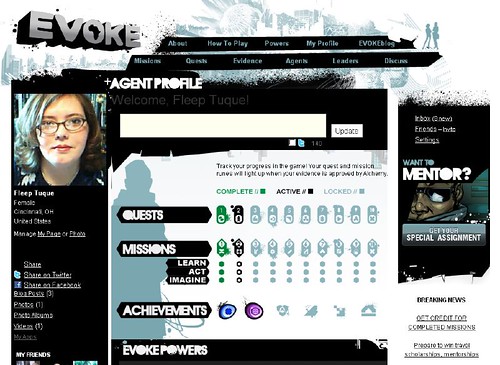
Screaming 3D Bootstrapper Csven Concord had been pinging me for weeks about the Superstruct game organized by the Institute for the Future. I finally got a few hours to take a look at it and was stopped cold at the very first mission of the game: describe yourself in the year 2019. Not a fantasy you, but you you, where you think you might actually be. It took me three days just to accomplish mission #1 to make my profile.
My efforts to get into the Superstruct mindset were somewhat hampered by the technology being used. Not sure if it’s just my PC or that I’m using the FF3 browser, but I continually have to relog into the site over and over just to navigate around (is it not tracking cookies properly or what?) and the framing they use makes it hard to grab direct links to specific content. With some trial and error, I finally got to Cven’s Screaming 3D Bootstrappers Superstruct page, and managed to add myself to the S3DBers wiki page, and saw a call for help under the heading “Young Farmer’s Outreach”:
Request: “we need 3d VR environments that mimic the reality of a farm/ranch so that our young farmers can share their skills”
So the idea is that it is the year 2019, and five major superthreats are having devastating effects on human populations. To play the game, you create or join Superstructs (groups) to address one or any of these threats by using your unique talents, resources, and perspective to generate ideas, stories, videos, websites, pictures, or anything else that helps us imagine how life would really be in that situation and what solutions might really work to address the problems we face in this fictional reality of 2019.
In my imaginary 2019, the Chilbo Community has grown tremendously into a large, global community in the metaverse. To deal with the Ravenous superthreat – where major disruptions in the global food supply chain threatens the world with starvation and lack of healthy, nutritious food – the Chilbo Community has established a virtual garden to allow farmers and scientists from anywhere in the world to help people learn to grow their own gardens. In this fictional world of 2019, Respiratory Distress Syndrome (ReDS) has also forced many cities and populations into Quarantine, so the Chilbo Community Garden might be especially useful for those stuck in quarantine zones where access to food supplies may be dwindling. By using virtual world technologies to connect people who cannot visit one another in real life, we can spread information about sustainable farming to a larger audience, use the 3D modeling capabilities of virtual worlds to create roleplay scenarios, display equipment and demonstrate techniques, and reach populations who are isolated because of possible contagion.
To flesh out this idea, I worked with some Chilbo residents to actually build out this garden in the Chilbo Nature Preserve in Second Life, and recorded a machinima clip to “report” on our progress in the year 2019. This is only the second machinima I’ve ever made, so pardon the amateur execution.
When I think about the future of education, I wonder why we don’t spend more time doing THIS kind of work. I wonder if we’re teaching students the skills they need to really evaluate information on the web in context. For example, in the process of “playing” this game, I came across the ReDSNet Project website. Now, this website is so well done, so realistic, it would be easy to think ReDSNet was real. How many students would have the skills to read for content AND context and eventually discover that this is a fictional website? How many students would have the creativity or skillset to create a fictional website that was so convincing? How can we use these types of .. roleplay scenarios to build digital literacy skills that really WILL be useful in the year 2019?
I wish I’d had more time to spend on the Superstruct game/concept. It was really a fascinating, thought provoking exercise. And even if the machinima still doesn’t make any sense to anyone but me, I enjoyed the experience, I spent some time seriously thinking about my own future and where I _want_ to be in 11 years, I got an excuse to practice my machinima skills, and I strengthened some bonds in my network, personal and professional. Quite an accomplishment for some crazy collaborative game on the intarnets that I only had a few hours to play.
Since the start of school in September, it’s been a whirlwind of activity! Like Dorothy, I’m trying hard to stay on the yellow brick road, but the poor blog suffers when I get too busy. Here’s a quick update though on a number of exciting things..
University of Cincinnati Galapagos Islands Project
Progress continues on the Galapagos Islands project, and I have to give all due credit to my student assistant Ferggo Pickles for his truly excellent work in creating the sculpted animal models! News of our project is spreading and we’ve gotten very kind mentions in EDUCAUSE Review, the Chronicle, and even Virtual World News! Another blogger discussed our work too, but I wasn’t sure if it was positive or negative considering we don’t have any plans for visitors to pull the tails of lizards. =)
Chilbo Community
Incredibly, the Chilbo Community marks its two-year anniversary this month! We held a Chilbo Town Hall Meeting this afternoon, and I managed to complete the 2008 CCBP Annual Land Census and am preparing to distribute the 2008 Resident Census in the next few weeks. A note to any Chilbo residents reading this – you’ll have to complete the survey to keep your house or store in Chilbo, so be sure to read that email when it comes! Aside from all of the professional opportunities I’ve had because of Second Life, I must say Chilbo – the place and the people – is my favorite spot in the Metaverse. Whatever serendipity led me to meet such great people, I’ll never know, but I continue to be grateful that I did.
Connectivism Course
The Connectivism & Connective Knowledge course continues into Week 7, and I have fallen woefully behind on the readings, and even missed the last couple of meetings in Second Life! Still, the Connectivism Village continues to receive a high amount of foot traffic and I keep getting emails that people really enjoy the resources we’ve provided there, so I’m hopeful that the sometimes asynchronous nature of our connections in online networks doesn’t dilute the usefulness of the space. I hope things will be a little calmer this week and that I’ll get to attend the next Second Life cohort sessions!
EDUCAUSE 2008
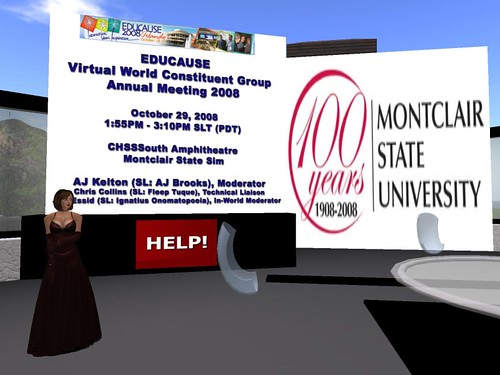
I have the privilege of working with AJ Kelton (SL: AJ Brooks) from Montclair State University and Joe Essid (SL: Ignatius Onomatopoeia) from Richmond University again this year to stream in the EDUCAUSE 2008 Virtual World Constituent Group Annual Meeting into Second Life in a few weeks. How often do you get to work in an evening gown! Looking forward to the conference itself, and the Second Life interaction. Are you coming to EDUCAUSE this year? Leave a comment and let’s meet up!
Another symptom of the “too busy!” syndrome – I almost missed the opportunity to put in a proposal for the Learning, Libraries, and Technology 2009 conference! Formerly called the Ohio Digital Commons for Education, the new name didn’t ring a bell when I saw the Call for Proposals in my in-box – doh! Thankfully, my good friend Brenda Boyd (SL: Stargazer Blazer) at Miami U gave me a poke with a sharp stick about submitting something – thanks Brenda! This is without a doubt one of the best educational technology conferences I attend all year. Ohio educators especially should go to meet and network with great colleagues, learn about what’s happening in the state, and to get new ideas to bring back to your home institution. In the years that I’ve attended, I don’t think I’ve ever come away from it without learning something new and immediately useful. Will cross my fingers on the proposals!
I’m sure there’s something else I’m forgetting, but that’s it for today’s updates. Hope everyone else is having a great quarter or semester so far, and maybe doing a better job of keeping up with everything than I am!
(This post is about the Massively Online Open Course called Connectivism and Connective Knowledge being taught by George Siemens and Stephen Downes from September to December 2008. Over 1900 participants have signed up, and I am facilitating the Second Life cohort for the course. Over the following months, I will be posting about the experience, home work assignments, and other materials related to our activities.)
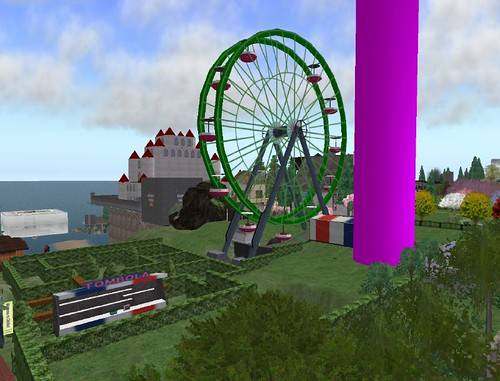
Following the end of the very successful Chilbo Summer Fair, we said goodbye to the Ferris Wheel and fabulous rides, artworks, and projects and made way for a new three month project in Chilbo.
Connectivism and Connective Knowledge is a twelve week course that will explore the concepts of connectivism and connective knowledge and explore their application as a framework for theories of teaching and learning. It will outline a connectivist understanding of educational systems of the future. George Siemens (SL: Whatever Russel) and Stephen Downes – the two leading figures on connectivism and connective knowledge – will co-facilitate this innovative and timely course. The course will run from September 7, 2008 to November 29, 2008 and will be fully delivered online.
Over 2000 participants from around the world have signed on to take part, and several members of the Chilbo community are fellow students, including Gann McGann, Olando7 Decosta, Samuel Sputnik, Sine Rennahan, Tara Yeats, and Wainbrave Bernal. The Chilbo Community is hosting the Second Life cohort of the class, and Cosimo Urbanowicz has also joined some of the early discussions and helped with the construction of the Connectivism Village down in Madhupak.
Second Life Cohort Weekly Meeting Times:
Tuesdays at 11AM SLT (-7GMT)
Thursdays at 6PM SLT (-7GMT)
Sundays at 5PM SLT (-7GMT)
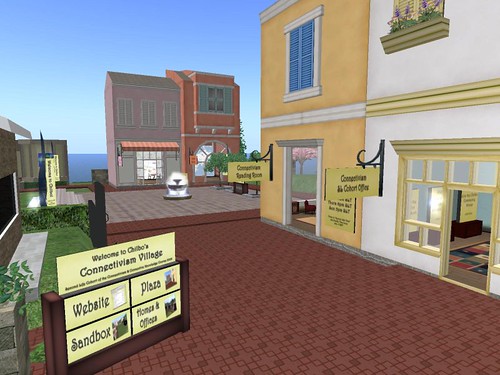
Purpose of the Connectivism Village
Initially, the impulse was simply to see if other students in the course who also had Second Life accounts were interested in meeting weekly in-world to discuss the Connectivism course. Though there are many communications tools used as part of the course structure, I’ve begun to feel I haven’t really “met” someone until I’ve “seen” them – even if that meeting and seeing takes place in avatar form. Psychologically, it seems as if I don’t feel the same level of engagement with another person through their blogs, tweets, or discussion board posts unless I’ve “met” them first, and I was interested in meeting other students in the class.
But as I began to read more about Connectivism, I started to think that it might contain concepts that could be better visualized in 3D, and for SL building, the Second Life cohort would need land and prims. After talking with folks in the community, we cleared up the Fairgrounds area and made room for a temporary Connectivism Village project that would last three months and house members of the course who needed a home base in Second Life.
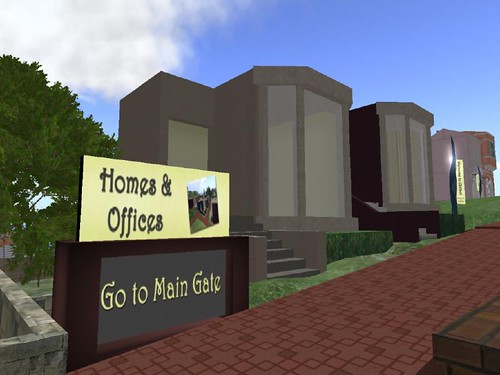
Small mini-homes and offices are available for members of the Second Life Cohort of the Connectivism course for the duration of the class time. Some students are interested in finding roomates!
The Fairgrounds area is also large enough to host some central facilities and resources for the course, to help make sense of the plethora of web based feeds, tools, readings, and course media. The Connectivism Second Life Cohort Office will simplify the process of folks joining the cohort, and the Connectivism Reading Room contains all of the assigned weekly readings and some introductory materials for the course.
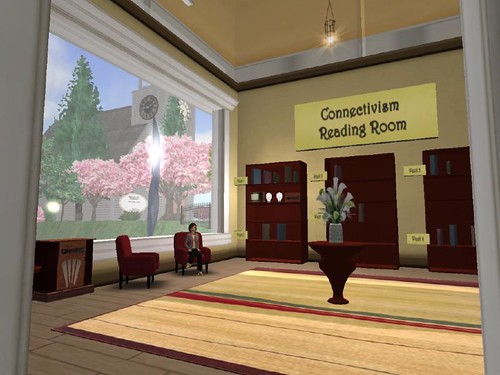
The Connectivism Reading Room can help students visualize course readings and discussion archives, as well as provide a place to discuss readings ad hoc through the week.
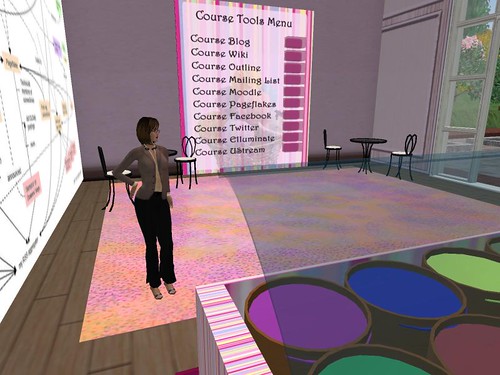
The Connectivism Course Tools Sundae Shop is a whimsical take on the somewhat overwhelming nature of the course structure. With several websites, communication mediums, RSS feeds, and course emails, Moodle forums, Facebook, and on and on, it’s a little rough trying to figure out which tools will work for your particular needs. The Sundae Shop is a metaphor for taking the flavors you like and sampling some of the others, not putting every choice on the sundae!
The “Menu” of various course tools in the Connectivism Sundae Shop.
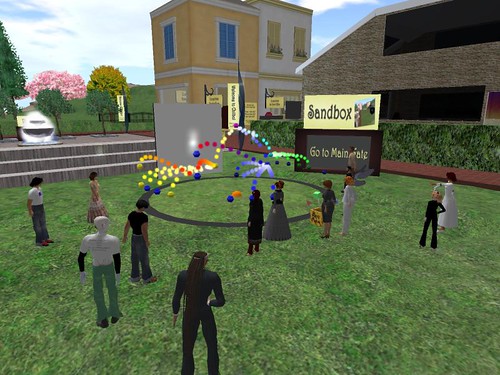
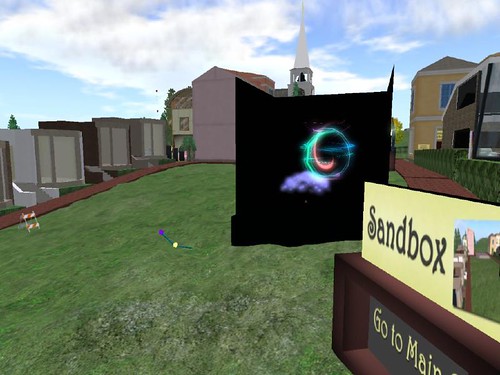
Beyond the few buildings near the plaza, however, I think it will be the Connectivism Sandbox that will hold the most interesting content of the course. Here we can play with models, particles, sets, artwork, media.. whatever strikes our fancy as we play with the concepts of the course and learn more about Connectivism. For those who are new to building in Second Life, visit the Ivory Tower of Primitives for a walk through, self-paced building tutorial. The Ivory Tower is a cultural institution of Second Life and shouldn’t be missed even if you’ve learned on your own!
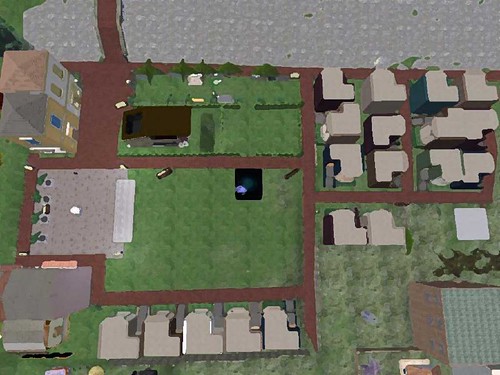
An overhead view of the Connectivism Village in the Chilbo Community (Madhupak sim).
I look forward to seeing how the Second Life cohort of the course progresses, and I encourage anyone from Chilbo to participate or check it out! If you have time to wander down, please say hi to any students you see too! They are members of the Chilbo Community Building Project group and have the group tag “Chilbo Connect!” ~ Fleep
This panel will feature a discussion about the current state of virtual worlds and how they may evolve in the future. What do we hope to see? What would be a “bad” outcome?
Moderator: Fleep Tuque
Panelists: Malburns Writer, Tara Yeats, Olando7 DeCosta
Second Life Community-Building: What We’ve Learned – Island Experience
Saturday, 8/23, 11:00 AM SLT
Location: Shrubbery Amphitheatre
SLurl: http://slurl.com/secondlife/Chilbo/167/129/109
This panel is one of a pair of panels that will take a look at lessons learned that can make – or break – communities in Second Life. What’s the “glue” that holds virtual world communities together? What helps people engage? What are the challenges? What Second Life tools and features help – or hinder the process? Saturday’s panel will focus on island communities; Sunday’s panel will focus on mainland communities.
Moderator: Tara Yeats
Panelists: Sophrosyne Stenvaag, Director, Extropia Core; Fleet Goldenberg, Community Manager, EduIsland II, 5 & 6
Second Life Community-Building: What We’ve Learned – Mainland Experience
Sunday, 8/24, 12 NOON SLT
Location: Shrubbery Amphitheatre
SLurl: http://slurl.com/secondlife/Chilbo/167/129/109
This panel is one of a pair of panels that will take a look at lessons learned that can make – or break – communities in Second Life. What’s the “glue” that holds virtual world communities together? What helps people engage? What are the challenges? What Second Life tools and features help – or hinder the process? Saturday’s panel will focus on island communities; Sunday’s panel will focus on mainland communities.
Moderator: Tara Yeats
Panelists: Prokofy Neva, Owner, Ravenglass; Fleep Tuque, Land Steward, Chilbo Community Building Project
Join us for a walking tour of the Chilbo sim! We’ll poke into the nooks and crannies of the community, visit the places and spaces where Chilbo began, and explore the hidden treasures and artifacts of our community’s history!
12 PM SLT – FlowerBall Reception
The tour will finish up at the FlowerBall, an interactive art build that was voted one of the “Ten Best Art Installations of 2007″ by New World Notes. The charming, witty, and extremely attractive co-creators Douglas Story and Desdemona Enfield will be on hand to answer your questions – and hell….maybe musician Aldomanutio Abruzzo if we can get him to come by.
If you do visit, be sure to follow the annoying directions – you’ll get a much better experience if you do. Also – scripters take note: there’s a great deal of complex and interesting scripting involved in the pre-loading of the music clips that makes them play smoothly. Desdemona’s achievement is that you don’t notice all this.
SLurl: http://slurl.com/secondlife/Madhupak/166/45/68
Sunday, August 17
1pm SLT – Presentation: HIV 101: What is HIV and How Does it Attack the Immune System? – Lizzette Zenovka
Location: SL HIV Education & Prevention Center
SLurl: http://slurl.com/secondlife/Madhupak/130/80/60
Monday, August 18
3PM SLT – Go Kart Race – START YOUR ENGINES!!!
Location: Chilbo Fairgrounds
SLurl:
Join us for a smashing good time at the Go Kart racetrack in the fairgrounds! Contestants will compete for the best time around the track, feel free to practice ahead of time, but all scores will be reset before the race! First Prize: $1000L Second Prize: $500L Third Prize: $250L
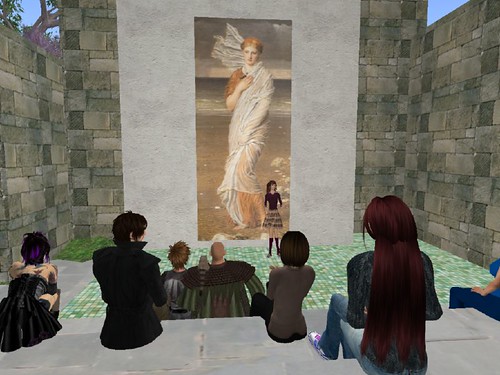
On Tuesday evening, Poet Cecilia Delacroix will perform some of her favorite works in the Chilbo Shells Plaza. Cecilia previously gave a reading centered on a nature/seasonal theme in the Shrubbery Amphitheatre, and is memorialized there for donating the lovely backdrop of images that graces the area behind the stage. Beyond her poetry, Ceclia also enjoys wine, jazz, and running many art galleries in Islandia’s canal district in Second Life. Please join us to celebrate her latest poetry!
Led by Rezago Kokorin, the premise of these sessions is simple: the host introduces a concept or technique that can be applied to building in Second Life, and the remainder of the session is dedicated to experimentation, using the concept or technique for artistic application. Rezago is an accomplished sculptor and photographer in both realities. The workshop sessions are very open and feature a lot of sharing of knowledge among the participants. It’s always interesting to see the variety of creations from a group of people all starting from the same point. Join us for some fun with the prims in the sandbox.
This panel will feature a discussion about the current state of virtual worlds and how they may evolve in the future. What do we hope to see? What would be a “bad” outcome? Panelists: Malburns Writer, Tara Yeats, Olando7 DeCosta
Olando7 Decosta (Roland Legrand) is not a professional philosopher, though he graduated in philosophy, but he still feels the urge to read some philosophers when he tries to make sense of his life as a Second Life resident. Olando7 will present some of his favorite thinkers in this context (Derrida, Deleuze&Guattari, Baudrillard) during 15/max. 20 minutes, and invites the audience to share their favorite philosophers and writers (also fiction!) and how reading throws some light on their virtual experiences.
This panel will take a look at some lessons learned that can make – or break – communities in Second Life. Potential focus on emerging plans for Mainland zoning and how that may impact existing communities and new ones. Panelists: TBA
Led by Rezago Kokorin, the premise of these sessions is simple: the host introduces a concept or technique that can be applied to building in Second Life, and the remainder of the session is dedicated to experimentation, using the concept or technique for artistic application. Rezago is an accomplished sculptor and photographer in both realities. The workshop sessions are very open and feature a lot of sharing of knowledge among the participants. It’s always interesting to see the variety of creations from a group of people all starting from the same point. Join us for some fun with the prims in the sandbox.
An ad farm along the Linden Road in Mangyeong sim seems much unchanged, despite changes in Linden Lab policies about ad farms announced seven months ago.
Because of my professional work in Second Life, it is very rare that I publicly discuss my frustrations. I still believe that the Second Life platform is on the leading edge of the hundreds of virtual worlds (or more accurately, virtual environments) out there. I am still committed to Second Life, I pay my tier every month even though it gets harder and harder in this economy.
A griefer fireball in Chilbo (slightly camouflaged by our bushes) that has been sitting undisturbed for over 14 months, despite abuse reports to Linden Lab, on a parcel of land that was claimed in October 2006 by a resident who has not logged in (as far as we can tell) once in nearly two years.
But in light of Linden Lab’s recent blog posts, I feel compelled to speak my mind as both a citizen of this virtual world. These are my personal views and do not represent any of the professional, community, or other organizations I work with or represent.
My post to the closed forum is cited in full below:
Dear Jack,
I have invested thousands of dollars in building the Chilbo community on the mainland over the past couple years, as have others in my group, and spent countless hours of time working with mainland residents, dealing with abandoned parcels, griefers, and ad farm jerks. This is a very serious investment for me. Further, I’ve extolled the virtues of Second Life and virtual worlds to literally thousands of educators and administrators at workshops and conferences all over the US. I can’t even calculate how many residents, universities, and colleges have come into Second Life directly due to my hard (uncompensated by Linden Lab) work. I feel I have paid my dues as a Second Life resident and then some with a cherry on top.
Regarding the mainland, in the past 6 months, representatives of Linden Lab have kicked me in the teeth in several ways: they have placed abandoned parcels for public auction despite the fact that our community owns the land on three or even all four sides, at least once resulting in me paying over $20,000L for a 512m parcel because it was literally right next to our Town Hall in the heart of our community; they have worked out private deals with other residents who are NOT members of or invested in the area around Chilbo, giving them abandoned land for $1L that they then turned around and sold for extortionist prices; they have sold huge tracts of abandoned land near Chilbo through private deals rather than putting them up on auction, which were then cut up into small parcels and sold for extortionist prices; they have left griefer objects on abandoned land for literally years; and they have failed to address nearly every single ad abuse report we’ve filed despite a supposed change in policy all those months ago.
I, too, am quite skeptical that a change in mainland zoning policy will do anything but hurt honest community building groups like Chilbo, and will indeed like so many other changes, only help those who want to make a quick buck. In all my years in Second Life, I’ve always been working towards creating open, diverse, pleasant mainland communities, and no one at Linden Lab has ever bothered to take the time to look and see that our community owns land in 6 neighboring mainland sims, that our community actually uses the group tier donation model, that we ALREADY HAVE community standards but no way to enforce them, that we meet regularly to resolve our own disputes and issues, and that we are very serious and dedicated in our investment into Second Life and the mainland. They just pop in when they finally address an abandoned parcel, sometimes dole it out to someone who has a connection with them and sometimes just throw it up on public auction, and it as if our community, our hard work, and our investment of time and money doesn’t even exist. We’re left to fend for ourselves and pay through the nose if we want to try to continue to grow and keep a cohesive feel to our little tiny spot of goodwill in the anarchy of the mainland.
My suggestions:
1. Remove blanket banlines and pay-to-enter barriers from the mainland PERIOD. If you want absolute privacy, buy land on an island or eject jerks and implement individual bans. Blanket bans and pay to enter zones are the bane of mainland existence, worse than ad farms in my opinion.
2. Make the process for reclaiming land absolutely transparent so mainland communities can plan ahead and not feel subject to Linden Lab’s whims. If you don’t pay your tier after X months, your land is cleared and reclaimed automatically the very day after that period expires. 3 to 4 months is more than reasonable.
3. When a parcel is abandoned or reclaimed for lack of payment, all landowning group owners and private landowners in the sim should be notified FIRST and get FIRST SHOT at a private, closed auction. This should be relatively easy to automate. This would allow existing residents to work it out amongst themselves who wants to compete for the land. This would encourage cooperation and self governance by people who already have an investment in that region. Only after a set period of time if no existing landowner in the sim bids should that parcel then be put up for public auction. STOP ALLOWING EXTORTIONIST PROFITEERS TO BENEFIT MORE FROM LINDEN LAB POLICIES THAN GOOD HONEST COMMUNITY BUILDERS DO. IT IS THE COMMUNITIES THAT RETAIN RESIDENTS, PROMOTE PREMIUM MEMBERSHIPS, AND INCREASE USER HOURS, NOT LAND FLIPPERS.
4. Linden Lab has for years claimed that they eventually wanted to put more governance in the hands of residents since they do not have the staff or the time to resolve all disputes. So do it. Where organized communities exist, empower long-term residents with established records of good payment, good stewardship, and good relations to manage the sims instead of Linden Lab. Enforce our community-generated standards or allow us to enforce them. Whether through appointment or elections or petitions or through some other means, give community managers the ability to remove offensive ads, griefer objects, and banlines. Put your money where your mouth has been for the last 5 years.
5. Do what you say you will do. Consistently. Across the board. In a timely manner. Quit making special deals with residents who are friends of Lindens at the expense of those of us who don’t cultivate insider relationships.
A short forum or blog post can barely do justice to the injustice I feel Linden Lab has done to its best customers. I rarely ever speak of it, I keep a good public PR face, I do my best to soothe the irritation of the residents of Chilbo, newbies, teachers, and students. I am a good citizen of Second Life, but I am angry, frustrated, and distrustful of the company who repeatedly says they want to do better but somehow ends up implementing policies that make my work harder. Maybe this time will be different, but I won’t hold my breath.
Sincerely,
Fleep Tuque
Founder, Chilbo Community Building Project
Web: http://fleeptuque.com
Email: fleep.tuque@gmail.com
Chilbo Community in the Mainland of Second Life
Web: http://chilbo.org
SLurl: http://slurl.com/secondlife/Chilbo/112/222/121