11
Jan 14

Twitter and the Reputation Economy in 2014

Back in 2009 when Twitter Lists first came out, I had a little epiphany about the reputation economy.  It isn’t just what you say about yourself online, but what others say and post about you in the aggregate, and all the associated metadata of your online life, that can define “who you are” in the Metaverse.  That only seems to be more true as time has gone on, and despite the over-hype of the “reputation economy” buzzword, I still find it interesting and potentially meaningful, but only if the measures of reputation are accurate.  We’re definitely not there yet, and I’m not sure we’re really any further than we were in 2009, either.

It’s hard to do an analysis of accuracy for anyone but myself, but if I had to say which system seems to currently have the best measure of “who I am” based on what others say about me, I’d have to say it’s not Klout, or LinkedIn Endorsements or any of those obvious attempts to measure reputation.  The best measure as far as I can tell is actually Twitter.  What Twitter Lists people have placed me in, which isn’t obvious at all, and isn’t even something Twitter seems to explicitly leverage as a measure of reputation, is actually a pretty good measure!

[A brief aside, I’m sad that Twitter seems to have buried Lists and made them almost non-obvious, since as far as I’m concerned, Lists are a crucial component of making Twitter useful at all.  Many folks who joined Twitter after Lists came out don’t even seem to know they exist!  If you happen to be one of those unfortunate souls, get thee to your Twitter page > Me > Lists > Create List and start categorizing people.  Or click “Member of” to see what lists others have added to you to.  I bet you’ll find some of them very surprising, hopefully in a good way.  And after you’ve made some lists, tools like TweetDeck will suddenly make a LOT more sense to you, and your Twitter stream will become much more meaningful, relevant and less.. ephemeral.]

But back to the topic.  So what does my Twitter network say about me?  Some pretty good stuff, actually:

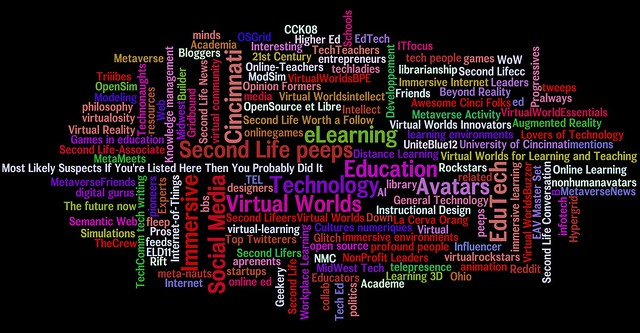
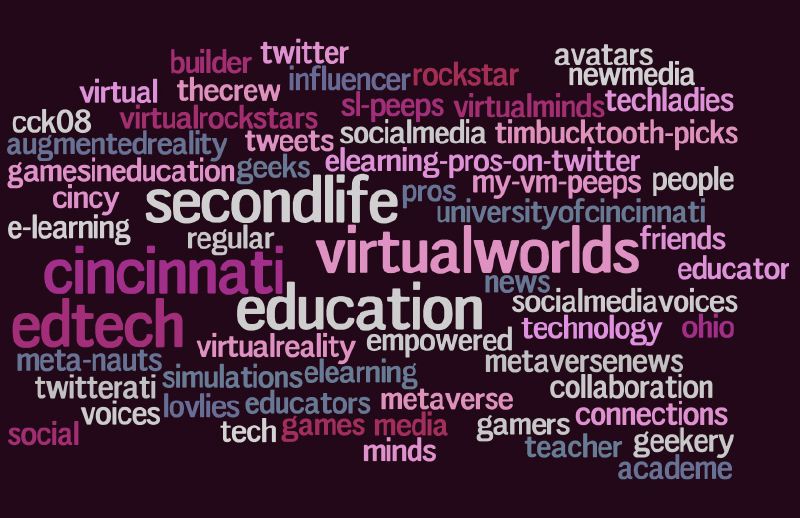
Twitter Lists Word Cloud for Fleep

When I boiled the List Names down, I got 191 unique terms and, though I modified the frequency to make the word cloud readable (if I hadn’t, all you would see is: Second Life, Virtual Worlds, Education, Immersive, Cincinnati, which were the top 5 list names), I’d say that’s a really accurate representation of my online life.  It accurately reflects my professional and geeky interests, and if you dig in there a bit, it tells you my gender, where I live, what I do for a living, some of the books I’ve read, games I’ve played, conferences I’ve attended, that I’m old enough to be on someone’s BBS list, and if I can say it humbly, that overall people have a pretty positive opinion of me.   

I am of course quite biased, but I think I have a pretty awesome network of super intelligent people who love digging into the future of technology and education, and who like to think about what all this emerging tech will mean for the future of society, so it’s all the more interesting to see what kinds of categories they create for themselves and where they place me within that context.  (I confess to having some warm fuzzies after seeing how the word cloud came out, so thanks Twitter peeps!)

LinkedIn’s Endorsements are another interesting measure, though of a slightly different sort.  I’d say it’s also fairly accurate, but it pretty much captures only my professional interests and misses all the personal, quirky, or other interests I have.
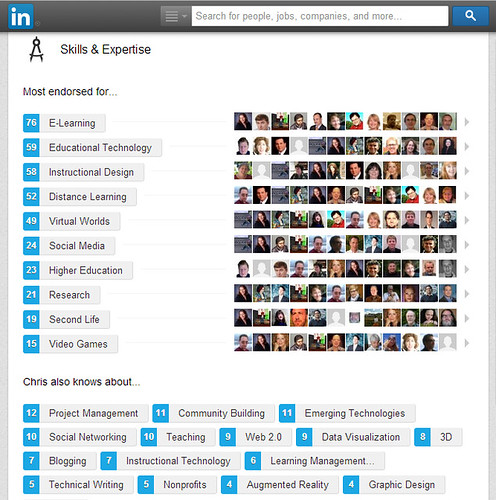
LinkedIn Endorsements for Fleep 2014

Some folks I know have also complained that they get endorsements for skills from people who aren’t even in a position to know whether or not they have any expertise in that topic, and that happens to me, too.  But in general, I’d say LinkedIn Endorsements are less a measure of what you are actually skilled at doing and more a measure of what people think you are skilled at doing.  They aren’t the same thing, but both are interesting and useful measures.

By comparison, I would say Klout is the least representative of the various “reputation economy” or influence measures about me.  I don’t know how they weight stuff, but it looks like the Klout list was probably fairly accurate about 5 years ago, but as my focus, interests, and activities have changed, Klout hasn’t seemed to have kept up.  It captures the same top 5 categories as Twitter Lists, but that’s about it.  None of the nuance, history, and none of the topics I’ve become interested in since.. what, their initial calculations?  I’m not sure.
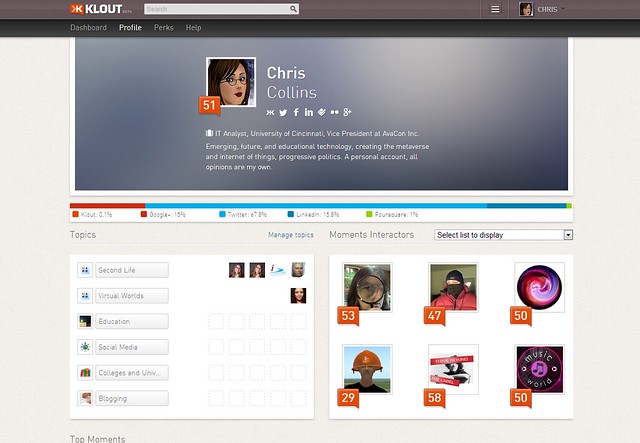
I should also admit some bias here, I became very aggravated with Klout when they sent me what seemed like an email every few days to tell me my Klout score was going down, when at the time I was helping take care of my grandpa who was dying of cancer.  The insensitivity of it really struck a nerve, like I should really give a hoot about my Klout score at a time like that?  And how meaningful a measure could it possibly be if I’m less influential because I’m offline doing something important?

No matter what Klout says, I know my network values human life and knows what is and isn’t truly important.  In fact, my guess is that my network would probably rank my reputation higher for having been a dedicated caregiver, not lower.

And of course that’s the big problem with all of these reputation or influence measures – the algorithms can’t yet measure what’s REALLY important: trustworthiness, competence, honesty, reliability, compassion, dedication, clarity, ability to synthesize and make meaning from complexity.  These are the measures I really want to know about someone, and as far as I can tell, there’s nothing out there like that yet.

The Twitter List names that people create for themselves, some of which touch on values not just buzzwords, are the closest I’ve seen to anything like those kinds of measures, which for me makes Twitter a potentially overlooked but pretty important tool in the reputation and influence measure toolkit in 2014.

16
Jul 10

Interview posted – Discussing Social Media on WVXU’s Impact Cincinnati!

Chris Collins & Chris Brewer in the WVXU Studios

Yesterday I had the pleasure of speaking with Chris Brewer from Northern Kentucky University on WVXU’s Impact Cincinnati show with host Maryann Zeleznik.  Our topic was how new communication tools are impacting our lives and we discussed all the usual suspects like Facebook, Twitter, Foursquare, etc. in addition to the changes iPhones and Android smart phones have brought to the scene since our last show back in July 2009.

From the Impact Cincinnati website:

Topic: How new communications tools are affecting our lives

Millions of people each day now access Facebook, Twitter, MySpace, and other social networking sites, using home computers as well as a rapidly growing array of sophisticated mobile devices that allow anywhere, anytime internet connections.

Guests include:
University of Cincinnati Instructional & Research Computing department IT Analyst Chris Collins
Chris Brewer, a social media consultant for clients such as Apple and the New Media Consortium, Director of Online Technology for NKU’s College of Informatics, and the developer of GrooveRiver.com, a niche social network for Cincinnati musicians.

Listen to the Program

It’s always fun to get a behind the scenes look at our local NPR station studio and I hope we encourage Cincinnati listeners to try out some of the social media offerings that can help expand your personal and professional networks.   Check out the recording here and many thanks to Chris and Maryann for a great conversation about social media!


10
Feb 10

On Fear of Blogging: Optimist: Speaking with your Digital Voice: Part 1

This is one of those self-indulgent, reflecting on my own blogging posts, so if you hate that sort of thing, stop reading now.

Wherein the Optimist Wins the Internal (Eternal?) Debate:  To Blog or Not To Blog

A friend and I recently got into a heated debate about blogging.  The context isn’t important so much, but it made me reflect a bit about my own blogging.   (Though I do wonder if I am alone in thinking that sites like Slashdot and the DrudgeReport – no matter how they may have started – are not “blogs”. They are or have become news sites, and news sites are not the same thing as blogs, in my mind.)

What is a blog anyway?

First, I had to separate out what _I_ do that I consider to be blogging.  Is Twitter a blog?  People say it’s a “micro-blog” but it rarely feels that way to me.  It feels more like a group IM conversation with an archive instead of a reflective piece of writing.  I think my core definition of blog includes that – a reflective piece of writing is a main feature of the vast majority of blogs.  It may reference other sites, it may incorporate different kinds of media, but the essence of the “web log” is a person logging their thoughts, experiences, results, art, images, whatever documentation that can be submitted to the “web log” system, so that others can learn and share from our experiences, so we can learn from the experiences of others, and so we can contribute some part of ourselves to .. well, the world – the world wide web log system, the internet, the metaverse – whatever you want to call it.

This is my blog.  This is where, when I can, from time to time, I try to share something of interest to the world.  Whoever’s listening, whoever’s reading, whoever shares a passion for the same things I do – here’s the stuff I’m working on.  I’m trying to “web log” my work, parts of my life, parts of my family, parts of me.  I don’t get as much time to do it as I wish I could, I’m not nearly as skilled at all the different forms of media as I wish I were, and I often self-consciously worry terribly about what people will _think_ of what I say or what I do – but I want to try to share my stuff with people who might care, and I want to have a web log for myself, so I can go back and reflect on what I’ve said, reflect on how my views have changed, or remember why it was that I chose some path that didn’t work out at all like I intended.

A “blog” to me is personal.  This blog is personal.

And in this age of .. such rapid change, with all notions of privacy being challenged, of a time in my life when I wear so many hats I couldn’t print a business card that would fit, when my work (which I personally define as attempting to study and help provide answers to the questions:  What’s happening on the internet and particularly in that part of the internet they call “virtual worlds”?  What implications does it have for education and for society as a whole? What or which of these tools are most effective for teaching, learning, sharing ideas, and instigating positive change?) is studying a rapidly, constantly dynamic phenomenon that I can only study by doing and being involved in to understand the technology well enough to study it..  What part of my life or my work is personal?

Isn’t ALL of it personal?

Is that a stupid question?

Why teachers, professors, and educators should blog

I try in my workshops to talk about how a technology can be used, for teaching, for personal discovery and learning, for organizing distributed workforces or volunteers, for communicating with constituents – but essentially, I don’t know if any of it makes sense until you’ve done it yourself – for yourself.  It’s hard to understand the real power of a “web log” until you’ve done it and seen how much it improves your own learning.

For every instructor or faculty member who has asked the question – why would _I_ want to blog?  That would be my answer.   We talk about experiential learning, and reflective writing, and all the appropriate buzzwords, but in terms of a tool that really truly enhances and promotes experiential, self-reflective learning, I almost can’t think of a better tool than a blog.  Telling a story, to yourself or someone else, and creating or finding the media, creating the narrative, and sending it .. out there, into the big world of all the people in the world having a conversation or sharing in the big web log system, is, frankly, a thrilling experience.  Or it can be, it should be.  The ability to create something, share something, document some part of your experience, communicate with others who share your passions, create an archive for yourself to learn from too – it’s journaling in the 21st century.  All of the great forebears of science, philosophy, and human knowledge recorded their experiences, publishing research is the heart of academia, and the web simply provides a better way to do it.

The “blog” – no matter how far they stretch the term in the media – is a reflective piece of writing that exists for its own sake or ties together all of the elements of an “entry”  that is thrust into the global web log system of human knowledge.  When you put it out there, you’re talking to everyone, anyone.  You’re talking to the person who is reading it now, and the person who will read it tomorrow, and all the people who will read it in the future to come.

What do you have to share with the world of now and the world of tomorrow?  What do your students have to share?

Education, at its core, is about training people to think rigorously.  It is about teaching people how to distinguish between signal and noise, correlate data, understand cause and effect, think broadly about the implications of our choices, and contribute something meaningful to society as a result of this training.

Speaking with your Digital Voice

To me, this is the beauty of blogging, of twittering, of connecting..  Watching the “web log” and learning from it, seeing my experiences echoed in it, recognizing and appreciating the art in it, applying what I take from it (to my own life and to my work), these things make blogging and participating in the conversation worth the investment of time.  The reward, the return, is enormous.  The power of finding the information I need or want when I need or want it, of finding the people I need or want when I need or want to talk to them, running across information I didn’t even know I needed – this stuff has changed how I work, how effective I can be, how many people I can reach, teach, learn from – it allows me to be my own teacher, my own guide, and still find the wisdom and the guidance from others whenever I am receptive and ready to learn from them.

Podcasting, videos, virtual worlds, blogging, twitter, social networks, social media, wikis, YouTube, they’re all elements of the same thing – using your digital voice to speak.  It is simply another mode of human communication, one with many implications for changing society in the future, and every student, and every teacher, should learn to speak with their digital voice.  When you do, the results of what you share are better indexed, searched, and located, which allows others to find you and you to find each other so that between you – between us – we can do a better job of.. whatever it is we want to do (or need to do).

Using our Digital Voice to Solve Real (Big) Problems

The people of the world seem to agree – global warming is real.  The people of the world seem to agree – solving the energy crisis is one of the great challenges of our time.  The people of the world seem to agree – giving every child an opportunity to live, grow, and learn in safety is a priority.  The people of the world seem to agree – actually on quite a number of things.  And what we disagree about, what we argue and debate about, the choices we make in our real lives as a result of our experience or nature or knowledge – the web log system is one way we are working it out and looking for answers, looking for solutions, or maybe just the right questions.

Everyone I know these days is saying and thinking, “There has to be a better way of doing things.  The world seems like a mess.”   We, as a people, have unprecedented power to reach each other, learn from each other, and work together using our digital voices.  Why aren’t we using it to solve the big problems ourselves?  Why does it seem everyone is waiting for Them to come up with the answers?  Institutions, governments, NGOs, charities, your boss, the board, the People In Charge.

I’ll ask again – why aren’t we solving the big problems ourselves?

I think I’ve come to the conclusion that not enough people with not enough of the right skills know how.  I don’t know how, myself, I’m trying to learn.  I’m trying to understand how my own actions help or diminish my own cause(s), I’m trying to understand how best to leverage my time and my resources to help solve common problems – or is that ridiculously naive?

A Bad Addiction or Addicted to Empowerment?

Maybe I’m just addicted to the fire-hose, watching the next generation’s version of the boob tube on endless repeat except there’s no repeat – just a steady stream of fresh data, fresh experiences, fresh laughter, fresh music, fresh conversation, fresh opportunities, fresh challenges.. all of the stimulation, freedom, creativity, joy, efficacy, acceptance, and .. empowerment.. that I feel quite denied in the “real world”.

I can’t afford to drive all over and pay for concerts.  I don’t have the right credentials to help plan cities or communities or spaces in the real world.  I don’t have the right wardrobe to attend certain kinds of functions.  I don’t have the capacity to hop-skip around the world to meet a colleague for coffee and chat when I have time.  But I can do all of these things online.  I can practice at any number of things that relate to people, to creating, to  planning, to experimenting.. with virtual things instead of physical things.  Virtual resources are, electricity permitting, infinite.  Time is not.  Talent is not.  But if I need to get people together to help me solve a problem, or create a community, if we collectively are going to solve the really big challenges of our time, I’m more convinced than ever that we’ll need our digital voices to do it.

That’s my optimistic answer for why you should blog, why I should blog, why my mom should blog, why teachers should blog.  I dunno if that’s right though. The pessimist wins some days.


22
Nov 09

Reputation Economy: Twitter Sez Fleep Is…

It was a startling moment the first time someone uploaded a picture of me on Facebook and tagged it with my name.  It wasn’t a very flattering photo, first of all, I never would have posted that picture anywhere publicly.  ;)  And it struck me quite suddenly that the web really is a two-way street – it’s not just what I say about me, it’s also what they say about me.  You know, them, those other people out there.

Twitter lists are another example of this two-way street.  The image above shows a word cloud of tags and phrases taken from twitter lists that other people have created and put me, @fleep, in.   I should note that this is a doctored word cloud, if I’d left it at the true frequency, you wouldn’t be able to read anything but secondlife, edtech, education, virtualworlds, and cincinnati because those tags are by far the most common.

But I wanted to bring out the other words as well because they paint a broader picture of who and what folks on twitter think I am.  It also better demonstrates how much CAN be known about a person when a bunch of disparate voices start chiming in and contributing what they know about someone.  Some of the folks who know me on Second Life might not know I live in Cincinnati, just like some of the local people might not have known I was involved in Second Life.  Put all their contributions together, however, and you (and they) can learn a lot more about me.

This is the basis for the reputation economy that’s coming – in the days ahead, your resume and your profiles and your website, all the things that you say about you, will matter a lot less than all the things that they say about you.  You know, them, those other people out there.  They will likely be much more verbose about you than you are about yourself, and they will come from all of the different spheres of your life – personal and professional, your private life and your work life, your social clubs and your work buddies, and yes, even people who don’t like you or what you believe in, your enemies and detractors.   You will have much less control over what the world knows about you, because you have no way to control what everyone else says about you.

If you google for “reputation economy” you’ll see that it’s often applied in the context of companies needing to protect their reputations, but the same applies to individuals, too.  Do you know what the web says about you?  Beyond vanity-googling yourself, do you have google alerts set up to let you know when someone mentions your name?  Trackbacks enabled on your blog?  A saved twitter search of your @username?  Are you checking out the twitter lists people are putting you on, and are they the kinds of lists you want to be on?

And if not, what should you, or can you, do about it?


08
Nov 09

Educause 09, Copyright/IP in Virtual Worlds, Dusan’s War

This week seemed impossibly full of interesting, with not enough time to process.  Wait, who am I kidding, I never feel there’s enough time to process, but this week more so than usual.  So a quick roundup to remind myself to keep thinking about these things:

EDUCAUSE 2009

I made a vow last year to reduce my conference travel.  It seemed prudent to cut back on expenses in this tough budget climate, but more than that, all the conferences began to run together in my mind, all the sessions sounding the same, the airports and hotel rooms one big blur.  From time to time I’ve felt sad to miss seeing good netfriends, at SLCC09 especially, but it also felt good to take a step back and not be so darned harried.  Until this past week, when so many people I admire gathered at EDUCAUSE 2009, and for the first time I felt a tinge of real regret.  Because it sounds like maybe this year’s EDUCAUSE breathed a bit of fresh air into the room.

Fortunately, I was able to follow at least some of what was happening through the ever fascinating tweets of EDUCAUSE attendees, and the conference organizers (bless them) streamed many sessions on the web, so those of us who couldn’t attend don’t get too terribly left behind.  I haven’t watched all the sessions, but two in particular that I want to keep thinking about:

Point/Counterpoint:  Disrespectful and Time-Wasting, or Engaged and Transformative
The Mile High Twitter Debate (Gardner Campbell and Bruce Maas)

I first met Gardner Campbell (@gardnercambell) through an NMC Summer Conference several years ago (another conference I was sad to miss this year) and I’ve been a faithful reader of his blog Gardner Writes ever since.  His passion for teaching, and for exploring the use of technology in teaching in meaningful ways, has been illuminating.  He’s the kind of faculty member I want to learn from and collaborate with, and he’s always been unbelievably approachable for such a rock star.  ;)   So when I heard he was taking the pro-Twitter position in a Point/Counterpoint session, it seemed like a must-see and I wasn’t disappointed.

From now on, when administrators and faculty ask me what the point of Twitter is, I’m not even going to discuss it, I’ll just send them a link to this video.  If they aren’t convinced after that, there’s no hope.

Thanks to Gardner and Bruce Mass for a great debate and a terrific resource we can share with others.

It’s About Time:  Getting Our Values Around Copyright Right
(Lawrence Lessig)

The other “must-watch” video from the conference is really a must-watch for more than just educators.  Netizens everywhere need to be thinking about this issue, especially in light of the ACTA treaty negotiations that were leaked this week (see the Electronic Freedom Foundation’s take, ReadWriteWeb, Wired, and more – universal sentiment is “BAD – VERY BAD”).  I’m beyond outraged about ACTA and hope to make a separate post on that topic soon.

In any case, Lessig delivered a powerful talk about copyright that I hope you’ll take the time to review.  You won’t be sorry you did.

On Copyright, Intellectual Property Rights, & the Rule of Law in Virtual Worlds

These issues, of copyright and intellectual property, are not abstract for many Second Life users.  Indeed, I often imagine that these Second Life content creators (the ones who make the virtual clothes, hair, buildings, cars, etc. that you can buy in Second Life or on the web) are likely some of the very people who downloaded pirated music, software, or movies without a second thought in earlier times, but now the tables are turned after experiencing what it is like to create something from your own imagination, market it, sell it, and have it stolen out from under them.  (Reminder to self, experience is truly the best teacher. )

I refer to the great angst and gnashing of teeth over content theft in virtual worlds.  Linden Lab responded to the lawsuit filed by SexGen bed maker this week, a group of content creators staged a 48 hour period of creating nothing to protest content theft, Ben Duranske urged everyone to register their copyright with the US government, and the very controversial Emerald Viewer team filed a DMCA notice to Google about the much vilified Neilife viewer.

Oh, and by the way, Michael Risch at the West Virginia University College of Law makes a compelling case that the rule of law has been an abysmal failure in virtual worlds.  From the abstract:

The article finds – unsurprisingly – that virtual worlds now lack many of the elements of the rule of law. Which aspects fail is more surprising, however. Provider agreements and computer software, the sources of regulation that are most often criticized as “anti-user,” provide the best theoretical hope for achieving the rule of law, even if they currently fail in practice. On the contrary, widely proposed “reforms,” such as community norms, self-regulation, and importation of real-world law face both theoretical and practical barriers to implementation of the rule of law in virtual worlds.

What are we to make of all this copyright/IP mess?  I dunno.  I don’t have any easy answers either.

But I have long argued that one of the greatest benefits of being involved in virtual worlds like Second Life is that you get to see some of the great issues of our time being played out in another context, a different context than the “real world” – a smaller context – and that this gives us a new perspective with which to view what’s happening in the “real world”.   It’s so difficult for me to articulate this thought, I wish I could do a better job of it, but it’s the primary reason I feel like educators – no – academics and intellectuals of all stripes – should be involved in what’s happening in virtual worlds.  This copyright issue is just one of many examples, it’s fascinating to see how it plays out in the context of a conversation at EDUCAUSE versus the context and conversations of Second Life.

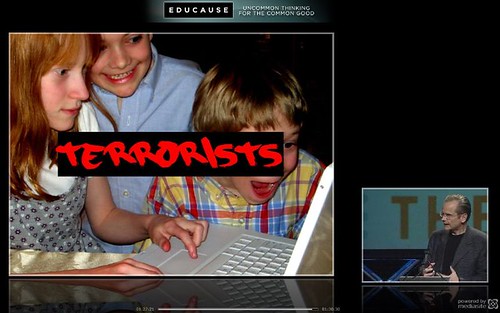
On one hand, we hear Lessig imploring educators and edtech IT folks to find ways to honor the rights of content creators in ways that do not turn our kids into terrorists.  He says, and I agree, that the creativity unleashed by mashups in the digital age cannot be stopped.  We hear Lessig warning us that by forcing people to live a a life outside the law, we undermine the very rule of law that democracy requires.  He urges us to help find a third way, a middle road between copyright extremists on both ends of the spectrum.

In another context, in the microcosm of virtual worlds and Second Life, we hear that the rule of law has yet to even emerge, all while we watch from the sidelines as real life courts are asked to adjudicate a potentially precedent-setting case about virtual content theft.   We hear some virtual world content creators arguing they must have the right to back up their work, to port their work, the products and artifacts of their creativity, into whatever medium they desire, whatever grid they happen to be on.   Other content creators are arguing that so long as the tools to make this backup/portability possible can also be used to steal THEIR content and creativity, these tools should NOT be available.  Even though they already are.  And, I think they are here to stay, no matter how much Linden Lab tries to enforce some kind of 3rd party registration for viewers.

Much to think about.  And I wonder,  what would the content creators who staged the 48 hour “create nothing” protest say to Lessig’s point?

I’ve run out of time to finish this post, and didn’t even get to the other big stories of the week.  I’ll add some links to remind myself, because they all play into this conversation even if I can’t synthesize it all at the moment:

Linden Lab offers standalone “behind the firewall” servers at $50k a year price – are they crazy?

Dusan talks about the Lab being at war with itself, and humanity at war with ourselves, and with technology – what?  I want to respond to this, I want to argue some of us ARE stopping to think about it – obsessively thinking about it even -  but it’s just all happening so damned fast (see this post, I can’t even get a few hours to properly synthesize):

But there’s a Masonic feeling to the whole thing: we’re not just individual actors contributing to the common good, we’re individual actors contributing to the evolution of digital spaces that have no governing body, and we’re hoping that in so doing our collective contributions will lead to a common good, without always stopping to have much of a conversation about it, although we start to get worried if it happens all over again: if Google actually turns out to BE the next Microsoft, although it’s typically only the big, easy-to-spot targets that we worry about – the rest of it is too granular, too innocuous, the metadata is invisible to us, it’s all held in those windowless rooms.

Healthcare reform passes the House after bitter partisan vote – will it actually improve anything?  Is this REALLY what democracy has come to in the digital age?  Am I the only one disgusted with the sausage making mess?

A fellow from the team writing recommendations for the National Education Technology Plan comes to Second Life for feedback – did he get anything useful from the process?  I greatly appreciated the effort of the ISTE organizers and all the speakers, and that he made the effort to reach out to cutting edge educators, but I found the process chaotic, frustrating, and unsure what the take-away was.

I’ll have to stop here.  Too much to process this week.


01
Nov 09

Twitter Lists, Google Wave, & Verizon’s Droid Phone

Twitter Lists

Twitter recently added the ability to categorize the people you follow into “Lists”, with quick links on your right sidebar to the status updates of all the people in that category.  Your lists can be public or private, with private lists only visible to you, and other people can follow your lists en masse or see the individual people you’ve added.

You can check out my Twitter lists to see if any of them interest you (though I’m not done adding people yet!).

TheNextWeb has a “how-to” guide if you’re not sure how Twitter Lists work, and so far it seems like it’s working out pretty well for me, despite the fact I’ve only got some small percentage of the people I follow categorized. Wow, talk about tedious work to add people!  New twitter users won’t have this problem since they can add folks to lists as they go along, but for those of us who have been around a while, this is a major chore.  I’m trying to do a few more each time I sit down at the PC, but it’s kind of slow going.

Still, the functionality seems worth the effort, since this gives you an easy way to “check in” with different categories or communities of people you follow, much like we’ve been able to do with 3rd party apps like Groups on TweetDeck.  As I posted to Twitter, I’m creating lists based on what’s most useful for _me_, not with the intention of creating a great list for someone else to follow, though if someone else finds a list of mine useful, more power to them.

Besides the obvious, I see a few other good or interesting uses for Twitter Lists:

  • Vanity list checking: It may be completely vain on my part, but I’m finding it interesting to see how people categorize my tweets and what tags they use to describe me when they put me on a list.  Many of them are obvious like “secondlife” or “education” but some of them have been surprising.  It’s also another example of how YOU are not always in control of your “brand” or your identity on the web.  What if someone put me on a list called “totaljerks” or something?
  • Making lists for your followers, instead of for yourself. I’ve seen some folks making lists called “recommended” or “moversandshakers” where it seems like people are aggregating lists less for their own consumption and more to help their followers find OTHERS to follow.  If that makes sense.  I definitely would be more judicious in my choices if I made a “recommended tweeters” list than I have been with the lists I’ve created so far, so perhaps curating a good list will become a useful Twitter skill.  I think I might try that once I get through the first phase of adding folks to lists.
  • Lists as another metric of quality. I don’t think this is very useful yet, as most established twitterers are probably, like me, still in the process of getting all their followers categorized.  But once lists are being used ubiquitously (and I think they will be), this feature adds a new metric to judge the quality of a tweeter before you add them.  Now, in addition to their profile and number of people they follow/follow them, you can also see how many people took the time to add them to a list, and what kinds of tags they use to describe them.   Hopefully this will be a less game-able metric than sheer numbers of followers, but I guess we’ll see.
  • Lists will be great for newbie Twitterers. I hope lists will help people new to Twitter get engaged with communities of interest more quickly than before.  If I introduce someone to Twitter and I know they also dig Second Life, I can point to that list as a great starting point.   They can either follow the whole list, or sort through it to pick and choose individual people to follow.
  • As a corollary, raiding your friends’ lists for new people to follow just got a whole lot easier since you can follow people only from the communities you’re most interested in.

My biggest complaint, other than not having an easy way to add multiple people to a list quickly, is that Twitter perversely orders your lists in the REVERSE order you created them, so my most frequently used lists are at the bottom rather than the top.  I hope they fix that little issue quickly.

Also, has anyone come across any iPod/iPhone apps that include list functionality yet?  It looks like Tweetie2, my favorite Twitter app, doesn’t do that yet.

Other than those complaints, I’d say Twitter Lists is two thumbs up.  Yay for tools that help break big info streams down into more manageable chunks!

Google Wave

Wish I could offer the same enthusiasm about Google Wave, touted as an alternative to email, but I must say my initial experience is “less than impressed”.  (And no, I don’t have any invites to give yet, I’ll let you know as soon as I do!)

I know this is still a beta service (what google service isn’t in perpetual beta?) but I guess I expected something more.. intuitive? easy? fast? useful?    At least on my machine, Google Wave is very slow to load everything – contact lists, inbox, and especially the content of the wave.   I even get such terrible typing lag when I try to make a reply that it sometimes takes 3 or 4 seconds for what I’ve typed to show up on the screen.  Reminds me of the 1200 baud modem days, waiting for things to appear.

Other sundry complaints:   Navigating through a wave is kind of tedious, I can’t tell what I’ve already seen and what’s new.  The scroll bar dealie on the right confuses me, the arrows at the top and bottom don’t actually jump you to the top or bottom of the wave.  Playback on a big wave either doesn’t work at all or goes very slowly and I can’t figure out how to speed it up (plus it seems to crash FF from time to time).  In general, I just can’t figure out why I would use this instead of email..?

I’ll give it some time and keep playing.   As I said, I know it’s early days for Wave, so perhaps I’ll see more utility when it’s more useable from a lag/organization standpoint.  But first impressions can be tough to shake and my first impression of Wave is it’s doing the opposite of Twitter Lists, instead of making big info streams more manageable, it seems to turn manageable email chunks into one big info stream.  Not a fan yet.

Verizon’s Droid Phone

Ok, I lied, I haven’t actually gotten my hands on one yet, even though @tom_streeter had one in the office last week, I was too darned busy at work to pester him about it.

For those of us who are on Verizon’s network, and thus unable to get an iPhone (insert major annoyance here), we’ve been waiting and waiting for a smartphone alternative to the iPhone and the web chatter says the Motorola Droid is Verizon’s first possible competitor.    CNet has the best review I’ve seen so far, and several Cincinnati area tweeters were given a first look through a Verizon promotion #droiddoescincy so you can see some real people reviews.

Me, I’m definitely keep an eye on it, but I don’t want “the next best thing” to an iPhone.  I want something equal to or better than an iPhone, otherwise, I think I’ve got most bases covered between my current phone and the iPod Touch I recently picked up.

So, uh, Tom, if you still have it next week, can I take a peek?  🙂


14
Jul 09

Discussing Social Media on Impact Cincinnati WVXU

The folks at WVXU posted the audio archive of the Impact Cincinnati show last week, but I forgot to post about it here!

In the WVXU studios with Chris Brewer of Northern Kentucky University

I’m a huge fan of WVXU, the local public radio and NPR station, so it was a real treat to go downtown, see the studio, and meet the people behind the voices I’ve listened to every day for years.  The producer and the host were both terrific and helped put me at ease – I was nervous!

Here’s the blurb from their website describing the show:

Impact Cincinnati Archive
Thursday, July 09, 2009

Topic: The advantages, and dangers, of social networking sites

If you have a Facebook, Twitter or MySpace account you’re not alone, millions of people now use these and other social networking sites, often revealing a surprising amount of personal information online.

Guests include:
University of Cincinnati Instructional & Research Computing department IT Analyst Chris Collins
Director of Online Technology for Northern Kentucky University’s College of Informatics, Chris Brewer

The toughest question came at the end – what impact do you think social media is going to have and sum it up in 2 minutes!  That’s pretty hard to answer even in 2 hours, so that’s the answer I was least happy with, but overall it was a great experience.   Thanks to Twitter friends @barbarakb, @CRA1G, @corcosman, @wjjessen, and others for giving feedback before and during the show – it looks like we broke their record for number of tweets during the program!

Listen to the audio archive of the program


15
Dec 08

Public Twitter Station in Second Life: The “Presence” Problem

Concepts like “place” and “presence” can get really mushed up when you’re working in the metaverse. I’ve been puzzling about these concepts so intently over the last couple of weeks that I was actually motivated to do some (*gasp*) scripting to see if I could mediate that “sense of presence” in Second Life. Let me explain.

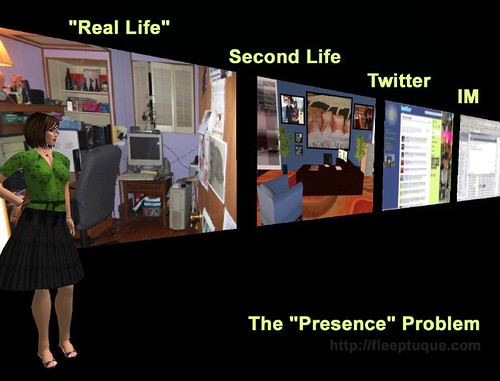
The Presence Problem

Right now I am sitting at my desk in my office at home physically, and at least nominally I’m also sitting at my desk in the Chilbo Town Hall virtually (which is where I park my avatar to let people know I’m probably off in another window instead of paying attention at that moment), AND I’m also “on” Twitter and IM. So, if you wanted to get in touch with me for a synchronous conversation or “visit” with me, you could come to my house in Cincinnati and ring the doorbell, but a) that would probably freak me out unless you’re a really good friend and b) being an internet peep, you’re more likely to send me an @fleep or DM on Twitter, or if we’re good friends you’ll poke me on Gtalk or AIM or send me an SMS on my cell, or if you’re a Second Life resident, you’ll log in and look for me in the Town Hall.

So many places I’m in at once, and that’s just trying to keep things simple – we’re not even including all the asynchronous options. But if you asked me “Where are you right now?” the answer I’m likely to give depends on context – if you called me on the telephone or sent me an SMS I’d say I was at home, but if you IMd me the same question in Second Life, I’d say I was in Chilbo, and if you asked me on Gtalk or AIM or Twitter, I don’t even know which way I’d answer. BUT, the truth is, I’m am in all those places and locations and “mental spaces” simultaneously – and yet it’s not REALLY simultaneous because my attention can only be focused on one “space” at a time.. Or is that really true?

And forget about me for a moment, “where” are all my friends right now? What are they up to and if I have a question or want to visit with them, “where” do I go to find them? With so many options and each relationship/friend connected to me in different ways through different media (some are on Twitter, some aren’t; some are in Second Life, some aren’t, etc.) it gets to be quite complicated not only figuring out where _I_ “am” but also where my friends “are” too.

This is probably a round-about way of approaching this issue, but that’s how the question/problem presented itself to me a few weeks ago when I was crunching numbers from the Chilbo Community census data and saw many comments that Chilbo often felt “empty” and that the residents of Chilbo didn’t know as many other residents as they’d like. I was a bit surprised by that finding, since the traffic reports show Chilbo gets pretty steady traffic, between 700-900 visitors per week, and because I am connected to so many Chilbo folks on so many different platforms, Chilbo rarely feels “empty” to me because even if a Chilbo resident’s avatar isn’t in the sim at that particular moment – I still “hear” what they are up to on Twitter and can still contact them any time through Second Life IM or Gtalk or wherever. I have a sense of where people are from all these other tools and that tenuous connection is enough to convey their “presence” to me that it doesn’t matter that they are not physically in the room with me or virtually in the sim with me. But are others having that experience?

If you’re not on Twitter or other web places, does Chilbo seem even more “empty” or disconnected than if you are? And could that be mediated with some way to “blend” these spaces?

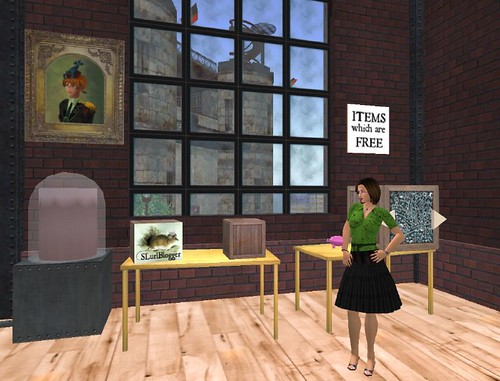
Shopping at Ordinal Enterprises

That was my question. And so I embarked on trying to modify Ordinal Malaprop‘s fantastic TwitterBox script to see if I could attempt to blend two different “spaces” together – the virtual location of the Chilbo sim and the .. “mental space” of Twitter (and if you use Twitter and SMS on cell phones, you know Twitter can be used on the go just about anywhere you are physically).

Now I should note, despite taking a programming class (I got a B+ and was thrilled), I remain stubbornly obtuse when it comes to understanding all of the logic involved in scripting. The lines of code, the variables, the repetition, the test-fail-test-fail all to no avail.. I find it incredibly frustrating. And, it turns out that in my ignorance, I attempted to modify the wrong script – instead of working on the basic one Ordinal gave me, I began with the more complicated one, so this probably took me many many many hours longer than it should have, and I was determined to try to figure it out myself and not bug one of my coder friends to help me, so it was an even longer time before I realized I’d taken the hard path. Doh. However, I am very pleased to report that THIS “Fleep Tries to Program” story has a happy ending! I eventually had to ask for help, but I learned much more about the Linden Scripting Language than I probably have in ages, and I have a working prototype going in-world, so I think all the torture and 3AM nights was worth it.

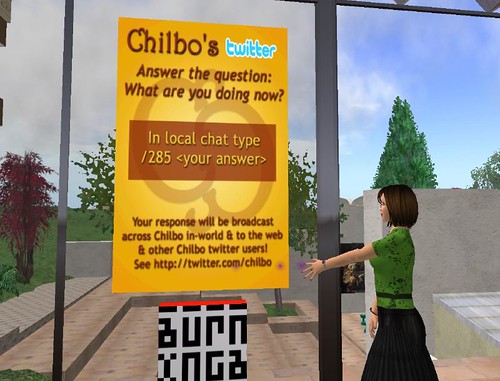
Chilbo Public Twitter Station - Instructions Poster

So what does this thing do? Considering all the effort it took, it sadly does not do your dishes or laundry. What it does do is a) imports tweets from the Chilbo Twitter account and all the people that account “follows” and reports them back out into the Chilbo sim in Second Life by printing the line in local chat and b) allows anyone in the Chilbo sim and within local chat range to send a tweet OUT of Second Life to the web world (through the Chilbo account).

So, if you’re walking down the street in Chilbo and happen to be near a Twitter station, you might hear a little birdie tweeting sound and see text appear on your screen that says “fleep: I’m waiting in line at the grocery store” and a few steps further down the road one that says “malburns: I’m visiting this cool sim in Second Life” or whatever our tweets might say. If you know Fleep and you know Malburns, even if they are not there in Chilbo with you, might you feel that Chilbo is less empty if you have some sense of what Chilbo people are up to at any given moment? Does it change your sense of presence if in some ways Second Life and Twitter are blended together so that your attention does not have to be focused on one OR the other, but can engage with people in both spaces at the same time?

Chilbo Public Twitter Stations disguised as birdbaths..

Will it change the sense of “community” and “connectedness” the residents of Chilbo feel with each other if they can send and see communications to and from Second Life even without being logged into Second Life, or for that matter, even if they don’t have personal Twitter accounts?

I don’t know, but that’s what I’ve been working on lately. I guess we’ll see how it works out. I’m still tinkering with the script, but if you’d like a copy in progress just let me know..


13
Jul 08

5 Years of Having a Second Life

It seems not too long ago that I was making predictions about Second Life and Education in 2008, and here we are more than half way through the year and I find myself helping organize the Second Life Education Community Conference and reflecting on SL’s fifth birthday and I’m just as involved and passionate about the future of education and virtual worlds as I ever was, maybe even more so. Lively and Vivaty made big splashes this week and the ever wonderful Dizzy Banjo released a video of the “Message in a Bottle” that he and Lillie Yifu created for the in-world birthday celebration and I can’t help but get a warm fuzzy feeling recognizing the voices of so many friends… (I’m at about 1:08 in the clip!)

My life has changed so much in the last 5 years, it’s hard to separate how much of the change was influenced by my involvement with Second Life, but I think I can say without a doubt that I owe my friend Spatch a huge debt for sending me that beta invite way back in 2003. It took some time for me to get a machine that could run SL well enough to really do anything with it, but once I did, and I had that first epiphany moment – there’s been no looking back.

Whatever the press may say, or my coworkers who make fun, or strangers who look at me oddly when I talk about what I do, I feel very, very good about my involvement with this platform and despite my frustrations with what feels like excruciatingly slow progress on the part of Linden Lab sometimes, I really can’t complain TOO much. This technology changed my life, helped me discover parts of myself I didn’t know existed, led me to people who share my passion for exploring all of this new technology not just for education in a formal sense, but in a very personal sense – as a tool for self expression, collaborative exploration, and shared experiences. Through Second Life and the people I met there, I got sucked into the blogosphere and Twitter, learned to wrestle with Photoshop and machinima, webcasting, podcasting, and managing a personal and professional network of friends and colleagues all over the world. Second Life changed my sense of time and place, and above all, what IS possible if you have a group of committed, caring, smart people who share similar goals.

Second Life hasn’t been a transformational experience for everyone who came to it, most of my old BBS crowd who started when I did have never returned, or never found a niche or a reason to come back except to stop in and visit me from time to time. But for those of us who have, whose careers changed, whose lives changed, it’s been a truly amazing journey. Just like in real life, I’m terrible at sending birthday wishes on time, but happy belated birthday to SL and thanks to all the wonderful friends who have shared in this experience with me.