@mwesch Are your slides from #TEDxNYED posted anywhere? =) 2 hours ago
@corcosman @chilbo Been trying to login, something wrong with my viewer? TH Draft agenda on the wiki if someone can send a reminder notice. 19 hours ago
@courosa I posted about stickybits earlier today, cute concept but the privacy implications are a little disturbing. 20 hours ago
RT @jokay: RT @SecondLie: Ask M how many of the original Lindens it takes to screw in a light bulb? M shouts "There's still some left? T ... 20 hours ago
This is one of those self-indulgent, reflecting on my own blogging posts, so if you hate that sort of thing, stop reading now.
Wherein the Optimist Wins the Internal (Eternal?) Debate: To Blog or Not To Blog
A friend and I recently got into a heated debate about blogging. The context isn’t important so much, but it made me reflect a bit about my own blogging. (Though I do wonder if I am alone in thinking that sites like Slashdot and the DrudgeReport – no matter how they may have started – are not “blogs”. They are or have become news sites, and news sites are not the same thing as blogs, in my mind.)
What is a blog anyway?
First, I had to separate out what _I_ do that I consider to be blogging. Is Twitter a blog? People say it’s a “micro-blog” but it rarely feels that way to me. It feels more like a group IM conversation with an archive instead of a reflective piece of writing. I think my core definition of blog includes that – a reflective piece of writing is a main feature of the vast majority of blogs. It may reference other sites, it may incorporate different kinds of media, but the essence of the “web log” is a person logging their thoughts, experiences, results, art, images, whatever documentation that can be submitted to the “web log” system, so that others can learn and share from our experiences, so we can learn from the experiences of others, and so we can contribute some part of ourselves to .. well, the world – the world wide web log system, the internet, the metaverse – whatever you want to call it.
This is my blog. This is where, when I can, from time to time, I try to share something of interest to the world. Whoever’s listening, whoever’s reading, whoever shares a passion for the same things I do – here’s the stuff I’m working on. I’m trying to “web log” my work, parts of my life, parts of my family, parts of me. I don’t get as much time to do it as I wish I could, I’m not nearly as skilled at all the different forms of media as I wish I were, and I often self-consciously worry terribly about what people will _think_ of what I say or what I do – but I want to try to share my stuff with people who might care, and I want to have a web log for myself, so I can go back and reflect on what I’ve said, reflect on how my views have changed, or remember why it was that I chose some path that didn’t work out at all like I intended.
A “blog” to me is personal. This blog is personal.
And in this age of .. such rapid change, with all notions of privacy being challenged, of a time in my life when I wear so many hats I couldn’t print a business card that would fit, when my work (which I personally define as attempting to study and help provide answers to the questions: What’s happening on the internet and particularly in that part of the internet they call “virtual worlds”? What implications does it have for education and for society as a whole? What or which of these tools are most effective for teaching, learning, sharing ideas, and instigating positive change?) is studying a rapidly, constantly dynamic phenomenon that I can only study by doing and being involved in to understand the technology well enough to study it.. What part of my life or my work is personal?
Isn’t ALL of it personal?
Is that a stupid question?
Why teachers, professors, and educators should blog
I try in my workshops to talk about how a technology can be used, for teaching, for personal discovery and learning, for organizing distributed workforces or volunteers, for communicating with constituents – but essentially, I don’t know if any of it makes sense until you’ve done it yourself – for yourself. It’s hard to understand the real power of a “web log” until you’ve done it and seen how much it improves your own learning.
For every instructor or faculty member who has asked the question – why would _I_ want to blog? That would be my answer. We talk about experiential learning, and reflective writing, and all the appropriate buzzwords, but in terms of a tool that really truly enhances and promotes experiential, self-reflective learning, I almost can’t think of a better tool than a blog. Telling a story, to yourself or someone else, and creating or finding the media, creating the narrative, and sending it .. out there, into the big world of all the people in the world having a conversation or sharing in the big web log system, is, frankly, a thrilling experience. Or it can be, it should be. The ability to create something, share something, document some part of your experience, communicate with others who share your passions, create an archive for yourself to learn from too – it’s journaling in the 21st century. All of the great forebears of science, philosophy, and human knowledge recorded their experiences, publishing research is the heart of academia, and the web simply provides a better way to do it.
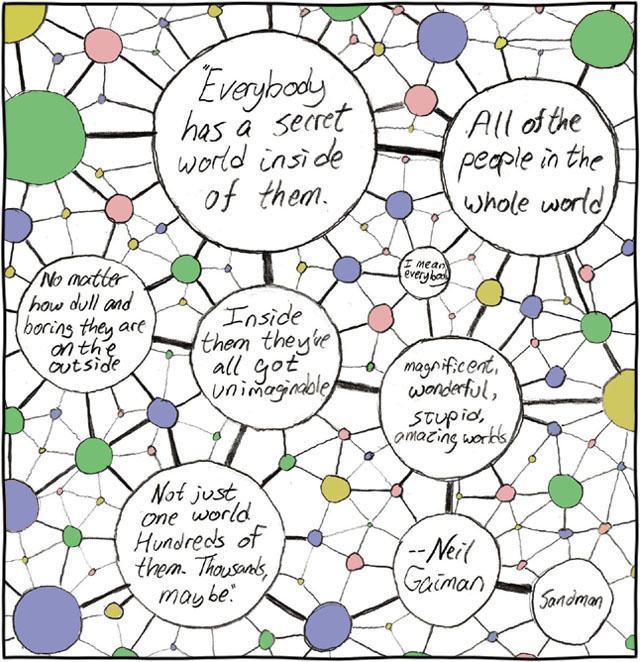
The “blog” – no matter how far they stretch the term in the media – is a reflective piece of writing that exists for its own sake or ties together all of the elements of an “entry” that is thrust into the global web log system of human knowledge. When you put it out there, you’re talking to everyone, anyone. You’re talking to the person who is reading it now, and the person who will read it tomorrow, and all the people who will read it in the future to come.
What do you have to share with the world of now and the world of tomorrow? What do your students have to share?
Education, at its core, is about training people to think rigorously. It is about teaching people how to distinguish between signal and noise, correlate data, understand cause and effect, think broadly about the implications of our choices, and contribute something meaningful to society as a result of this training.
Speaking with your Digital Voice
To me, this is the beauty of blogging, of twittering, of connecting.. Watching the “web log” and learning from it, seeing my experiences echoed in it, recognizing and appreciating the art in it, applying what I take from it (to my own life and to my work), these things make blogging and participating in the conversation worth the investment of time. The reward, the return, is enormous. The power of finding the information I need or want when I need or want it, of finding the people I need or want when I need or want to talk to them, running across information I didn’t even know I needed – this stuff has changed how I work, how effective I can be, how many people I can reach, teach, learn from – it allows me to be my own teacher, my own guide, and still find the wisdom and the guidance from others whenever I am receptive and ready to learn from them.
Podcasting, videos, virtual worlds, blogging, twitter, social networks, social media, wikis, YouTube, they’re all elements of the same thing – using your digital voice to speak. It is simply another mode of human communication, one with many implications for changing society in the future, and every student, and every teacher, should learn to speak with their digital voice. When you do, the results of what you share are better indexed, searched, and located, which allows others to find you and you to find each other so that between you – between us – we can do a better job of.. whatever it is we want to do (or need to do).
Using our Digital Voice to Solve Real (Big) Problems
The people of the world seem to agree – global warming is real. The people of the world seem to agree – solving the energy crisis is one of the great challenges of our time. The people of the world seem to agree – giving every child an opportunity to live, grow, and learn in safety is a priority. The people of the world seem to agree – actually on quite a number of things. And what we disagree about, what we argue and debate about, the choices we make in our real lives as a result of our experience or nature or knowledge – the web log system is one way we are working it out and looking for answers, looking for solutions, or maybe just the right questions.
Everyone I know these days is saying and thinking, “There has to be a better way of doing things. The world seems like a mess.” We, as a people, have unprecedented power to reach each other, learn from each other, and work together using our digital voices. Why aren’t we using it to solve the big problems ourselves? Why does it seem everyone is waiting for Them to come up with the answers? Institutions, governments, NGOs, charities, your boss, the board, the People In Charge.
I’ll ask again – why aren’t we solving the big problems ourselves?
I think I’ve come to the conclusion that not enough people with not enough of the right skills know how. I don’t know how, myself, I’m trying to learn. I’m trying to understand how my own actions help or diminish my own cause(s), I’m trying to understand how best to leverage my time and my resources to help solve common problems – or is that ridiculously naive?
A Bad Addiction or Addicted to Empowerment?
Maybe I’m just addicted to the fire-hose, watching the next generation’s version of the boob tube on endless repeat except there’s no repeat – just a steady stream of fresh data, fresh experiences, fresh laughter, fresh music, fresh conversation, fresh opportunities, fresh challenges.. all of the stimulation, freedom, creativity, joy, efficacy, acceptance, and .. empowerment.. that I feel quite denied in the “real world”.
I can’t afford to drive all over and pay for concerts. I don’t have the right credentials to help plan cities or communities or spaces in the real world. I don’t have the right wardrobe to attend certain kinds of functions. I don’t have the capacity to hop-skip around the world to meet a colleague for coffee and chat when I have time. But I can do all of these things online. I can practice at any number of things that relate to people, to creating, to planning, to experimenting.. with virtual things instead of physical things. Virtual resources are, electricity permitting, infinite. Time is not. Talent is not. But if I need to get people together to help me solve a problem, or create a community, if we collectively are going to solve the really big challenges of our time, I’m more convinced than ever that we’ll need our digital voices to do it.
That’s my optimistic answer for why you should blog, why I should blog, why my mom should blog, why teachers should blog. I dunno if that’s right though. The pessimist wins some days.
Screaming 3D Bootstrapper Csven Concord had been pinging me for weeks about the Superstruct game organized by the Institute for the Future. I finally got a few hours to take a look at it and was stopped cold at the very first mission of the game: describe yourself in the year 2019. Not a fantasy you, but you you, where you think you might actually be. It took me three days just to accomplish mission #1 to make my profile.
My efforts to get into the Superstruct mindset were somewhat hampered by the technology being used. Not sure if it’s just my PC or that I’m using the FF3 browser, but I continually have to relog into the site over and over just to navigate around (is it not tracking cookies properly or what?) and the framing they use makes it hard to grab direct links to specific content. With some trial and error, I finally got to Cven’s Screaming 3D Bootstrappers Superstruct page, and managed to add myself to the S3DBers wiki page, and saw a call for help under the heading “Young Farmer’s Outreach”:
Request: “we need 3d VR environments that mimic the reality of a farm/ranch so that our young farmers can share their skills”
So the idea is that it is the year 2019, and five major superthreats are having devastating effects on human populations. To play the game, you create or join Superstructs (groups) to address one or any of these threats by using your unique talents, resources, and perspective to generate ideas, stories, videos, websites, pictures, or anything else that helps us imagine how life would really be in that situation and what solutions might really work to address the problems we face in this fictional reality of 2019.
In my imaginary 2019, the Chilbo Community has grown tremendously into a large, global community in the metaverse. To deal with the Ravenous superthreat – where major disruptions in the global food supply chain threatens the world with starvation and lack of healthy, nutritious food – the Chilbo Community has established a virtual garden to allow farmers and scientists from anywhere in the world to help people learn to grow their own gardens. In this fictional world of 2019, Respiratory Distress Syndrome (ReDS) has also forced many cities and populations into Quarantine, so the Chilbo Community Garden might be especially useful for those stuck in quarantine zones where access to food supplies may be dwindling. By using virtual world technologies to connect people who cannot visit one another in real life, we can spread information about sustainable farming to a larger audience, use the 3D modeling capabilities of virtual worlds to create roleplay scenarios, display equipment and demonstrate techniques, and reach populations who are isolated because of possible contagion.
To flesh out this idea, I worked with some Chilbo residents to actually build out this garden in the Chilbo Nature Preserve in Second Life, and recorded a machinima clip to “report” on our progress in the year 2019. This is only the second machinima I’ve ever made, so pardon the amateur execution.
When I think about the future of education, I wonder why we don’t spend more time doing THIS kind of work. I wonder if we’re teaching students the skills they need to really evaluate information on the web in context. For example, in the process of “playing” this game, I came across the ReDSNet Project website. Now, this website is so well done, so realistic, it would be easy to think ReDSNet was real. How many students would have the skills to read for content AND context and eventually discover that this is a fictional website? How many students would have the creativity or skillset to create a fictional website that was so convincing? How can we use these types of .. roleplay scenarios to build digital literacy skills that really WILL be useful in the year 2019?
I wish I’d had more time to spend on the Superstruct game/concept. It was really a fascinating, thought provoking exercise. And even if the machinima still doesn’t make any sense to anyone but me, I enjoyed the experience, I spent some time seriously thinking about my own future and where I _want_ to be in 11 years, I got an excuse to practice my machinima skills, and I strengthened some bonds in my network, personal and professional. Quite an accomplishment for some crazy collaborative game on the intarnets that I only had a few hours to play.
This post is for Prof. Jenning’s Communication & Technology class. If you want to comment, please comment back on the class blog so Prof Jennings sees it! – Fleep
(This post is about the Massively Online Open Course called Connectivism and Connective Knowledge being taught by George Siemens and Stephen Downes from September to December 2008. Over 2000 participants have signed up, and I am facilitating the Second Life cohort for the course. Over the following months, I will be posting about the experience, home work assignments, and other materials related to our activities.)
Suggested Reading for CCK08 & CCK08SL
Not that those of us in the CCK08 course don’t have plenty to read and keep up with already, but I’ve received quite a number of questions about the Second Life cohort of the Connectivism class. If you aren’t sure what Second Life is, what virtual worlds are, or why they might be applicable in a connectivist context, I think Sarah Robbins-Bell’s article Higher Education as Virtual Conversation might be a good text to read.
She writes:
We know that the demographics of Facebook, Digg, Fark, and World of Warcraft are the same as the general demographics of college/university students. So, why don’t we see the same levels of participation in the social media that are used in the classroom (typically, learning management systems) as are evident in the social media that students engage in voluntarily? I think the problem is that our pedagogy often isn’t ready for an increase in conversation.
She goes on to examine the specific characteristics of virtual worlds and how they are manifested in the Second Life platform, a good primer for those who aren’t familiar with it, and continues with an analysis of how these platforms can facilitate an increase in conversation and dialogue – between and among students, students and instructors, and students and the world. More than just conversation, she demonstrates how they can be used to facilitate active and participatory knowledge making (and some things we SHOULDN’T do in virtual worlds that can shut down that kind of knowledge making).
A persistent world offers persistent learning opportunities. It is up to the instructor and the student to define and explore what kind of activities will be useful for the learning goals of a particular course, but it’s possible that many of those goals can be accomplished in the community at large rather than in a delineated space intended for “learning.”
Second Life Education Multimedia
If it’s still hard to imagine what kinds of educational projects are taking place in Second Life, Claudia L’Amoreaux (SL: Claudia Linden) gave a keynote yesterday at the Holland Open 2008 conference in Amsterdam, accompanied by this beautiful and rich Vuvox collage called “Open Mind”. Take the time to explore it, it contains many types of embedded media.
Hopefully a few minutes with these resources will give some sense of what the Second Life cohort is on about in the Connectivism course.
I’ve been a bit deluged this week with last minute preparations as the start of the new school year approaches, but I wanted to take a moment to post about the September/October 2008 issue of EDUCAUSE Review.
If you have any interest whatsoever in virtual world technology and how it is being used for education, I highly recommend taking a look at this issue. I felt so honored to have been asked to contribute an article (Looking to the Future: Higher Education in the Metaverse), but feel even more so now that I’ve had a chance to read all of the contributions by my colleagues. They write about theoretical and practical questions we all should be asking, describe a wide variety of use-cases across many disciplines, and give us thought provoking glimpses of what the future may hold, as both teachers and students, individuals and institutions. It’s good stuff!
It’s really great to see the work of so many friends and colleagues highlighted – especially when I know how much effort, thought, and preparation has gone into their projects – and I hope it will inspire other educators to take the plunge into this fascinating and complex space.
Many thanks to all who lent their support and advice when I was wrestling with my contribution!
This panel will feature a discussion about the current state of virtual worlds and how they may evolve in the future. What do we hope to see? What would be a “bad” outcome?
Moderator: Fleep Tuque
Panelists: Malburns Writer, Tara Yeats, Olando7 DeCosta
Second Life Community-Building: What We’ve Learned – Island Experience
Saturday, 8/23, 11:00 AM SLT
Location: Shrubbery Amphitheatre
SLurl: http://slurl.com/secondlife/Chilbo/167/129/109
This panel is one of a pair of panels that will take a look at lessons learned that can make – or break – communities in Second Life. What’s the “glue” that holds virtual world communities together? What helps people engage? What are the challenges? What Second Life tools and features help – or hinder the process? Saturday’s panel will focus on island communities; Sunday’s panel will focus on mainland communities.
Moderator: Tara Yeats
Panelists: Sophrosyne Stenvaag, Director, Extropia Core; Fleet Goldenberg, Community Manager, EduIsland II, 5 & 6
Second Life Community-Building: What We’ve Learned – Mainland Experience
Sunday, 8/24, 12 NOON SLT
Location: Shrubbery Amphitheatre
SLurl: http://slurl.com/secondlife/Chilbo/167/129/109
This panel is one of a pair of panels that will take a look at lessons learned that can make – or break – communities in Second Life. What’s the “glue” that holds virtual world communities together? What helps people engage? What are the challenges? What Second Life tools and features help – or hinder the process? Saturday’s panel will focus on island communities; Sunday’s panel will focus on mainland communities.
Moderator: Tara Yeats
Panelists: Prokofy Neva, Owner, Ravenglass; Fleep Tuque, Land Steward, Chilbo Community Building Project
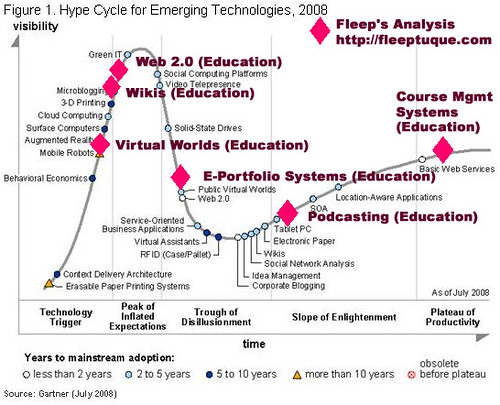
Virtual World News alerted me to Gartner’s latest “Emerging Technology” Hype Cycle analysis, and I was a bit surprised to see where they placed public virtual worlds, particularly in relation to Web 2.0 and wikis.
Gartner shows wikis far out in front of Web 2.0 generally and Web 2.0 and public virtual worlds neck and neck. I don’t think I agree with that analysis if applied to an educational context. Based on my experience in the field, I’d have put Web 2.0 and wikis much closer together and before the peak of Inflated Expectations, and put virtual worlds even further behind. I’ve added some other educational technology markers for comparison (again, this is based on my own “anecdata”).
Where would you put these markers based on your experience?
RezEd Interview with James Paul Gee
If you’re involved in education and virtual worlds and haven’t yet joined RezEd, take a minute to do so now. They’re creating not only a really terrific community, but also a very rich repository of resources, information, interviews, and best practices. SLEDcc has a group that you can join, but I’ve been very impressed with the quality of their podcasts and best practices guides.
James Paul Gee - image courtesy http://rezed.org
This week they interviewed James Paul Gee, author of the seminal book What Video Games Have to Teach Us About Learning and Literacy (a must read). In the interview, he discusses how video games and virtual worlds can be used to help address some of the major deficiencies in modern educational systems – letting learners produce the lesson content instead of just “taking it in” and how virtual worlds help kids develop complex literacies through experiential and situated learning. Good stuff!
So many things happening right now, I haven’t had time to even blog about them all! Two events happening today and one archived event below.. hope to see you in-world!
ISTE Speaker Series Event
Tuesday, July 22, 2008 – 6PM SLT/9PM EST
Robert Bloomfield (SL: Beyers Sellers) is the host of Metanomics, a weekly broadcast (Mondays at Noon SLT/PDT) focusing on current trends and developments impacting vitrual worlds. Their archived events listing powerfully illustrates the depth and breadth of their weekly productions. ISTE is proud to be partnering with Metanomics to bring our audiences together in the hopes of facilitating dialogue, networking, information sharing, and join innovation in Second Life. Beyers will be joined by our very own Chris Collins (SL: Fleep Tuque, a correspondent for Metanomics) in a lively, open discussion surrounding the question, “How can Metanomics, and the Metanomics archives, inform K-20 educators, librarians and instructional technologists who would like to use information about business and policy in virtual worlds?” This will be a voice presentation, please be sure you have a working voice setup prior to the event!
Virtual Policy 2008: A conference on innovation and governance in virtual worlds
London, England – July 22 & 23, 2008
Virtual Policy 08 is set to be a land mark event focusing on global virtual worlds sited in a European legal and regulatory context. The key policy themes for this year’s event are:
The event is targeted at industry representatives, legal scholars, policy makers and regulators from around Europe and the rest of the world and is a unique opportunity to interact directly with key stakeholders.
Virtual Policy is organised by the Virtual Policy Network (tVPN: www.virtualpolicy.net ) in conjunction with The Department of Business, Enterprise & Regulatory Reform with New York Law School providing program support.
BlogHer 2008
This past Saturday, I participated in a BlogHer panel in world. The conference took place in San Francisco and in Second Life and our panel covered Second Life as an Educational & Training tool. Scan the liveblog notes for the highlights on the panel.