08
May 08

Weblins – another transitional step to 3DWeb?

I was hanging out with @malburns and @tarayeats yesterday evening in Chilbo and we were having a wide ranging discussion of all things Second Life, Web 2.0, and virtual worlds more generally, when Malburns mentioned this cute little program at http://weblin.com. He was describing how it gives you a little avatar and you “teleport” from webpage to webpage, but I couldn’t quite grasp what he was saying until I tried it for myself.

Weblin.com homepage

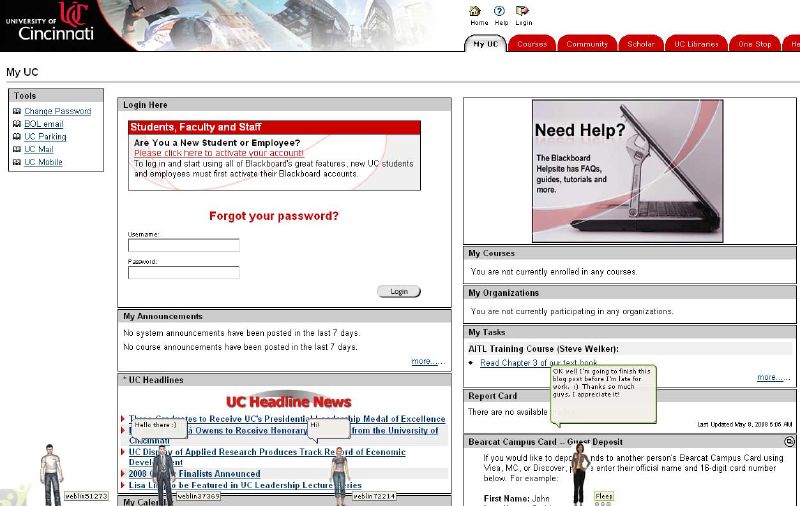
This is a screenshot of the Weblin.com website, and you’ll notice along the bottom of the screen that there are a bunch of little avatars down there. Mine is in the lower right corner and hey presto, it’s actually an image of my Second Life avatar.

So in effect, you download this program and install it (doesn’t work with Macs yet), and then as you browse the web, you are represented by this little avatar and you can see the avatars of any other Weblin user if they happen to be on the same page as you. Which means, of course, that the solitary and isolated experience of browsing the web is transformed into a _social_ experience. I can pop over and see who else is checking out the CNN homepage. I can start a spontaneous conversation. I can add friends and invite them to view the web page I happen to be at. I can hang out on my OWN webpage and see who stops by for a visit and say hi.

I think this is something of a paradigm shift, and another transitional step to the fully immersive 3D Web or whatever you want to call the evolution we see happening with online social networks and virtual worlds technology.

How could this be useful for education? I’m glad you asked!

Weblins at the UC Blackboard page
University of Cincinnati Blackboard homepage, with little Weblins hanging out below.

Imagine students going to their course website to get information about an assignment, but instead of being there “by themselves” they run into a classmate who happens to be there at the same time. The visual representation of an avatar, something that indicates co-presence, opens up all sorts of opportunities for spontaneous dialogue, greater engagement with the course material, and additional network building. Imagine if the instructor popped in and was available to answer questions about the assignment on the spot, or even held “office hours” at the course website at specific times.

But wait, you’re saying, this is already possible with Instant Messenger or an embedded chatroom or any number of other tools, and of course that’s true, but the sense of _co-presence_ we keep talking about in relation to 3D immersive environments is simply not replicated in a text based chatroom environment. I can’t _SEE_ you in a chatroom. I can “see” you with a weblin. Beyond that, the chance encounter aspect, the ability to meet random other people who happen to be, for that moment, reading the same webpage that I am reading, wherever they are in the world, is something that intentional entry into a chatroom can’t replicate.

Co-presence, immersion, deeper engagement, serendipity. These are some of the keys, even if I’m not sure exactly what we’re unlocking.

Want to try it for yourself? Click this link which should take you back to my website, but this time with a little demo Weblin of your own. And maybe I’ll be around here to say hi. 🙂

(With thanks to twitter friends @iAlja and @iYan for stopping by the UC Blackboard page so I could get a good screen grab!)


03
May 08

Dean of SL Law School Speaks at SL’ang Life Education Conf…


Julynn Lilliehook, Dean of the soon to be opened Second Life Law School, spoke at the “Educational Possibilities of Second Life” series, sponsored by SL’ang Life magazine.

“I have found in both RL and SL that people are very uneducated about the laws that affect them,” she said, “In SL it’s vitally important to me that people outside of the USA understand the Ameican legal system, since most of what the world learns about the US is media driven. I’m also very interested in hearing about how the legal systems operate in other countries.”

According to Julynn, the school will be focusing on educating Second Life residents on legal systems and issues, it will not be focusing on training lawyers. “I would like to have at least one lecture series session per week, plus 3 or more sessions per week on particular topics,” she said, “and then a weekly open discussion session.”


posted by Fleep Tuque on SlangLife using a blogHUD : [blogHUD permalink]


30
Apr 08

Hey! I’m on (Draxtor) TV!

Life4u reporter Draxtor Despres just sent me an IM about his latest report on the past week’s vBusiness Expo and Federal Consortium of Virtual Worlds in Second Life. I was a speaker for the Education track at the vBusiness Expo and Draxtor interviewed me afterwards. Look ma, I’m on virtual TV!


30
Apr 08

Essayish: Traditional Learning Spaces in Virtual Worlds

What follows are some thoughts that have been percolating since I read Peter Ludlow’s critique of virtual campuses in Second Life (Chronicle article) back in early December (talk about a long tail, eh?) and recently re-sparked by some conversations on the SLED listserv. In any case, the question about traditional learning spaces keeps coming up, so I thought I’d address the issue head on. This is a first draft, any feedback?

Traditional Learning Spaces in Virtual Worlds
by Fleep Tuque

I have been involved with education in virtual worlds for several years now, and at discussions and conferences I often hear the question asked, “Why recreate a classroom with desks and PPT presentations in a world where anything is possible? Why create buildings with roofs and walls in a place where it never rains or gets cold?”

These are good and interesting points to consider, and certainly one of the most exciting aspects of virtual worlds is the sense of limitless possibilities they offer – we could hold class in the clouds, or on a beach, or in an environment imagined and created by the students themselves, for that matter. I think many educators hope that the flexibility and endless creativity available in virtual worlds will help us re-think and re-examine our teaching spaces and practices – not just in the virtual world, but in the real world, too. I count myself in that camp and think rigorous questioning of our teaching methods and learning spaces is very important, particularly in light of the changing landscape of knowledge production, aggregation, publication, and sharing that we’re seeing with Web2.0 technologies.

Having said that, however, I’d like to make the case for why you _shouldn’t_ scoff at the countless university islands in Second Life with traditional buildings containing traditional classrooms with traditional desks and chairs and the ubiquitous PowerPoint slide presenter. I’ll add this caveat: If in 10 years those Second Life islands still contain nothing but traditional buildings with traditional classroom spaces, then you have my permission to scoff and you should. But today, hold your scorn in check, because what you are seeing are the artifacts of learning taking place, and who of us ever gets anything perfect on the first draft?

I’ve personally introduced the concept of virtual worlds and Second Life to hundreds and hundreds of people. From my grandfather to college professors, from personal friends to strangers and students and administrators and geeks and non-geeks alike; I’ve sat through their first tentative steps, encouraged them to explore, and watched as many decided it wasn’t for them or took too much time or wasn’t far enough along yet. I’ve also watched as some smaller percentage become intrigued and stick with it long enough to cross the line into immersion, and I see patterns in what happens next – across gender and age lines, across populations with varied levels of computer and technology access, skill, and know-how, and even across cultural and national identities.

The first step for the majority of folks is to recreate what is familiar. The first spaces they create are meaningful _real world_ symbols that resonate within the context of their engagement with the _virtual world_. Teachers look for classrooms, administrators look for familiar campus landmarks, librarians want to know how to make books. Friends create houses and gardens and look for fancy cars and luxury items they don’t have in real life. My mother looks for virtual replicas of the types of furniture she wants to put in her real life sewing room.

For some people, the transitionary period seems to be much shorter – before long they tire of recreating the familiar and move on to exploring the limits of the platform; instead of recreating their house, they imagine a house in the clouds or skip the concept of a house altogether and begin building fantastic creations that simply are not possible in real life. Given enough time, and the resources and learning communities that speed learning, teachers begin to hold classes around campfires and in tree houses. They might not demolish that first traditional classroom they built, though, not yet anyway, because man that took a lot of work and there is some pride in the accomplishment and some nostalgia in remembering those early days when the virtual world was new and fun and not yet coupled to responsibility or work (for those who begin to use it seriously to teach, believe me, it’s a lot of work!). It’s the equivalent of a child’s crayon drawing that you don’t throw away, but rather hang on the fridge as a reminder of how far they’ve come.

But for others, the transitionary period takes much longer, or perhaps for their own personal reasons never happens at all – they choose to spend their time in and create for themselves spaces that are symbolic replicas of the real world. Maybe with some sparkly floating stars and a few bells and whistles not normally seen on Main Street, but for the most part they stay in spaces that evoke something you might see in the real world. My own Second Life community called Chilbo looks and feels like a small, cosy village, and we like it that way. Who are you to judge if it serves our purposes?

But to bring this back to education in particular, it seems unfairly harsh to criticize the early efforts of individuals and institutions who are exploring virtual worlds for the first time. A recognizable school building _does_ serve a purpose – it says to the newcomer “This space is intended for learning!” A classroom with desks and podium and PowerPoint projector allows a teacher new to virtual worlds to experiment with a new interface while keeping all the other variables the same. And in terms of looking at a campus space, what we see manifested in that space often is not the result of one person’s journey, but the result of a group experience, with laggards and speed demons mixed in with bureaucrats and oversight committees, and relics of past stages of learning that simply haven’t been torn down yet.

There are some imaginative and creative teachers who perhaps never built a classroom in Second Life at all, because they chafe at real life classrooms already. That’s terrific, and I hope that virtual worlds will provide a giant laboratory for us all to experiment and play and explore other possibilities, other configurations. There are some instructional designers who can extrapolate from their experiences with other technologies and immediately seize on using virtual worlds for what they are best at (co-presence, simulation, collaboration, prototyping) and leave the quizzes and notes and document repositories on their course management system, which delivers those types of content better than virtual worlds currently can. That’s terrific too, and probably results in a more effective learning experience for students as a result of their wisdom.

But for every instructor who experiments with delivering a quiz in the virtual world, one of them might stumble upon a method that IS more effective than the course management system. I haven’t seen one in Second Life yet, though the Sloodle chair that moves a student higher up in the air the more questions they answer correctly is a step in that direction, but that doesn’t mean there won’t ever be one. And it doesn’t mean that we shouldn’t _try_ and encourage others to try.

Critiquing our and our institutions’ efforts in virtual worlds is good practice, and it is imperative that we continue to push our own boundaries and not get locked into habits or practices in the virtual world that we don’t even like in the real world (true story, I rarely use PPT in real life presentations, but find myself using them more often than not in presentations I give in the virtual world), but to instantly dismiss every replica of a traditional learning space in a virtual world without understanding the context in which it was created, the purpose and intent with which it was to be used, is not only unproductive, I think it may even be harmful. No one wants their sincere efforts to be mocked, and as teachers and educators, we shouldn’t be engaging in that kind of behavior. We should be showing alternatives, starting conversations, and experimenting with new solutions to stubborn old real world problems that we can share with our colleagues.

I’ll continue to create familiar classroom spaces for faculty who are brave enough to explore these virtual worlds with me, because my goal is to facilitate their learning, and I believe learning should be student centered – don’t you? As far as I can tell, the best way to speed that process isn’t to refuse to build a classroom with a roof, it’s to create a classroom to real life dimensions with roofs and all and let them experience bumping their head every time they try to fly. And some examples of traditional learning spaces, I hope to keep for a very long time to come. I’m very fond of the little one room school house that sits on our virtual campus, complete with desks and chalkboard. It reminds me that learning can happen anywhere, that good teaching can happen anywhere, and that we truly are pioneers in this increasingly digital, computerized, information saturated, complex virtually real world.
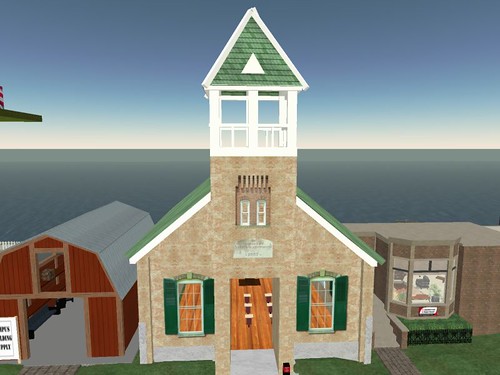
One room school house

To be pioneers means that many of our efforts will fail, that the development of virtual learning spaces will be iterative, and that the real world symbols of teaching and learning will take time to morph into something else even in the virtual world. I think we should be patient, take a longer view, and do some very real research into the efficacy of all sorts of learning spaces and teaching models in virtual worlds. And in the meantime, we should let people experiment with teaching and learning in whatever spaces feel the most comfortable for them, because in virtual worlds, we’re all learners – even the teachers.

26
Apr 08

Panel on Education in Virtual Spaces


Sarah Robbins (SL: Intellagirl Tully) of Ball State University chairs a panel with Jeremy Kemp (SL: Jeremy Kabumpo) of San Jose State University and Jeremy Hunsinger (SL: buridan Simon) of Virginia Tech about the future of education in virtual spaces. As long term veterans in SL education, Jeremy Hunsinger points out that educational gaming and 3D spaces have long been a part of the academic computing tradition, and asks, “The future isn’t all face to face, is it?” Jeremy Kemp remarked that he expected to see more concrete data about effective teaching practices in SL than we have seen up to this point. “We need to be studying the efficacy of these models,” he said.
posted by Fleep Tuque on Clever Zebra 3 using a blogHUD : [blogHUD permalink]


26
Apr 08

Human-Centered Research for Avatars


Aleks Krotoski from the University of Surry and Mark Bell from Indiana University discuss best practices for performing survey research in virtual worlds like Second Life. One key affordance of doing research in virtual environments is the ability to capture reams of data, not just from the avatar, but also the environment itself. Aleks (SL: Mynci Gorki) suggests researchers try to focus on the data they really want, since you can capture more than you need. Mark Bell (SL: Typewriter Tackleberry) announced a new SL HUD-based survey tool his team has created to simplify data collection while preserving the immersion of the environment. Both suggest that researchers approach campus IRB groups early on in the process to help ensure plenty of time for answering their questions about the environment.
posted by Fleep Tuque on Clever Zebra 3 using a blogHUD : [blogHUD permalink]


26
Apr 08

IBM’s Sandra Kearney on 3D Internet & Virtual Business for…


On the third day of the vBusiness Expo in Second Life, IBM’s Sandra Kearney, Global Director for 3D Internet & Virtual Business, speaks about the evolution of internet technology and the potential of virtual worlds for work and collaboration. She sees an ecosystem of technology tools, platforms, and services that are springing up around this 3D Internet concept, from machinima and broadcasting tools, to fully immersive 3D platforms like Second Life. “We are closing the gap between static and real time information, interaction and experience in a cost effective manner,” she said. She also raised questions about developing good governance mechanisms for these environments.
posted by Fleep Tuque on Clever Zebra 3 using a blogHUD : [blogHUD permalink]


25
Apr 08

Virtual Worlds & Law Panel


Benjamin Duranske moderates a panel about virtual worlds and legal issues that arise from working in them, and Dave Elchoness (SL: Da Etchegaray), Executive Director of the Association for Virtual Worlds, brings up an important point – if a company hires a builder or scripter in Second Life, what are the legal implications in terms of minimum wage laws, pensions, and employee rights? These are questions that still need to be addressed, he says, and both companies and employees need to consider these issues.
posted by Fleep Tuque on Clever Zebra 3 using a blogHUD : [blogHUD permalink]


25
Apr 08

Accelerate Reports on Corporate Responses to Virtual Worlds


From the vBusiness Expo in Second Life – On-boarding new hires with virtual worlds, John Boring, Accelerate

John reports on study to gauge barriers and interest in virtual worlds from corporate sector, sneak peek from the report:

Top 5 Barriers to Adoption of Virtual World Tech

1. lack of clear ROI is strong #1
2. worry about insufficient resources to build or maintain
3. corporate culture
4. lack of executive support because age 35+ are the deciders and they still see these as video games
5. data security

Top 5 Apps they think virtual worlds will enhance/most willing to work with

1. sales training
2. collaboration
3. knowledge management
4. employee engagement
5. stimulating creativity

He thinks the culture change will be bottom up, as younger managers who are already experienced gamers come in to upper management levels and get to make decisions.


posted by Fleep Tuque on Clever Zebra 3 using a blogHUD : [blogHUD permalink]


19
Apr 08

Testing a Google Map – Virtual/Real Travel

Testing embed code for a Google map I created that shows the real life locations that I have visited to give presentations or learn more about Second Life, virtual worlds, and Web 2.0, and social media. (Hint, they’re all the same thing.) The lighter blue markers are places I traveled to “virtually” to attend or present.


View Larger Map

Does it work?

Update: Ok looks like that worked. The map makes a couple of points clear to me. First, the stereotypical perception that everyone heavily involved in Second Life or virtual worlds or web stuff is a closet shut in geek who never leaves the house clearly isn’t true. I do leave the house, lately more than I’d like to. Which leads me to the second point, that I’m feeling rather unhappy about doing so much flying and driving to talk about virtual world and web based technologies with people face to face. It just doesn’t scale, for one thing, it’s exhausting for another, and even though I’m very grateful my employer sponsors my work related travel, it’s also expensive. Don’t think I can pull a Christian Renaud from Cisco, who told us at the Dr. Dobbs Life 2.0 Summit that he would no longer be giving presentations in the flesh to cut down on needless travel, but I’d definitely like to travel less and still reach my audience. Hm.

Last point maybe the most important though, and that is, if I think back over all the things I’ve attended or presented at, virtually or in person, I think in terms of _content learned_, being on task and not just socializing, but learning about the topic we all reportedly gathered to discuss, the virtual events win hands down. The social networking at real conferences is just as crucial, I think, to one’s professional development and success, but in terms of actual _learning_, I seem to retain more, pay closer attention, and stay on task when attending a virtual conference session as opposed to a real one. Maybe that’s just me, but an interesting thought anyway.

I hope to show this map on Monday when I and some colleagues give another Second Life Bootcamp workshop at the US Distance Learning Association Conference in St. Louis. I think it demonstrates how crucial the discussions about Second Life and other web based technologies have been to my professional development over the last year.

Update2: Last edit, I swear. This is missing a ton of events I’ve attended with real world location counterparts, and another ton that only happened in a virtual world, no idea how to map those. You also have to zoom out to see the ones on other continents. I feel so.. virtual worldly. 😉