I just read a very interesting post from my friend Aldon Hynes over at Orient Lodge, where he gives a good summary of some themes from Computers, Freedom, and Privacy 2008. The issues he raises are important ones – the human connections that power social media and concerns about privacy and due process for those of us who are investing our time, work, and money into these tools.
The concept of “due process” derives from legal rights that we enjoy as citizens, but in a virtual or viral community, we are users or accounts, on many different platforms, across various service providers, and it isn’t yet clear how due process applies in these environments. Over and over I hear service providers claim that they are just that – service providers – and not even guaranteed service providers, for that matter. They may terminate your account for any reason or no reason at all with no recourse, and they steadfastly claim that they are not mediators, not arbiters of content, not responsible for conflict resolution among users unless a law has been broken or someone is endangered. Wait, scratch that, they are not responsible unless a law has been broken, period.
In terms of building real, sustainable digital communities and productive endeavors (in economic terms), this seems like a particularly destructive long-term approach on the part of the service providers. As a user, I don’t want to be stuck waiting for our legal and political institutions to solve these problems, because at their current glacial pace, I’ll be dead before that happens. There are too many barriers; hundreds of jurisdictions and competing legal systems, widespread ignorance and hysteria about the digital metaverse, simple ineffectiveness. I have work I need to do _now_, I have conflicts and issues that need to be resolved _next week_ not next century. The technical implementations of these various platforms govern the behaviors of its users – what we can and can’t do – and it sure seems like there must be ways to leverage this emerging cloud, this network effect, to enable self-governance mechanisms. Trust models, participatory models, strength of P2P network connections that are sustained over time, across media, this stuff should be giving users the ability to decide for themselves who is credible and who is not, and to take appropriate action accordingly. The service providers who figure this out will win the game, I think.
I’m not going to ditch Twitter tomorrow after reading their admin’s response to a user who reported stalking and harassment and received a “sorry about your luck” response, but I think my whole Twitter network, everyone who read about it yesterday and retweeted or posted, has a liiiitle bit less Twitter loyalty than they had yesterday, and as each incident makes it into our consciousness, that will aggregate over time, and communities and networks will shift to other platforms when an alternative presents itself and consensus among the community is achieved. I think this is Second Life’s problem at the moment, their base is ready for the next platform to come along, because the one we have just isn’t cutting the mustard. We’re still there because we have few alternatives, but we’re looking. And if we found somewhere better to invest our time and our money, we sure would.
So how do we get from here to there? I’m not sure. I think it has to come from listening to the communities themselves. What are people asking for? What are they doing on their own, informally, that works, and that can be systematized or scaled up or facilitated, either through the technology itself, or by the service provider’s own governance models (they all have them, even while claiming not to be in the governance business)?
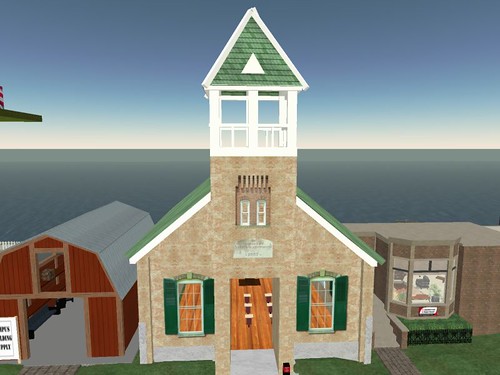
Here’s a specific example. I “own” land in the Mainland of Second Life within a group land collective. That is, I and another person put up the capital to buy land, and we both pay the lion’s share of the monthly rent, but many people in our community group contribute smaller amounts to that monthly fee. Within our region, many independent landowners who do not contribute towards our monthly rent are still members of our group and have rights on our land, and we work together to maximize our enjoyment of the spaces we mutually inhabit in this particular corner of the metaverse. Our group is growing all the time and it is a vibrant, thriving, place.
In the middle of all this bustle are many small plots of abandoned land, people who bought, built some junk, and then never logged back in. Most don’t pay their bills either, but Linden Lab is slow to reclaim those plots and in some cases, we’ve been waiting for a couple of years. Some of them are more than just eyesores, they actually hinder the movement of active residents in our neighborhood by erecting mile high barriers that you can’t cross – you have to walk or fly around them them to get to the other side. It’s a real pain and it’s ugly, so when Linden Lab _does_ reclaim one of these plots, the entire community rejoices and anxiously await our fate, because unless we’re willing to pay top dollar – and I do mean in US dollars – there is no way to guarantee that we won’t be stuck in the same boat again, depending on who bids the highest for the land.
There is a simple technical solution to solve this problem. 1) Automate reclamations of abandoned land. If a bill is not paid for x number of months, it is automatically reclaimed by Linden Lab. 2) When reclaimed, a notice is sent to all existing land owners or group owners who own land in that particular region to alert them. 3) Place the land up for an auction limited to only those who already own land in that region. 4) If the land is unclaimed after a set period of time, place the parcel up for public auction.
This change would empower those who have worked to hard to build real communities in this virtual space to maintain cohesion around their communities. It would encourage local landowners to work together and cooperate so as not to bid against one another and drive up the price. It would give first choice to those who already “live or work” in a given location. It would reduce if not eliminate legitimate community builders from being held hostage by land flippers.
Linden Lab’s current systems seem to reward extortionists and jerks because they do not implement technical solutions that reward collaboration and cooperation. And so many of the other social media tools make the same mistake. When will their creators wake up and smell the roses? Privacy, due process, and allowing communities to self-mediate and self-regulate, these issues seem deeply intertwined to me, and I’m on the lookout for good implementations. Do you know of any?