If you haven’t been around Second Life for long, it can feel like a lonely place, but getting to know some of Second Life’s citizens through their blogs can be a good way to get a broader sense of all of the interesting and terrific things happening in the virtual world.
So when a friend asked me to recommend my Top 5 Second Life Blog choices, I was stumped – I read so many, how to choose! But I can say, the following five blogs are some of my favorite “thinkers” in Second Life. I don’t always agree with their analysis, but they consistently make me re-evaluate what a virtual world or community is, can be, ought to be, or ought NOT to be. They make me think.
I’ll try to post some more in the next few days covering some of my favorite education, art and music, and travel and news blogs.. but I have to say, it is darned hard to choose!
In thinking about that post and the responses I received, I started to think about what exactly “informal learning” with social media looks like for me, and Igori’s comment led me to break down my personal social media use into the various toolsets I’m using. Each communication tool seems to represent a different kind of “head space” to me. In reality, I’m using many many software platforms, widgets, and technologies, but I think it can be broken down into a few broad categories.
Gmail is my nerve center. All the sensors, accounts, message boards, subscriptions, notices – all of my “stuff” out there on the internet alerts me when certain events take place that I may need to pay attention to, and if someone out on the net needs to reach me, that’s the surest way to get my attention. My family and closest friends are on my google contact list, where we IM each other, and Twitter is embedded in the window too. I glance at this screen probably hundreds or thousands of times a day. It is where I broadly monitor my whole network.
Twitter is a portal to shout outs, brief chats, announcements, news blurbs, and a finger on the pulse of my little corner of the internet. It’s my bustling town. I don’t know everyone personally anymore, it grew too big for that, but I know lots of folks, and I’m reassured to look out the window and see everyone out and about and doing things. If I feel like having a quick chat, asking a question, saying hi, whatever, Twitter is there. It tells me the world keeps on keepin on, and if anything urgent comes up, I’m sure they’ll let me know.
(I knew about Tim Russert dying within moments of it being leaked, for example, and shared in a collective moment of shock, grief, sadness, wondering who would take the lead in holding our government accountable on Meet the Press in his absence – we all felt that as soon as we heard, and we experienced the event in a collective way through Twitter. It’s perhaps another post to think about how those collective emotions can be experienced through short, text-only little bleats..)
Blogs are my newspapers, where I get more lengthy, formal information about what’s happening in my world. They also link to the “course materials” for my informal learning. Media of all sorts, videos, films, papers, reports, research – original sources or analyses of them. Some blogs are also discussion boards, I do some amount of peer review and feedback, lengthier Q&A, and if I want, I can email or talk directly to the author to follow up and learn more.
All of this is aggregated in Google Reader, where I manage subscriptions to the blogs and websites I have personally selected to read, as well as the shared posts from my colleagues, who highlight the best of the various blogs and sites that they are reading. It’s pretty efficient, and allows me to see a much broader cross-section of information than I could ever process on my own. I depend on my smartest friends to do some of that pre-processing for me.
Second Life is my office, my laboratory, my work space, my classroom. I try to apply the things I’m learning to this particular medium – what works best for communicating concepts, ideas, facts, information? How do you use a 3D virtual environment to teach, to explain, to inform? How do you build and sustain communities in this place? How effective are my previous attempts? What needs to be improved, changed, or perhaps deleted altogether?
Those are the main tools for my informal learning. On a typical day, at any given time, I have several Firefox windows open (Firefox is my primary Learning Management System), each with 15-20 tabs open representing all the places that I’m working, learning, or reading. One window is reserved for “stuff I want to read and think about later”, all the links from tweets and blogs and friends and emails that seemed interesting or important, and when it grows so big it starts to lag my machine down, I go over and winnow it down, skim through things, close anything that doesn’t seem so interesting after all.
And by the end of the day or the week, sometimes themes have emerged. My brain draws links between all this stuff I’ve seen and read and starts to connect dots between different sources. As I become more aware of the emerging theme, I start to self-select different sources around that theme. Whatever I scan, I’m especially interested in information that fills in gaps in my knowledge about that theme. Sometimes I find myself reading such technically complicated material that I wonder how the hell I got into reading this report that is confusing the heck out of me.
Each foray, I think, stretches my mind a little further. I feel like I am learning in little bits all the time, even while I am working, producing, creating, helping, whatever.
Human Brains & Cloud Computing
Injenuity said months ago that she thinks her technology use is changing the way she thinks, the way her brain is beginning to draw connections between things. I agree, I feel that sense, too. I was reminded of her comment several times as I explored the various sites I kept running into this week about how the brain works, and how the growth of human participation in web services is changing our conception of “the network” online.
The theme didn’t emerge from thinking consciously about how the brain works, but rather from an article in the New Yorker that appeared to be about people who suffer from a demonic sense of itching. Having just recovered from the worst mosquito bite attack I’ve had in years, an article about the irrepressible urge to scratch caught my attention. The blog poster who linked to this article had highlighted the following paragraph:
One morning, after she was awakened by her bedside alarm, she sat up and, she recalled, “this fluid came down my face, this greenish liquid.†She pressed a square of gauze to her head and went to see her doctor again. M. showed the doctor the fluid on the dressing. The doctor looked closely at the wound. She shined a light on it and in M.’s eyes. Then she walked out of the room and called an ambulance. Only in the Emergency Department at Massachusetts General Hospital, after the doctors started swarming, and one told her she needed surgery now, did M. learn what had happened. She had scratched through her skull during the night—and all the way into her brain.
Was this fiction? Could a person really scratch through their skull and into their brain? What on earth would drive someone to do that?
When I finally made time to read the full article, it turned out to not be just about itching, but also about an emerging theory of how the brain receives and associates information from our sensory perceptions, and how that in turn affects our perception of reality.
The account of perception that’s starting to emerge is what we might call the “brain’s best guess†theory of perception: perception is the brain’s best guess about what is happening in the outside world. The mind integrates scattered, weak, rudimentary signals from a variety of sensory channels, information from past experiences, and hard-wired processes, and produces a sensory experience full of brain-provided color, sound, texture, and meaning. We see a friendly yellow Labrador bounding behind a picket fence not because that is the transmission we receive but because this is the perception our weaver-brain assembles as its best hypothesis of what is out there from the slivers of information we get. Perception is inference.
This seemed like a very interesting thread, one that picked up again later when I saw that the Top 10 TED Talks had been released, including one by
neuroanatomist Jill Bolte Taylor. (If you don’t know about TED Talks, be sure to check them out, they’re some of the best lectures available on the net, if you ask me.) In this talk, Jill describes – from a brain scientist’s perspective – what happened to her as she experienced a stroke and felt various brain functions shutting down one by one – it is absolutely fascinating.
And as I’m thinking about what all this new information about the brain means to ME and how it is applicable to my work, George Siemens sends out his weekly newsletter with a section about “Brain Based Learning”. Hmm, I wonder what that is, I think, and click on to read more. This lead me to a research paper, “The Seductive Allure of Neuroscience Explanations”, which concludes that people are generally much more likely to be satisfied by theoretical explanations that contain neuroscientific verbiage – even if it’s completely irrelevant – than by explanations, even good ones, that don’t contain neuroscientific verbiage; and a short 8-minute video about how often theorists incorrectly apply levels of analysis from neuroscience and cognitive psychology research to individual behavior, and to a child’s mind, and indeed to education as a whole.
By this point, I’m thinking wow, the brain is so complex! I go back to thinking about the “itch” article, and wonder if my evaluation of the “brain’s best guess” theory of perception was tainted by all of the neuroscientific data that was included in the article. I wish I had some experts in a room to discuss all these things I’ve just learned, because I find it interesting, but confusing, and I’m not sure how to apply this new knowledge in my own work, which is about teaching with technology.
And while I’m waiting for experts to magically appear and explain things, I run across a post on the Long Tail site about a brief article in Wired magazine that compares the “One Machine” (aka the internet and all of the computers and devices connected to it) to a human brain.
Infographic: Christoph Niemann, Flash Design: officevsoffice
I think to myself that this isn’t the first time I’ve read about or considered the connections, similarities, and differences between this “ubiquitous cloud computing” concept and the human brain, but I don’t know if I really understand what is meant by “cloud computing”, so I find this fairly in-depth and technical article about the topic on InfoWeek, called, simply enough, Guide to Cloud Computing. (Warning, it gets pretty geeky in there, but if you want to put some finer edges on your understanding of the concept, it’s a good piece.)
This leads to me to think about how universities are using technology, or more accurately, implementing technology infrastructure and systems for students, faculty, and staff to explore all these new possibilities for publishing, searching, accessing, and receiving the vast quantities of information and ideas out there living on the web. And while I’m musing on this topic, I discover an article in The Chronicle of Higher Education about Kansas State Cultural Anthropology prof Michael Wesch’s recent lecture “The Anthropology of YouTube” to the US Library of Congress. (Was that lecture recorded? Anyone have a link? Oh wait, I see it will be archived eventually at the Library of Congress website.)
I’ve posted about Michael Wesch’s work before, he was the creator of the now famous “The Machine is Us/ing Us” video that Wayne Porter and I connected over more than a year ago, and he talks about how YouTube, video-logging (vlogging), and the interaction people are getting online is changing people’s very sense of identity.
And THIS leads me to think about how I need to improve my machinima skills in Second Life, because I want to try using video has a mechanism to communicate various concepts I’m learning about, and I think I’ll feel more comfortable hiding behind my avatar than talking straight to a camera.
. . .
Why did I take you on this long journey? Is anyone even reading this still? I don’t know, but when we talk about “informal learning” and “social media” and what this means to us as educators, I sometimes don’t even know what these terms actually mean to anyone but myself. I know how I am using these tools, but I don’t know what the “best practices” are per se, nor the most effective ways to teach them to others. I think this little trip through Fleep’s Informal Learning Experience was maybe more for me than for an external reader, but as I think about all these topics I’m digesting, I keep returning to the thought that I want formal education at the university level to look more like THIS kind of learning than what I experienced in my undergrad courses.
With all due apologies for the length of this post, I hope if you’re still with me that you’ve learned something about the human brain, cloud computing, and how the web can facilitate “informal learning” that is very real learning about very real and important things. Look at all the fascinating, rich content that a passing curiosity about my mosquito bites itching led to..
Please note: This post will likely be of interest only to those involved in Second Life, and even then a subset of that group, only those involved in the “society” of Second Life that includes the blogosphere community and the various daily rags that chronicle the activities in this world. The rest of you will think this is all very ridiculous. 🙂
Prokofy Neva and the FIC 2.5
I don’t know when the name “Prokofy Neva” entered into my consciousness. Like Aimee Weber and Anshe Chung and some other famous Second Life residents, the name seemed to be peppered throughout lots of the unofficial documentation and websites and help pages about SL on the web. I’d glanced at the Second Life forums once or twice, but they looked to be full of the ridiculous drivel on every game message board everywhere (ever read the WoW forums?), so other than posting once or twice for help (I think), I didn’t participate. Somehow I escaped Prokofy’s notice until.. not sure, 2006 maybe? He first accused me of being a noob and what did I know, and I had to prove that I wasn’t the noob he took me for just because we hadn’t crossed paths before. Since then, I’d say we have a fine relationship, even if it gets heated from time to time.
For those of you who don’t know “Prok”, as he is affectionately known, he is the Second Life resident that everyone loves to hate. Banned from more forums, meetings, groups, and discussions than probably/possibly anyone else, Prokofy is one of those “squeaky wheels” who Never. Shuts. Up. in a debate, writing exhaustively looooong diatribes, appearing on webpage comments to post a criticism before the ink is even dry, using profanity, sarcasm, and your every weakness to score points. When Prokofy gets you in his sights.. look out. Because, as much as folks want to dismiss Prok as a nutjob, there’s this annoying little niggling detail that just can’t be ignored – usually, there’s valid, real criticism buried in all those words, and he has been reporting on the activities of Linden Lab and the residents of Second Life for so long, that he can dig up examples and history that really is instructive. Darn, you hate it when the blowhards have a point, don’t you?
Now, that paragraph is a caricature, I don’t actually view Prok that way myself, but that’s the “persona” of Prok cultivated out on the intarnets. Just google Prokofy Neva if you want to know more and judge for yourself.
One of the things that Prokofy has contributed to Second Life culture is the term “FIC” which is pronounced like “bike” not like “bic” – and it means Feted Inner Core. The FIC are the cool kids, the popular ones, the movers and shakers, the suck-ups to Linden Lab, the ones who get special breaks because they’re famous or friends with someone who runs the world. Prok has long railed against the unfairness of special deals the FIC had/has with Linden Lab and even the broader SL society, and he actually publishes the names of the people he thinks are receiving this undeserved and special treatment on a semi-annual basis.
Now the vast majority of Second Life residents don’t read blogs and don’t know who Prokofy Neva is and if they see the term “FIC” in someone’s title they have no idea what it means, but those who have been around a while use the term almost endogenously now, “Oh they’re FIC,” someone will say at some Linden’s office hours. And when Prok updates the list, I always find it funny that those who end up on it go to great lengths to post all over the internet about how much the FIC list DOESN’T matter or mean anything and who cares what Prok thinks anyway.
This year, I was quite surprised to see that I am on the list. My first reaction was shock and a sort of dismay, I’ve always thought of the FIC as folks who actually really DO have some ties to the Lindens and who probably DO get some special treatment. I don’t believe everything Prok writes uncritically, but he’s been uncomfortably close to the mark lots and lots of times, so I put some weight to it. But I don’t have any special access to the Lindens to be sure, I think Claudia and Pathfinder know my name, but that’s about it. I have to go through the same processes as everyone else when I need help or have a problem. And unlike previous FIC folks, I don’t run a successful money making enterprise in Second Life, in fact in recent months my tier bill has seemed awfully hard to bear as gas prices and everything prices continues to rise.
So what the heck, I’m thinking! I’m one of the good guys! Et tu, Prok?!
Having slept on it over night, (I started getting messages from friends/acquaintances within a few minutes of it being posted, which tells me that it isn’t completely meaningless or people wouldn’t feel compelled to talk about it), I think I’ll choose to see this as a kind of recognition that I’ve had some positive impact on the crazy world of Second Life, that I’ve been somewhat successful in highlighting the really hard work that educators are doing – NOT JUST IN WORLD – but in their schools and colleges and institutions, trying to change a culture that says that virtual worlds are just games and technology is just gadgets and who needs all these newfangled things anyway.
Further, I recognize many of the names on the 2.5 list as colleagues and people I admire, people who I believe are working damned hard to make Second Life a better place, and to use its technology to make the real world a better place, too. I believe many of those folks are wonderful, creative people, who impress the hell out of me with what they manage to accomplish, and frankly, I don’t feel like I really deserve to be named in their company.
So maybe I never really understood what the term “FIC” meant or maybe the 2.5 list is different than the previous ones, but either way, it feels like SOME kind of an accomplishment. I’m not sure if it means I’m a good guy or a bad guy in Prok’s eyes, but any list that puts me in the company of people I really respect seems like a good thing.
So thanks, Prok, even if it’s a mixed blessing. =)
The Viral Professional Development that injenuity has been writing about and the EduPunkflare-up (EDUCATION IS SERIOUS BUSINESS YOU CAN’T PUT PUNK IN THERE!) got me thinking about social media both in the context of a learning tool, but also in the context of a business tool.
We all love free stuff, and I think my “viral professional network” includes some of the most creative, collaborative, and giving colleagues I’ve ever had the pleasure to work with, but at the end of the day we all have to make a living, and in these economic times, I want to know if living the networked professional life actually yields a better paycheck.
I’m already convinced that it leads to a much, much more fulfilling career, but as I start to feel the real pinch of all these increased prices, I also find myself forced to think in practical economic terms. I know money doesn’t buy happiness, but happiness doesn’t buy kitty food, either. 🙂
Social media, for me, is time intensive. Blogging, browsing, trying things out, keeping in touch with the network and trying to figure out how to do that when the network grows bigger than I’ve ever experienced before.. As I said on twitter the other day, some days it feels like the social media manages ME instead of the other way around.
While I was musing about this, I ran across Intellagirl’s recent slideshow about the differences between formal education in an institution and informal learning through social media. Check this out:
Her analysis really jives with my personal, lived experience of both completing a degree and being very active in social media in the last couple years. I got my degree after 7 years and finally had that stamp of approval, but at the same time, the work I’ve done in my online communities of interest has in many ways been far more important to my personal learning than my formal education experience.
I do feel a greater sense of accomplishment for my online work than for any of the tests or exams I took and scored well on, and through my online experiences I’ve become part of a wider professional community that seems far more relevant to me than, say, other UC alumni.
Social Contract with Social Media?
But then Intellagirl goes on to talk about the sort of social contract we make (Promise, Tools, Bargain) and that’s where I got hung up, because the bargain we make with formal education isn’t just credentials/reputation, it’s also dollar signs in a directly transferable sense. Get the right degree from the right institution and you’ll make more money, guaranteed. Get a degree from any institution and you’ll have a better shot at making more money than you’d make otherwise. That’s also implied in the social contract, leading to the stories I mentioned last week about so many completely un- or under- prepared students entering college.
So, I guess my question is, how does the informal learning through social media translate to better economic conditions, particularly when so many are working in companies or institutions that are completely ignorant of the social web phenomena? It isn’t as if you’re going to get higher marks on your evaluation because you twitter (though if you’re doing it right, you WILL do better at your job because of twitter). That is to say, the time spent on social media, for most people, is personal time, and even though it also benefits the workplace, or the institution, that benefit is not accounted for or rewarded explicitly, and often is actively blocked or sanctioned on work time.
Given this, and even though social media promises all sorts of wonderful learning opportunities, how can we ask our students, or our faculty, (or even ourselves) to keep up the time intensive pace of it all when they’re busy trying to raise a family or work a job that doesn’t have them at a computer all day? It seems that even though the formal educational model is rigid and top down and appears to be counter to what I’d consider a very valid and important form of learning, it’s the mode that pays the bills, and as long as that’s the case, that’s what people will do because they have to.
I don’t know. I feel fortunate that I’ve been able to so closely align my personal passions with my professional career, including social media, but when I’m up there in front of a room full of people who do not work at a computer all day, I want to make a compelling argument that convinces them to try it when they get home. It’s not just the educational or personal impact I’m wondering about, but also the economic impact of social media, and how that plays into the “education crisis” analysis.
If anyone has any thoughts, I’m all ears.
Speaking of Economics.. Metanomics!
Last bit, I’m delighted to say that I’ll be working with the folks at Metanomics as the Education Correspondent for the new season. Hosted by Cornell Prof. Robert Bloomfield, Metanomics is a weekly webTV program focusing on economics and policy in the “metaverse” of online worlds. I’ve been a fan since I caught some of their first episodes last season, and I’m very excited about the opportunity to cover education in virtual worlds and Second Life for the show. I’ve never been a webTV journalist before, so I expect to be learning some new technical skills in that arena (all from my social network!), and brainstorming about some good angles to cover.
I can’t recall a speech that seemed more urgent for anyone who cares about democracy to hear. This is one to listen to when you have the time to really think about what he’s saying.
I often get lazy with my blogging. It’s hard to make time for it, I’m sometimes afraid of posting what I’d like to say, I worry about posting too much or too narrowly. But with Web 2.0 and the social networks and the online communities, it seems that we’re all now responsible for telling the truth. We have no excuses for not doing it. Those who are not online, who don’t read blogs and twitter and have 51 million accounts and passwords and 1000 emails a day, are without the tools to find the information we can find, can’t share what we can share, can’t tell their truth.
Bill inspires me to be flowery, with that really magnificent oratory style that I rarely hear these days. He makes me feel ashamed for being so timid and passive. He reminds me that in the run-up to Iraq, I did a lot of objecting to my friends and family, I argued with the folks my grandpa eats breakfast with on the weekend, and I voted for the candidates that offered the most anti-war stances allowable at the time – but it wasn’t enough. Six years later, I wish I’d done more. A lot more. I don’t know what, exactly, I don’t have campaign contribution money to give and that seems to be all that the political system really cares about. But I wish I’d taken the time to figure it out.
And if being a good teacher means being a good example, I don’t think my use of this site has been very exemplary as I talk every day about online tools for teaching, learning, community building, and making positive change for us personally, and for society at large. I believe in it, my Second Life work is all inspired by that belief, but I shy away from blogging about the things that hit most close to home, that I actually care about very deeply. Things like democracy, and government, and the woeful state that we’re in. Things like, how I see these policies playing out in my own family, in my own life, in my own personal experiences. Part of the problem is that this site has become so entwined with my work life, it seems inappropriate, somehow, to mix work and politics, to mix work and personal.
I don’t know how to navigate this confusion, and indeed all the confusion that social media has brought to my life in the last couple years, but I hope I can remember this speech the next time I write a draft but don’t hit publish because I worry about how it might be perceived. It’s easy to think, sometimes, that the sense of urgency I feel is just my own personal paranoia or neuroticism of some sort, but when something manages to pierce the busy day-to-day trying to keep up fog, like this speech did, and reminds me of our higher purpose, and the message is that this urgency is real, it’s not just me, it’s not just my family…
I’ve admired and respected Bill Moyers for as long as I’ve been watching PBS, and certainly this speech is one of the reasons why. I’m glad I found it, and it came from Crabby Old Lady’s site, which I highly recommend. She also inspires me to use blogging as a tool to inform, to share, and to tell the truth, and her writing about elder issues reminds me that good citizens listen to their elders. I’m glad I had the time to listen to them both this morning. I hope you make the time, too. – Fleep
Here are some things that caught my eye today. Hit play on this video while you read the rest of the post, it’s such a sweet video.
Ok, now that we have some music…
Tools & Sites
I just installed a little map widget down in the lower right sidebar that shows a map of visitors. It’s a free download from ClustrMaps.com and tracks by IP address where in the world your readers are. Not sure how often it will update, but so far I’m big in the US and barely heard of in Europe and completely absent everywhere else. 😉 It’s going on data since this morning though, so we’ll see how it goes.
Next up is Freebase. I don’t know what it does yet, but their tagline is, “Freebase is an open, shared database of the world’s knowledge.” Hmmm. Definitely will check it out in a bit.
Last is a site that looks to be about teaching programming concepts to high schoolers, called Greenfoot. I’m already a fan of Alice, but might be of interest to those of you working with high school students.
If you only have time to read one, read the second one, and then Chris’ take on that article in 3rd link. I don’t agree with all of the positions taken, but as I try to imagine what education could be, it’s helpful to read critiques by others.
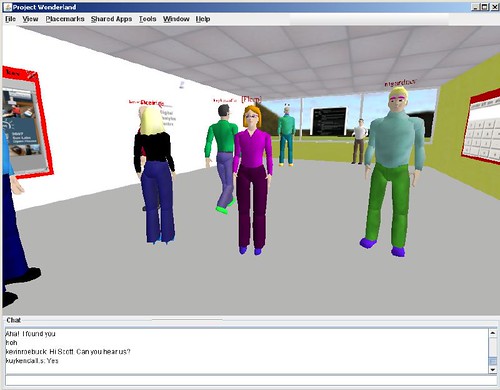
Aaron Walsh from Media Grid launched the initiative from within Second Life and the island quickly filled up with many more avatars waiting to get in to join the demonstration.
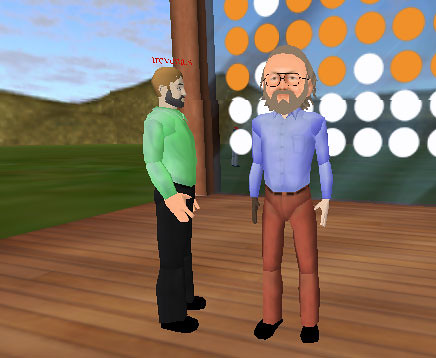
There are already six nodes on the grid and we got to pop around between them and check out the various applications and builds already in place. What follows are some screen shots, the tools are still pretty primitive, but the audio/voice worked pretty seamlessly and we saw a demonstration of live application sharing, video streaming, and more. What fun! Will try to post more later..
Fleep in Wonderland, purple clothes!
Classroom in Wonderland
Larry Johnson in Wonderland
And my favorite picture of all.. on the New Media Consortium node, my avatar turned into.. Larry!
The Second Life Education Community Conference 2008 planning team has been hard at work and we have several important updates for you:
The main SLEDcc 2008 website is now available at: http://sledcc.wikispaces.com. This will be your one-stop-shop for important information about the SLEDcc conference, in Tampa or in Second Life. Please note: SLEDcc is part of the official Second Life Community Convention (http://slconvention.org). Registration fees cover both the SLEDcc and SLCC events! Conference registration and fees only apply to those going to SLEDcc/SLCC in Tampa, in-world only participants do not need to register or pay any fees.
The Call for Proposals deadline has been extended to June 17, 2008. See the CFP below or view the complete details on the website. Don’t want to do a big paper presentation? No problem! The SLED Sparks and Speed Mentoring formats are designed for rapid information sharing. Can’t go to Tampa? No problem! SLEDcc will have presentations in Second Life as well as real life. You’d really rather show off a great build or project than do a presentation? No problem! “The Sleddies” award competition might be just the thing for you. See the CFP below or the website for more details.
There are many low overhead ways that you can help with the conference, from putting a link/logo to the SLEDcc website from your own blog or webpage, to volunteering for a few hours in Tampa or in Second Life – we can use your help! See the Volunteer Opportunities page and the SLEDcc Social Media page on the website to find out how you can join the team.
In addition to these updates, the website also has more information about “The Sleddies” Award competition, sponsorship information, and much more. Please take a few moments to have a look around and if you have any feedback, let us know.
Thanks for your continued support and we look forward to seeing you in Tampa or in SL this September!
Sincerely,
Chris Collins (SL: Fleep Tuque)
Hilary Mason (SL: Ann Enigma)
Jonathon Richter (SL: Wainbrave Bernal)
Co-Chairs, Second Life Education Community Conference 2008
Member of the Second Life Community Convention 2008
September 5 – 7, 2008 in Tampa, FL and in Second Life http://sledcc.wikispaces.com
sledcc08@googlegroups.com